The Landscape of AI Adoption in 2024
The rapid proliferation of AI is evidenced by its ubiquity in consumer hardware; currently, 77% of digital devices utilize some form of artificial intelligence in their core functionalities. This saturation has created a "trickle-up" effect, where consumer expectations for personalized, instantaneous, and high-quality digital experiences are forcing businesses to adopt AI tools to meet these demands. For online store owners, bloggers, and project managers, the challenge is no longer whether to use AI, but which tools will provide the highest return on investment.
Market research from AuthorityHacker and other industry analysts indicates that the primary drivers for this adoption are cost reduction, speed of execution, and the ability to scale personalized marketing efforts without a linear increase in headcount. As we move further into 2024, the distinction between "AI-powered" companies and traditional firms is becoming the defining factor in survival and growth within the digital economy.
The Evolution of E-Commerce Technology: A Chronology
To understand the current state of AI in e-commerce, it is essential to look at the timeline of its integration.
- 2010–2018: The Era of Predictive Analytics. AI was primarily used by giants like Amazon for recommendation engines and demand forecasting. Small to medium enterprises (SMEs) had limited access to these black-box technologies.
- 2019–2021: The Chatbot Wave. Basic automated customer service tools became common. These were largely rule-based and lacked the nuance of modern generative models.
- 2022: The Generative Breakthrough. The release of high-functioning large language models (LLMs) like GPT-3.5 changed the paradigm. AI became capable of creating content, not just analyzing data.
- 2023: Integration and Proliferation. Major e-commerce platforms like Shopify, Wix, and Adobe began embedding AI directly into their dashboards, allowing users to generate product descriptions and edit images with single clicks.
- 2024: The Year of the Autonomous Agent. Current trends show a move toward "Agentic AI," where tools do not just assist but can autonomously manage complex workflows, from inventory management to multi-channel marketing campaigns.
Strategic Implementation of AI Across Business Verticals
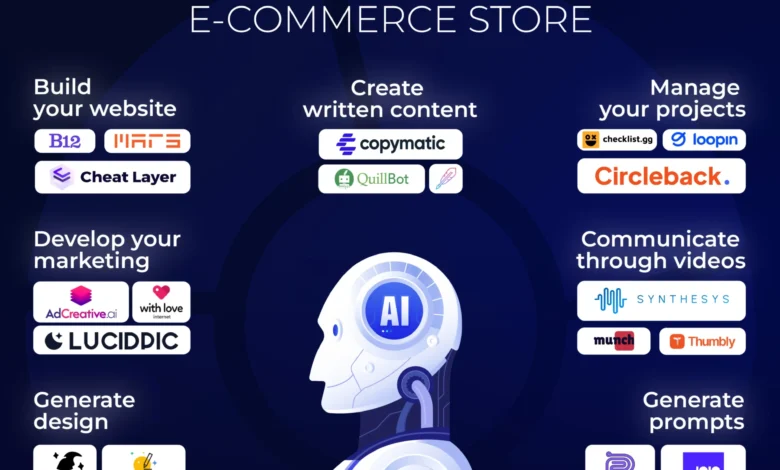
To optimize a digital presence, businesses are categorizing AI tools into specialized functional areas. This structured approach allows for targeted improvements in specific departments, from web development to content strategy.
Building and Optimizing Web Infrastructure
The democratization of web development has been one of the most significant impacts of the AI revolution. Traditionally, launching a high-performance e-commerce site required a team of developers and designers. Today, AI-powered site builders like Wix ADI, Framer, and 10Web allow entrepreneurs to generate functional, aesthetically pleasing websites through natural language prompts. These tools analyze the user’s industry and preferences to create layouts, write initial copy, and optimize for mobile responsiveness in a fraction of the time previously required. This reduction in "time-to-market" is critical for startups looking to capitalize on fleeting market trends.
Revolutionizing Digital Marketing and Brand Development
Marketing has moved from a "one-to-many" approach to a "one-to-one" hyper-personalized model. AI tools now assist in brand development by analyzing market sentiment and competitor strategies. Platforms such as Jasper and Copy.ai enable marketing teams to produce high-converting ad copy, email sequences, and social media posts that are tailored to specific audience segments. Beyond text, AI-driven analytics platforms provide predictive insights into customer churn and lifetime value, allowing for more efficient allocation of advertising spend.
The Rise of AI-Driven Video Communication
Video remains the most engaging form of content for online consumers, yet it has historically been the most expensive and time-consuming to produce. The emergence of AI video tools has disrupted this dynamic. Tools like Synthesia and HeyGen allow companies to create professional-grade video content using AI avatars, eliminating the need for cameras, studios, or expensive editing suites. This is particularly transformative for international e-commerce, as these tools can translate and dub videos into dozens of languages with perfect lip-syncing, allowing brands to localize their marketing globally with minimal effort.
Streamlining Project Management and Operations
Operational efficiency is the "back-office" benefit of the AI boom. Tools such as Asana and Monday.com have integrated AI to help managers predict project bottlenecks, summarize meeting transcripts, and automate routine task assignments. Notion AI has also become a staple for e-commerce teams, serving as a centralized knowledge base that can draft project briefs and organize complex documentation. This level of automation allows small teams to manage complex supply chains and multi-platform sales strategies that would have previously required a much larger staff.
Content Creation and the Science of Prompt Engineering
Content marketing remains a vital component of SEO and brand authority. However, the sheer volume of content required to stay competitive is daunting. AI writing assistants now help in developing comprehensive content marketing strategies, generating blog outlines, and refining tone of voice. This has given rise to the discipline of "Prompt Engineering." Specialized tools and marketplaces have emerged to help professionals generate high-quality prompts—the instructions given to AI—to ensure the output is accurate, on-brand, and free of the generic "hallucinations" sometimes associated with early AI models.
Visual Design and Aesthetic Consistency
In e-commerce, visual appeal is directly correlated with trust and conversion rates. AI design tools like Midjourney, DALL-E 3, and Canva’s Magic Studio have empowered non-designers to create high-fidelity graphics, logos, and product lifestyle images. For an online store, this means the ability to place a product in any setting—a Parisian cafe, a beach, or a minimalist living room—without a physical photoshoot. This capability not only saves thousands of dollars in production costs but also allows for rapid A/B testing of different visual styles to see which resonates best with the target demographic.
Supporting Data and Industry Implications
The shift toward AI is backed by compelling economic data. According to a 2023 McKinsey Global Institute report, generative AI could add the equivalent of $2.6 trillion to $4.4 trillion annually across various industries. For the retail and e-commerce sector specifically, the potential impact is estimated at $400 billion to $660 billion.
Industry leaders have begun to speak out on this transition. During a recent tech summit, executives from major e-commerce platforms emphasized that AI is not a replacement for human workers but an "augmentative force." The prevailing sentiment is that the "human-in-the-loop" model—where AI generates the bulk of the work and humans provide the creative direction and final verification—is the most effective strategy for the foreseeable future.
However, the rapid adoption of AI is not without its challenges. Issues regarding data privacy, intellectual property rights for AI-generated content, and the potential for algorithmic bias are at the forefront of regulatory discussions in the EU and the United States. Businesses are advised to maintain transparency with their customers regarding the use of AI, particularly in data handling and customer service interactions.
Broader Impact and Future Outlook
The broader implications of this AI surge suggest a future where the barrier between a "good idea" and a "market-ready business" is almost non-existent. As AI tools continue to evolve, we can expect:
- Hyper-Localization: Small businesses will be able to compete in foreign markets with perfectly localized content and customer support.
- Dynamic Pricing: AI will enable real-time price adjustments based on demand, competitor pricing, and even weather patterns, a tactic previously reserved for airlines and hotels.
- Reduced Operational Overhead: The "solopreneur" model will become more viable, as one individual can manage the workload that once required a team of five.
In conclusion, the selection of AI tools available today represents a fundamental shift in how digital business is conducted. By leveraging these technologies for website construction, marketing, video production, and project management, e-commerce entities can achieve a level of efficiency and scale that was previously unimaginable. As the data suggests, the competitive advantage of 2024 belongs to those who can most effectively integrate these "silicon colleagues" into their daily operations, transforming artificial intelligence from a technical novelty into a core pillar of commercial success.