Bridging the Gap: How Agentic Reasoning and Traditional Machine Learning Converge to Reshape AI Systems

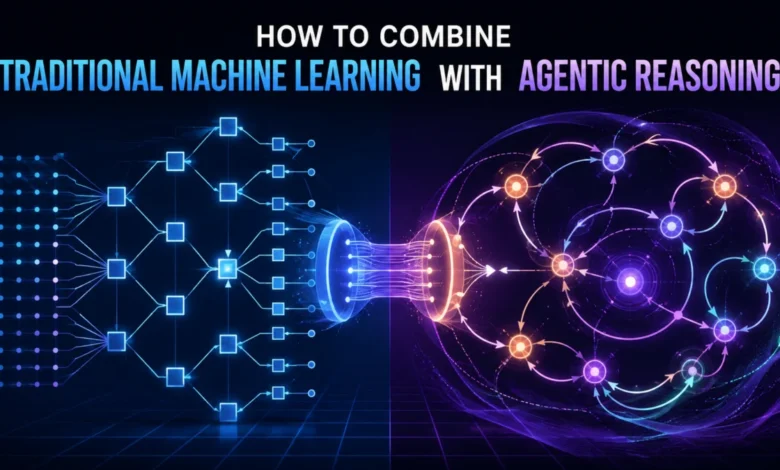
For over a decade, the landscape of artificial intelligence has been dominated by the success of predictive machine learning models. These systems, characterized by their ability to map complex input data to specific outputs, have revolutionized industries ranging from finance to healthcare. However, as organizations attempt to move beyond simple classification tasks toward autonomous operational workflows, they are encountering the inherent boundaries of these static models. The current industry shift toward agentic reasoning represents a fundamental evolution, moving from systems that merely predict to systems that orchestrate, adapt, and execute. By integrating traditional machine learning with agentic frameworks, developers are creating a new generation of AI that is significantly more capable, resilient, and business-aligned than its predecessors.
The Evolution of Predictive Architecture
The history of machine learning can be traced back to the statistical breakthroughs of the early 2010s, when deep learning architectures began consistently outperforming traditional algorithmic approaches. The primary mechanism of this era—supervised learning—relies on the ingestion of massive labeled datasets to identify latent patterns. In a fraud detection scenario, for example, a model is trained on millions of historical transactions, learning the subtle statistical signatures of illicit activity. Once deployed, these models are exceptionally efficient; they operate in milliseconds and provide high-confidence probabilities.
Despite their performance, these models function as "black boxes" of static logic. They are strictly confined to the parameters established during their training phase. They lack "agency"—the ability to perceive a dynamic environment, evaluate the necessity of additional information, or pivot when faced with novel, edge-case scenarios. Throughout the 2010s, this limitation was often bridged by human-in-the-loop systems or brittle, hard-coded rule engines. This infrastructure, while functional, creates significant operational bottlenecks, requiring human intervention for every decision that deviates from the training distribution.
The Limitations of Static Inference
The current industry consensus identifies three critical failure points where traditional machine learning reaches its functional ceiling. First, in multi-step workflows, predictive models fail to maintain state. A model can estimate the probability of loan default, but it cannot independently coordinate the necessary background checks, document verification, and regulatory compliance steps required to finalize a loan approval.
Second, traditional models suffer from "context rigidity." They assume that all variables required for a decision are present at the moment of inference. In real-world environments, however, context is often discovered iteratively. A cyber-security analyst, for instance, does not know which logs to inspect until the initial scan reveals an anomaly. A static model, limited by its initial input vector, cannot "ask" for more data or perform an exploratory search.
Third, there is the "action gap." Predictive models are designed to produce outputs, not outcomes. A model identifying an equipment failure in a factory provides a signal, but it cannot autonomously schedule a maintenance technician, order the necessary parts, and update the facility’s production schedule. These operational gaps have historically been filled by manual labor, which introduces latency and increases the cost of implementation, often negating the efficiency gains of the AI model itself.
The Rise of Agentic Reasoning
Agentic reasoning serves as the orchestrating layer that addresses these systemic shortcomings. Unlike a standard model, an agentic system is designed around a reasoning engine—typically a large language model (LLM)—that operates in a loop of observation, thought, and action. This framework, which began gaining widespread adoption in 2023, allows the system to interact with its environment through tools.
The capabilities added by agentic reasoning are transformative:
- Planning: The agent decomposes high-level goals into actionable, logical sequences, maintaining a memory of its progress and adjusting its strategy based on intermediate results.
- Tool Utilization: Through the use of APIs, databases, and search engines, the agent escapes the limitations of its training data. It can query current market conditions or pull specific, up-to-the-minute records, allowing for dynamic data-driven decision-making.
- Feedback Loops: Adaptation is built into the architecture. If a tool returns an error or an unexpected result, the agent is capable of re-evaluating its approach, potentially trying a different query or source, a process that is entirely impossible for a standard regression or classification model.
- Executory Capacity: Perhaps most importantly, these systems are designed to interface with external software, enabling them to trigger automated workflows, send communications, or modify database entries directly.
Strategic Integration: The Hybrid Model
The most sophisticated AI architectures currently being deployed in the enterprise sector are hybrid in nature. They recognize that agentic reasoning and traditional machine learning are not competitors but complementary components of a functional stack.
In this hybrid paradigm, traditional machine learning retains its role as the specialist. It is used for tasks where precision, speed, and calibration are paramount—such as identifying patterns in high-dimensional datasets or calculating probabilities. Meanwhile, the agentic framework acts as the "manager" or "orchestrator." It decides which specialized model to call, interprets the model’s output in the broader context of the business objective, and determines the subsequent course of action.
For example, in a modern insurance claim system, a traditional model remains the primary engine for assessing risk and detecting anomalies in claim data. However, the agent handles the periphery: fetching the claimant’s history from a CRM, searching legal precedents for similar cases, and summarizing the findings into a report for the human adjuster. By delegating pattern recognition to the specialized model and orchestration to the agent, organizations can ensure high accuracy while drastically reducing the time required to close a case.
Industry Implications and Future Outlook
The shift toward agentic AI is already impacting the global economy. According to recent industry analysis, the integration of autonomous agents into existing workflows is projected to improve operational throughput by 30-50% in administrative and technical sectors. Organizations that have transitioned from "predictive-only" models to "agentic-hybrid" systems report a significant reduction in technical debt, as these systems can self-correct and handle exceptions that previously required engineering intervention.
From a management perspective, the implications are profound. This shift suggests that the future of AI investment is not necessarily in building larger, more general models, but in building better "connective tissue" between existing, highly optimized predictive models. The challenge for enterprise developers is no longer just training models, but designing robust environments where agents can safely and effectively interact with tools and human systems.
As these hybrid architectures mature, we are moving toward a future where AI is not just a peripheral tool providing insights, but an active participant in business operations. By combining the rigorous statistical power of traditional machine learning with the flexible, plan-based logic of agentic reasoning, the technology sector is successfully closing the gap between raw data analysis and actionable, real-world utility. This synthesis marks a milestone in the trajectory of artificial intelligence, transitioning from the era of "automated prediction" to the era of "autonomous execution."