The Ultimate Guide to Integrating Artificial Intelligence Tools into Your Online Store and Business Operations

Artificial intelligence has rapidly transitioned from an experimental technology into a foundational pillar of modern commerce and professional workflows. As language models, machine learning algorithms, and neural networks diversify in their capabilities, organizations across virtually every sector are discovering new avenues to optimize operations. Recent industry data underscores this shift: according to statistics compiled by AuthorityHacker, approximately 35 percent of companies have already integrated artificial intelligence into their core business processes. Furthermore, an overwhelming 90 percent of enterprises now view AI assistance as a vital competitive advantage, signaling a profound cultural and operational transition in the global marketplace. This widespread adoption is further mirrored in consumer technology, where an estimated 77 percent of modern electronic devices incorporate artificial intelligence in their day-to-day functionalities.
To navigate this rapidly evolving technological landscape, businesses must look beyond general curiosity and systematically understand how AI tools can be deployed to streamline enterprise workflows, enhance e-commerce operations, and elevate digital marketing strategies. Below is a comprehensive breakdown of the essential artificial intelligence categories, their functional implications, and the ways organizations are leveraging them to secure a competitive edge.
The Evolution and Chronology of AI Adoption in Commerce
The journey of artificial intelligence from academic research laboratories to mainstream commercial application has accelerated dramatically over the past decade. The early 2010s were characterized by narrow machine learning implementations, primarily used for basic data sorting and predictive analytics in large financial and tech institutions. However, the subsequent introduction of deep learning frameworks and advanced neural networks marked the beginning of a transformative era.
By 2018 and 2019, early adopters in retail and e-commerce began testing automated customer service chatbots and rudimentary recommendation engines. The true inflection point arrived between late 2022 and 2023, catalyzed by the public democratization of generative artificial intelligence and sophisticated large language models. Suddenly, tools capable of generating human-like text, synthesizing complex imagery, and writing functional code were made accessible to small- and medium-sized enterprises. By 2024, integration moved from a luxury experiment to a baseline operational requirement, prompting business leaders to audit their tech stacks for AI-driven efficiencies.
Building and Optimizing Your Digital Presence with AI
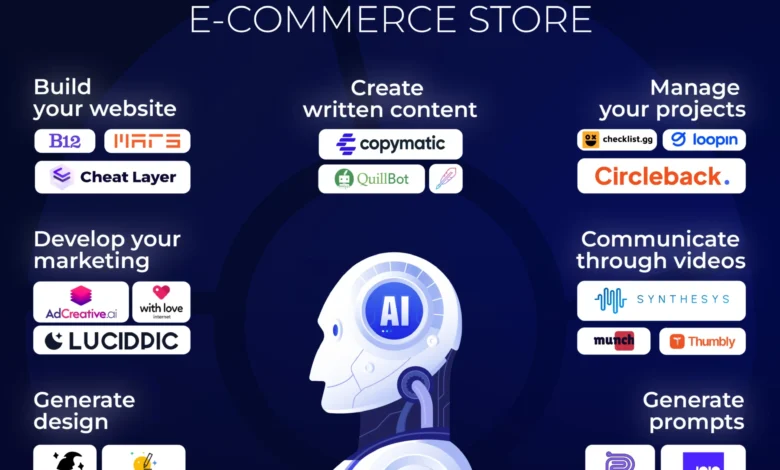
Establishing a robust online presence is critical for any modern enterprise, yet traditional web development often demands significant investments of time, technical expertise, and financial capital. Artificial intelligence has fundamentally democratized web design and development, allowing business owners to construct sophisticated, responsive, and visually appealing websites without writing a single line of code.
Modern AI-powered website builders utilize conversational prompts and automated design generators to understand a brand’s identity, target audience, and functional requirements. Within minutes, these systems can generate fully customized layouts, suggest color palettes optimized for user conversion, and write foundational metadata. For online store operators, AI integration ensures that site architectures are automatically structured for optimal search engine performance (SEO) and seamless mobile responsiveness, significantly reducing time-to-market for new product lines and digital storefronts.
Transforming Brand Outreach and Digital Marketing
Marketing in the digital age requires hyper-personalization, data-driven decision-making, and rapid content deployment across multiple channels. Artificial intelligence tools have become indispensable for marketing professionals seeking to scale their campaigns without compromising on quality or relevance.
AI-driven marketing platforms analyze vast datasets regarding consumer behavior, purchasing patterns, and seasonal trends to predict customer intent with remarkable accuracy. These insights enable brands to execute highly targeted email campaigns, dynamic website personalization, and automated social media distribution. By automating routine analytical and deployment tasks, marketing teams can redirect their focus toward high-level strategy, creative conceptualization, and brand positioning, ultimately maximizing their return on investment.
Revolutionizing Video Communication and Multimedia Production
Video content continues to dominate digital consumption, serving as one of the most effective mediums for consumer engagement and brand storytelling. However, traditional video production—encompassing scriptwriting, filming, editing, post-production, and localization—has historically been resource-intensive and expensive.
Artificial intelligence has dismantled these traditional barriers through advanced video generation, automated editing suites, and synthetic voice synthesis. Modern AI video tools can automatically cut raw footage, generate realistic avatars for corporate training or product demonstrations, and translate video content into dozens of languages with synchronized lip movements. For e-commerce businesses, this capability allows for the rapid creation of dynamic product showcase videos, user-generated content style advertisements, and localized marketing assets designed for global audiences.
Streamlining Complex Workflows and Project Management
As remote and hybrid work models become standard, maintaining operational alignment and tracking complex project lifecycles present significant challenges for modern enterprises. Project management has evolved from static spreadsheets to dynamic, AI-enhanced ecosystems designed to anticipate bottlenecks and optimize resource allocation.
AI-driven project management tools utilize predictive analytics to forecast project completion dates, evaluate team workload distribution, and automatically generate meeting summaries or progress reports. By continuously learning from team habits and historical project data, these systems can flag potential risks before they impact deliverables, ensuring that projects remain on schedule and within budget. This administrative reduction allows managers to focus on strategic leadership and collaborative problem-solving.
The Art and Science of Prompt Engineering
The efficacy of generative artificial intelligence is inextricably linked to the quality of the input provided by the user. Consequently, prompt engineering—the practice of structuring precise, context-rich instructions for AI models—has emerged as a vital professional skill.
To bridge the knowledge gap and maximize output quality, specialized AI prompt generation tools have been developed. These platforms assist users in refining vague concepts into structured, highly optimized prompts that elicit accurate, context-aware responses from language and image models. By mastering or utilizing prompt generation technology, businesses can drastically reduce trial-and-error cycles, ensuring that AI-generated outputs consistently align with corporate standards and specific operational objectives.
Scaling Content Marketing and Written Communication
Content remains the bedrock of digital authority, search engine visibility, and brand loyalty. Whether drafting long-form blog posts, crafting compelling product descriptions, or developing comprehensive whitepapers, the demand for consistent, high-quality written content is relentless.
Artificial intelligence content creation tools empower organizations to scale their content marketing strategies efficiently. These systems assist with outline generation, draft creation, tone adjustment, and SEO optimization. Far from replacing human writers, these tools act as advanced cognitive co-pilots, helping content creators overcome writer’s block, synthesize research data rapidly, and maintain a consistent publishing schedule across all digital channels.
Generating High-Impact Visual Designs and Brand Assets
Visual aesthetics play a critical role in consumer perception and purchasing decisions. In e-commerce, high-resolution imagery, compelling banner designs, and cohesive branding are essential for establishing trust and driving conversions.
AI-driven design generators have transformed graphic creation by enabling users to produce professional-grade visuals through descriptive text prompts or automated template manipulation. These tools can generate unique product mockups, marketing banners, and social media graphics in seconds, eliminating the immediate need for extensive graphic design resources. By lowering the cost and complexity of visual asset creation, businesses can continuously refresh their visual branding to match seasonal campaigns and emerging market trends.
Economic and Strategic Implications for Modern Enterprises
The integration of artificial intelligence into business infrastructure carries profound economic and strategic implications. Industry analysts project that companies failing to adopt AI-driven efficiencies over the coming years risk falling behind competitors in terms of operational agility, cost-management, and customer responsiveness.
However, this technological shift also demands careful governance. Organizations must balance the pursuit of automation with data privacy compliance, ethical AI usage, and the reskilling of their workforce. As artificial intelligence continues to mature, the dividing line between market leaders and laggards will increasingly be defined by how effectively enterprises harness these tools to augment human ingenuity, streamline operations, and deliver superior value to the modern consumer.
Related posts: