Navigating the Future: Emplifi Report Outlines How Artificial Intelligence and Shifting Consumer Discovery Will Shape Marketing Strategies by 2027

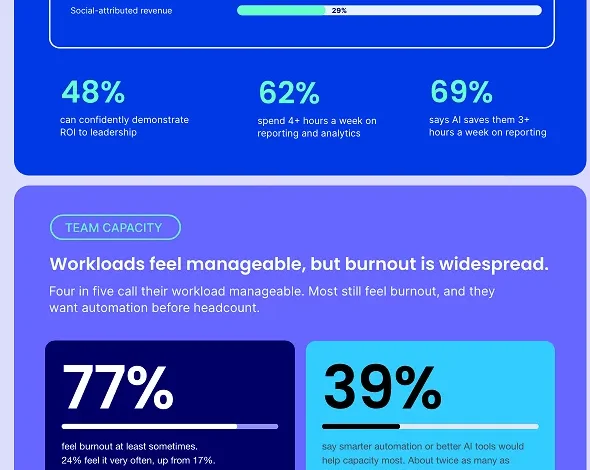
As marketing executives look toward the horizon of 2027, the integration of advanced technologies and the rapid evolution of consumer habits have emerged as the defining imperatives for sustained commercial growth. A comprehensive new industry study released by customer engagement platform Emplifi offers a vital roadmap for brands seeking to modernize their operations, optimize internal workflows, and harness the full potential of artificial intelligence. Based on a targeted survey of 405 marketing managers, directors, and executive-level decision-makers, the research delivers an illuminating snapshot of where corporate budgets, creative strategies, and technological implementations are heading over the next several years.
The findings arrive at a critical juncture for the global advertising and communications sectors. In an era defined by economic headwinds, shifting data privacy regulations, and an explosion of digital noise, traditional marketing playbooks are proving increasingly inadequate. Brands are no longer merely competing against direct industry rivals; they are fighting for consumer attention in an ecosystem saturated with hyper-personalized, algorithmically generated content. By examining how forward-thinking peers plan to deploy artificial intelligence for workflow optimization, alongside evolving trends in product discovery and social media engagement, the Emplifi report provides actionable intelligence designed to anchor strategic planning sessions for the coming years.
Background Context: The Evolution of Modern Marketing Technology
To fully appreciate the gravity of projections extending to 2027, it is necessary to examine the rapid technological acceleration that has characterized the marketing landscape over the past decade. The widespread commercialization of generative artificial intelligence around 2022 fundamentally altered the creative and analytical paradigms of corporate marketing. What began as novelty text generation and basic image creation quickly matured into sophisticated machine learning pipelines capable of predicting consumer churn, automating complex media buying, and generating hyper-localized video content at scale.
Simultaneously, the channels through which consumers discover products and services have undergone a seismic shift. The traditional consumer journey—once a linear progression from television commercials or search engine queries to physical or digital storefronts—has fragmented. Today, social media platforms function as primary search engines for younger demographics, while decentralized creator economies and algorithmic feeds dictate brand perception in real time.
Against this backdrop, leadership teams are grappling with a paradox of choice and capability. While the tools at their disposal are more powerful than ever, consumer skepticism is high, and attention spans are historically fleeting. This environment necessitates rigorous empirical research to guide capital allocation. Emplifi’s survey of over 400 marketing leaders was specifically commissioned to cut through the industry hyperbole and uncover the concrete operational adjustments that executives are making behind closed doors.
Methodology and Participant Demographics
The insights compiled within Emplifi’s research are drawn from a robust, multi-tiered survey framework. The sample size of 405 respondents was intentionally restricted to professionals holding managerial, directorial, or executive positions within marketing departments across a diverse array of industries, including retail, business-to-business (B2B) technology, financial services, healthcare, and consumer packaged goods (CPG).
By focusing exclusively on decision-makers who hold budgetary control and strategic oversight, the survey successfully filters out entry-level perspectives to capture the genuine anxieties, priorities, and capital deployment plans of corporate leadership. Participants were questioned across three primary operational pillars: the tactical integration of artificial intelligence, shifts in the product and brand discovery ecosystem, and the evolving metrics of social media engagement.
The resulting data paints a picture of an industry in transition—one where optimism regarding technological efficiencies is tempered by the operational realities of integration, talent acquisition, and brand safety.
Artificial Intelligence as a Core Workflow Optimizer
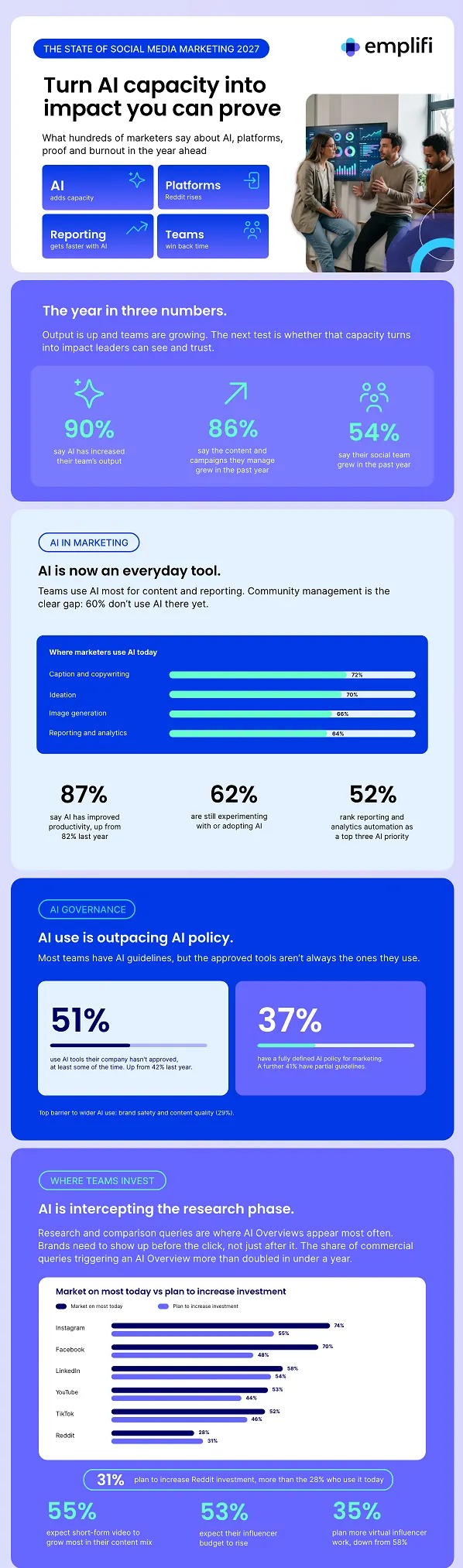
The most prominent thread running through the Emplifi findings is the normalization of artificial intelligence as an indispensable infrastructure component rather than an experimental marketing tactic. By 2027, marketing executives anticipate that AI will be deeply embedded across every layer of the organizational workflow, from foundational market research to final creative deployment.
According to the surveyed leaders, the primary driver for AI adoption is not necessarily headcount reduction, but rather workflow optimization and scale. Marketing teams are increasingly tasked with producing more content across a wider variety of formats and platforms than ever before, all while maintaining consistent brand messaging. Human teams alone can no longer manually sustain the volume required to feed modern algorithmic feeds.
Consequently, executives are turning to AI-driven automation for data analysis, customer segmentation, and predictive performance modeling. By leveraging machine learning algorithms to sift through terabytes of consumer interaction data in seconds, marketing managers can identify emerging trends and pivot campaigns with unprecedented agility. Furthermore, generative AI tools are being utilized to streamline the localization of global campaigns, allowing brands to rapidly adapt copy and creative assets for distinct regional markets without incurring prohibitive translation and production costs.
However, this technological pivot is not without its strategic hurdles. Industry analysts reviewing the report note that as AI-generated content floods the digital ecosystem, the risk of homogeneity looms large. When every brand utilizes similar algorithmic tools to draft copy and design visuals, the distinctiveness of corporate voice risks being diluted. Therefore, a secondary theme emerging from the data is the premium placed on human oversight—curating and refining AI outputs to ensure authenticity and emotional resonance.
The Transformation of Product and Brand Discovery
Beyond internal operational efficiencies, the Emplifi study sheds critical light on how consumers find and evaluate brands—a dynamic that has fundamentally broken away from traditional search engine optimization (SEO) paradigms.
For decades, establishing a dominant digital footprint meant capturing high-intent keyword traffic via major search engines. However, the survey data highlights a decentralized discovery model. Modern consumers, particularly Gen Z and Millennials, increasingly initiate their product searches on social media networks, video-sharing platforms, and conversational AI interfaces rather than traditional browsers.
This behavioral shift requires marketing directors to rethink their discovery funnels entirely. Brand visibility is no longer solely about ranking high on a search engine results page; it is about maintaining a pervasive, culturally relevant presence across a fragmented web of social ecosystems. Micro-communities, creator partnerships, and interactive social commerce features are rapidly supplanting static landing pages as the primary touchpoints for initial brand discovery.
The implications for 2027 strategic planning are stark. Marketing budgets are projected to continue migrating away from traditional outbound advertising and conventional search marketing toward immersive, community-driven social engagement strategies. Brands that fail to integrate their product catalogs seamlessly into social ecosystems risk becoming invisible to the next generation of consumers.
Social Media Engagement Trends in an Automated World
Social media engagement remains the lifeblood of brand-to-consumer relationships, yet the metrics and methods defining success are undergoing a rapid metamorphosis. The Emplifi research underscores a growing disillusionment with vanity metrics—such as raw follower counts and passive impressions—in favor of deep, interactive community engagement and measurable conversion pathways.
As algorithms continue to prioritize content based on relevance and user interest rather than chronological timelines or social graphs, brands must adopt a nimble, content-heavy approach. The survey indicates that marketing executives are increasingly utilizing AI to monitor social sentiment in real time, allowing them to participate in cultural conversations authentically and instantaneously.
Moreover, the line between social media engagement and direct e-commerce continues to blur. Social platforms are aggressively rolling out native checkout functionalities, transforming feeds into virtual storefronts. For marketing directors, this means that every piece of social content must be optimized not just for engagement, but for frictionless conversion. The modern social media manager must operate at the intersection of creative storytelling and data-driven performance marketing.
Chronology of Strategic Implementation Leading to 2027
To understand how organizations are operationalizing these insights, industry observers have mapped out a tentative chronology of strategic milestones leading up to the 2027 horizon:
Phase One (2024–2025): The Exploration and Standardization Era. During this initial phase, brands focused heavily on drafting internal AI usage policies, experimenting with generative content tools, and auditing existing data infrastructure to ensure compliance with emerging privacy laws. Pilot projects dominated marketing budgets as teams tested the waters of automation.
Phase Two (2025–2026): Integration and Workflow Overhaul. As evidenced by current research findings, this period marks the systemic integration of AI into daily workflows. Marketing departments are restructuring teams to blend creative talent with technical data science oversight. Social discovery channels are formally integrated into media planning budgets on par with traditional search channels.
Phase Three (2026–2027): Autonomous Optimization and Hyper-Personalization. Looking toward the culmination of the report’s timeline, leading brands are expected to achieve near-real-time automated personalization. Campaigns will dynamically adjust creative assets, messaging, and delivery channels based on individual user behaviors captured across integrated social and digital ecosystems.
Expert Analysis and Industry Implications
The release of the Emplifi report serves as both a validation of current industry anxieties and a pragmatic call to action. From a factual and analytical standpoint, the implications of the data are clear: the widening gap between technologically mature brands and laggards will accelerate over the next three years.
For executive leadership, the primary challenge will not be acquiring access to new technologies, but rather managing the organizational change required to implement them effectively. Technology is a commodity; the strategic human insight required to direct that technology toward meaningful brand building remains scarce and invaluable.
Furthermore, issues of trust, data ethics, and transparency will inevitably move to the forefront. As consumers become increasingly aware of AI-generated content and automated targeting, brands that prioritize transparency and authentic human connection are predicted to command higher long-term customer lifetime value.
Conclusion: Preparing for the 2027 Marketing Paradigm
As brands map out their strategic initiatives for the years ahead, reports such as Emplifi’s State of Social Media Marketing provide an indispensable compass. By acknowledging the reality of AI-driven workflow optimization, adapting to decentralized product discovery, and redefining social engagement around authentic community interaction, marketing leaders can position their organizations for resilient growth.
The road to 2027 demands a delicate balance: embracing the undeniable efficiency of machine intelligence while fiercely protecting the human creativity and empathy that ultimately forge lasting brand loyalty. Those who successfully navigate this duality will define the next era of commercial marketing success.
Related posts: