A Mysterious Martian Cloud Stretching 1,800 Kilometers Reveals Exotic Physical Phenomena

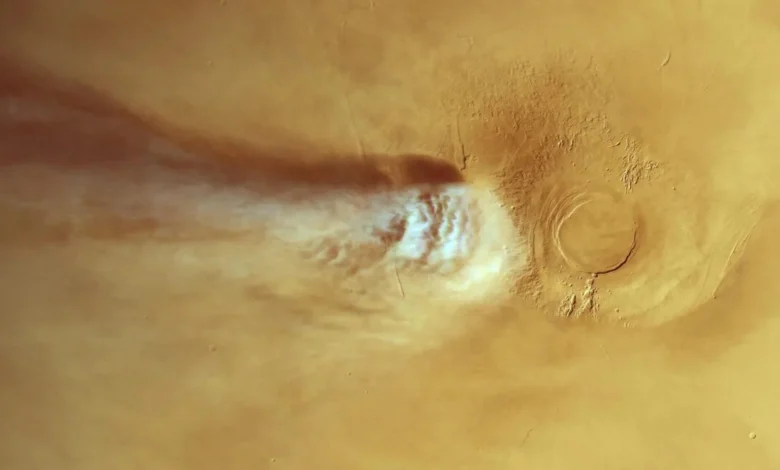
The Red Planet has long captivated astronomers with its complex weather patterns, but a recent discovery involving the Arsia Mons Elongated Cloud (AMEC) has shifted our understanding of planetary meteorology. A groundbreaking study published in the journal Nature Geoscience has revealed that this massive, recurring cloud formation—which can stretch up to 1,800 kilometers in length—is governed by a physical process never before observed in natural planetary environments. By leveraging advanced atmospheric modeling and observational data, researchers have determined that AMEC forms through a rare process known as homogeneous nucleation, effectively challenging established paradigms of how clouds take shape in the solar system.
The Mechanism of Homogeneous Nucleation
On Earth, cloud formation is a predictable, albeit complex, dance of physics and chemistry. Water vapor typically requires a "seed"—a microscopic particle such as dust, salt, or soot—to condense into liquid droplets or solidify into ice crystals. This process, known as heterogeneous nucleation, provides a surface for water molecules to cling to as the temperature drops.
However, the latest research into the Martian atmosphere indicates that AMEC ignores this conventional rule. Instead, it forms through homogeneous nucleation, a process where water vapor spontaneously transitions directly into ice crystals without the presence of any debris or foreign nuclei.
"It is akin to droplets of condensation appearing in the middle of a room, rather than on a window," explained lead researcher Jorge Hernández-Bernal. "It is wholly unexpected, and it demonstrates that the atmospheric conditions above Arsia Mons are far more extreme and exotic than our previous models suggested."
The Arsia Mons Catalyst
The formation of the AMEC is intrinsically linked to the geography of Mars. Arsia Mons, one of the largest volcanoes in the solar system, stands at a staggering 65,000 feet—more than twice the height of Mount Everest. This massive topographical feature acts as a colossal barrier to Martian wind currents.
As air flows toward the volcano, it is forced upward by the slope. When this wind current hits the mountain, it generates a powerful orographic wave. This wave launches moist air high into the thin Martian atmosphere in a matter of minutes. The study notes that for homogeneous nucleation to occur, the atmosphere must undergo a rapid and extreme transition: a sharp temperature drop of 30 degrees Celsius within a ten-minute window, coupled with exceptionally high relative humidity.
This specific combination of vertical motion and thermal shock creates the conditions necessary for the cloud to bloom across the Martian horizon with startling speed. While scientists had previously hypothesized that such a mechanism might exist on other planets, including Venus and even Earth, it has remained purely theoretical until now. The primary barrier to such a phenomenon on Earth is the requirement for humidity levels that are roughly 100,000 times greater than any values currently measured in our own atmosphere.
Chronology of the Discovery
The study of AMEC is the result of years of cumulative observation. The cloud is a seasonal feature, appearing repeatedly during the Martian solstice. Because Mars has an orbital period nearly double that of Earth, its seasons are longer and more intense.
- Initial Observations (2018–2020): High-resolution imagery from the European Space Agency’s (ESA) Mars Express orbiter began capturing the elongated, repeating structure of the cloud. Initially, researchers struggled to explain why such a massive feature would appear and disappear with such clockwork regularity.
- Data Integration (2021–2023): Scientists integrated data from the Mars Monitoring Camera (MMC) and global climate models (GCMs) to simulate the atmospheric pressure and moisture content at high altitudes.
- The Breakthrough (2024–2025): The modeling efforts reached a critical juncture when researchers realized that standard cloud-seeding physics could not account for the cloud’s density or its rapid rate of expansion. The realization that homogeneous nucleation was occurring provided the "missing piece" to the puzzle.
- Formal Publication (2026): The findings were peer-reviewed and published in Nature Geoscience, providing the first concrete evidence that this exotic physical process is responsible for the recurring Martian spectacle.
Implications for Planetary Science
The confirmation of homogeneous nucleation on Mars serves as a humbling reminder of the limitations of our planetary models. "We don’t have nearly as much information about Mars’ atmosphere as we do about Earth’s," Hernández-Bernal stated. "So, reproducing the AMEC to this degree of accuracy is a significant success, and the result is frankly remarkable."
The implications of this discovery are twofold. First, it refines our understanding of the Martian water cycle. If large quantities of water vapor can be locked into ice crystals through sudden, explosive atmospheric events, it suggests that the redistribution of water on the planet is more dynamic than previously thought. This has significant consequences for missions seeking to map water ice reserves for future human exploration.
Second, the study expands the "envelope" of known meteorological phenomena. By identifying that homogeneous nucleation can occur on a planetary scale, atmospheric scientists can now look for similar, potentially overlooked signatures in the atmospheres of other worlds, such as the gas giants or the high-altitude haze layers on Titan.
Analysis of Atmospheric Constraints
The research highlights a stark reality regarding the Martian environment: it is capable of harboring "extreme" localized conditions that defy terrestrial intuition. While the average humidity on Mars is notoriously low—making the planet a hyper-arid desert—the AMEC formation demonstrates that the atmosphere is capable of brief, localized surges of saturation.
The fact that this happens in the shadow of a volcanic giant suggests that topography plays a more critical role in Martian weather than previously estimated. These "orographic clouds" are not merely curiosities; they are indicators of energy transfer between the surface and the upper atmosphere. The rapid cooling required for the cloud’s formation implies that significant amounts of energy are being dissipated as the air rises and expands.
Future Research Directions
As the scientific community digests these findings, the next phase of research will likely focus on the longevity of these ice crystals and their impact on the Martian radiation environment. Clouds, even at high altitudes, influence the planet’s albedo—the amount of solar radiation reflected back into space. Understanding how AMEC influences the local thermal balance could lead to more accurate global circulation models.
Furthermore, this discovery underscores the value of sustained observation. The Mars Express mission, which has been in operation for over two decades, provided the longitudinal data necessary to distinguish between a transient weather event and a seasonal, recurring phenomenon. As NASA’s Perseverance and Curiosity rovers continue their surface operations, and as new orbital assets are planned, the synergy between surface-level soil analysis and high-altitude meteorological data will be essential to building a complete picture of the Martian climate.
Ultimately, the study of the Arsia Mons Elongated Cloud is more than an investigation into a single cloud; it is a fundamental expansion of our understanding of fluid dynamics and thermodynamics in low-pressure, thin-atmosphere environments. As we look toward the potential for future human settlement on Mars, understanding these massive, exotic weather systems is not merely academic—it is a prerequisite for ensuring the safety and operational efficiency of future planetary outposts. The discovery proves that the Red Planet still holds significant secrets, and that the most extreme physics are often occurring exactly where we least expect them.