Building a Robust JSON Serialization Pipeline in Python for Complex Machine Learning Workflows

The rapid evolution of machine learning engineering has shifted the focus of data scientists and software developers alike from merely architecting complex neural networks to mastering the intricate "data plumbing" required to sustain production-grade pipelines. As machine learning models transition from experimental notebooks to scalable microservices, the reliability of data movement becomes paramount. A significant bottleneck in this lifecycle is the serialization and deserialization of structured datasets across distributed systems, APIs, and persistent storage. When Python’s native JSON handling encounters non-primitive types—such as datetime objects, sets, pathing objects, or enumerated types—it frequently triggers runtime failures that can halt critical training jobs or inference services. Addressing these limitations requires a sophisticated approach to data serialization, incorporating custom encoding logic, robust decoding hooks, and schema migration strategies to ensure system resilience.
The Anatomy of the Serialization Challenge
At the core of modern data engineering lies the need for interoperability. JSON (JavaScript Object Notation) is the industry standard for data exchange due to its human-readable format and broad support across programming languages. However, JSON is inherently limited to a small subset of data primitives: strings, numbers, booleans, arrays, objects, and null values. In contrast, Python’s standard library is rich with complex types—such as pathlib.Path for filesystem interaction, datetime for temporal tracking, and enum for categorical constraints—which are essential for maintaining the state of a machine learning experiment.
When a developer attempts to use the standard json.dumps() method on a configuration dictionary containing these complex types, the process terminates with a TypeError. This limitation is not merely a technical nuisance; it represents a systemic vulnerability in automated pipelines. In a production environment, a failure to serialize a model’s metadata can result in silent data corruption or, more commonly, a complete system crash. To mitigate these risks, engineers must implement a custom serialization framework that bridges the gap between Python’s rich type system and the rigid requirements of JSON.
Establishing a Custom Serialization Framework
The primary defense against serialization errors is the implementation of a custom encoder. By subclassing json.JSONEncoder, developers can inject custom logic into the default() method, which acts as a fallback mechanism when the encoder encounters a type it does not recognize.
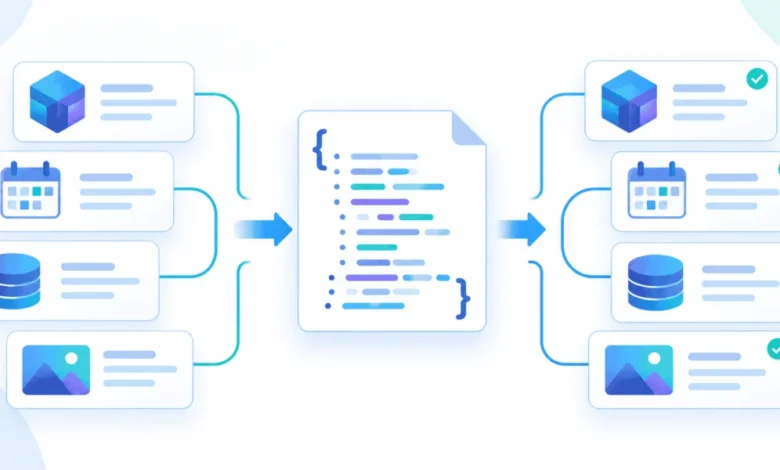
In a professional data pipeline, this process involves more than just conversion; it requires the inclusion of "type markers." By attaching metadata keys—such as __type__—to the serialized output, developers ensure that the downstream system retains context. For instance, when a Python set is converted into a list for JSON compatibility, tagging it with __type__: "set" allows the decoder to reconstruct the object correctly later. This metadata-driven approach transforms raw data into a self-describing schema, which is critical for long-term data preservation and auditability.
The Role of Decoding Hooks and Defensive Programming
While encoding creates the data, the integrity of the system rests on the decoding process. The standard json.loads() function can be extended using the object_hook parameter, which recursively scans dictionaries during the parsing process. By defining a robust decoding function, developers can transform serialized markers back into their original Python class instances.
However, the reality of production data is that it is rarely perfect. Malformed data, version mismatches, and network interruptions can introduce errors into the parsing process. A mature pipeline employs "defensive parsing"—a strategy where the decoder anticipates failure. By wrapping the logic in try-except blocks, the system can catch ValueError or TypeError exceptions, log the occurrence for administrative review, and either provide a fallback value or continue processing without crashing. This level of fault tolerance is a hallmark of resilient software engineering, ensuring that a single malformed configuration file does not compromise an entire batch processing run.
Managing Schema Evolution in Dynamic Environments
Machine learning projects are characterized by constant iteration. A configuration file that works for a model today may be insufficient for a model released next month. As new hyperparameters are added, existing metrics are deprecated, and model architectures shift, the schema of the underlying JSON files inevitably changes. This evolution creates a "versioning gap" where older serialized objects become incompatible with newer codebases.
To bridge this gap, engineers must implement a factory function that serves as an intermediary layer. This function acts as a validator, performing three essential tasks:
- Deserialization: Utilizing the custom decoder to restore the object’s structure.
- Migration: Applying default values for missing keys, effectively "upgrading" old configuration files to the current standard.
- Cleanup: Removing deprecated fields that are no longer supported by the latest pipeline, thereby ensuring a clean state for subsequent operations.
For example, if an experiment configuration is updated to include a learning_rate parameter, the factory function can detect its absence in older files and inject a default value, such as 0.001. This approach allows legacy data to remain functional within modern pipelines, significantly reducing the maintenance overhead associated with schema changes.
Broader Implications for ML Infrastructure
The shift toward robust, custom-tailored serialization pipelines is not merely a matter of convenience; it is a fundamental requirement for the industrialization of machine learning. As organizations scale their AI initiatives, the ability to maintain consistency across distributed teams and heterogeneous computing environments becomes a competitive advantage.
Data plumbing, while often relegated to the background, determines the upper limit of an organization’s ability to deploy models. By investing in resilient serialization—handling complex types, managing malformed data, and automating schema migrations—engineering teams reduce the time spent debugging infrastructure and increase the time available for model optimization. The techniques discussed here provide a foundation for building self-healing, maintainable, and scalable ML systems that can adapt to the rapid pace of technical innovation.
Ultimately, the goal of these strategies is to abstract away the volatility of data handling. When the serialization layer is robust, the data becomes a reliable asset rather than a source of instability. As the field continues to move toward automated MLOps, the adoption of these standardized, defensive programming practices will likely become a prerequisite for any team operating at scale. By treating data plumbing with the same rigor as model architecture, practitioners ensure that their pipelines are built to last, capable of navigating the complexities of modern data science while minimizing the risk of systemic failure.