Snapchat Report Reveals Shifting Consumer Perceptions Around AI Integration, Trust, and the Delicate Balance of Privacy

Artificial intelligence has officially crossed the threshold from experimental novelty to an integrated utility in daily life, according to a comprehensive new report published by Snapchat. Entitled "Navigating the Age of AI," the study offers a granular look at how everyday consumers, creators, and marketing professionals interact with and perceive AI chatbots and digital assistants. Based on rigorous survey data compiled in partnership with market research firms Ipsos and WPP, the findings indicate that public trust in AI systems is rising, though distinct boundaries remain regarding data privacy, advertising, and the authenticity of automated content.
As the digital ecosystem continues to grapple with the rapid deployment of generative tools, Snapchat’s research sheds light on the psychological shifts accompanying widespread adoption. The study surveyed more than 4,200 active artificial intelligence users globally, capturing a snapshot of a society increasingly reliant on algorithmic assistance for communication, ideation, and decision-making.
Massive Adoption and the Normalization of Daily AI Interaction
The statistical foundation of Snapchat’s report underscores the sheer scale of modern AI integration. According to the data, 48% of surveyed consumers now utilize artificial intelligence tools on a daily basis. Among digital creators and commercial marketers, that number climbs even higher, with 50% confirming that AI has become a core, indispensable component of their routine operations.
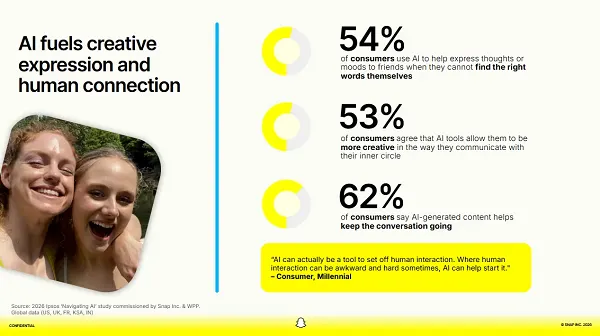
This rapid normalization is driven largely by utility. Rather than viewing chatbots as distant, complex technologies reserved for technical specialists, everyday users are finding practical applications in personal communication. Approximately 62% of respondents reported that AI tools actively assist them in maintaining conversations, suggesting a growing reliance on algorithms to refine thoughts, overcome writer’s block, and formulate responses.
Furthermore, the demographic data highlights unique behavioral patterns among core social media users, such as Snapchat’s younger base. According to the study, Snapchat users are 2.2 times more likely than non-users to agree that artificial intelligence positively impacts their social lives. They are also 1.6 times more likely to leverage AI assistants to plan real-world activities, ranging from itinerary generation to social event coordination.
The Rise of the Judgment-Free Digital Coach
One of the most notable insights derived from the Ipsos and WPP partnership centers on the psychological safety users feel when interacting with conversational AI. Over 80% of respondents described artificial intelligence as friendly and collaborative, challenging early narratives that framed automated assistants as cold, intimidating, or purely transactional.
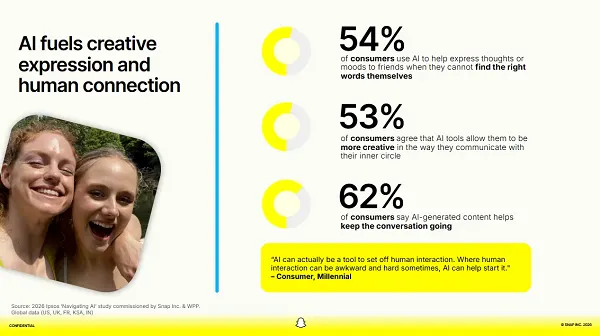
More specifically, 74% of participants view AI environments as judgment-free spaces. Users are increasingly turning to chatbots as private coaches to help articulate complex feelings, navigate difficult interpersonal conversations, or organize their thoughts before sharing them with human peers. This therapeutic or preparatory utility has transformed the chatbot into an intermediary communication layer, helping individuals process emotions without the fear of social repercussion or immediate judgment.
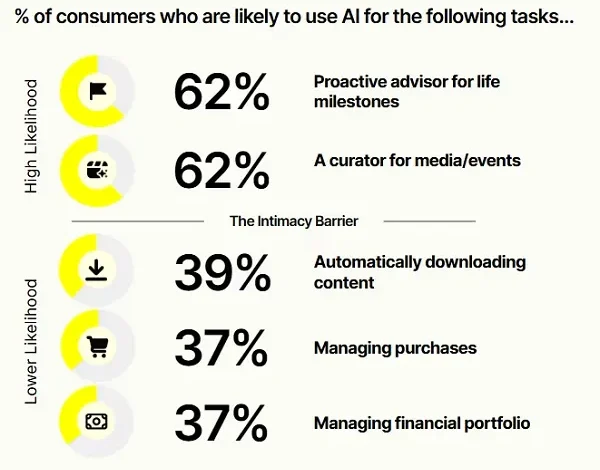
Despite these interpersonal benefits, the report reveals clear boundaries when it comes to high-stakes decision-making. Users remain decidedly hesitant to hand over control of sensitive personal domains—most notably personal finance management and major purchasing decisions—to automated systems, signaling that human oversight remains paramount in areas involving financial risk.
The Value Exchange: Privacy on a Sliding Scale
A central theme of Snapchat’s report addresses the long-standing tension between data privacy and digital utility. For over two decades, the business model of social media platforms has relied on a fundamental compromise: users surrender personal data in exchange for free, highly functional, and connected digital experiences. Snapchat argues that this dynamic is evolving within the context of artificial intelligence.
"Privacy today isn’t an absolute—it’s a sliding scale," the report states. "Consumers aren’t asking, ‘Is this private?’ They’re asking, ‘Is this worth it?’ The reality is that users will willingly trade data for personalized AI experiences when the immediate value is obvious. But that value exchange has boundaries."
This explicit acknowledgment highlights a strategic pivot for technology companies. By framing privacy as negotiable based on immediate utility, platforms are attempting to legitimize data collection practices as a fair trade-off for advanced capabilities. However, this perspective exposes a complex internal contradiction within consumer sentiment regarding digital marketing and personalization.
The Dichotomy of Personalization and Consumer Resistance
Even as users embrace AI for personal expression and conversational guidance, the report uncovers deep-seated skepticism regarding commercial applications of the exact same technology. This dichotomy presents a significant hurdle for brands and advertisers seeking to capitalize on the AI boom.
Specifically, the study revealed that 70% of consumers find personal data utilized in hyper-personalized AI advertisements to be intrusive. Furthermore, 56% of respondents consider 100% AI-generated content to be "soulless."
This creates a paradox for the digital economy. Consumers are increasingly comfortable sharing intimate thoughts, conversational challenges, and daily routines with personal AI chatbots to receive tailored, empathetic assistance. Yet, when those same data points or generative capabilities are deployed by corporations to deliver targeted ads or synthetic marketing campaigns, the reaction shifts from appreciation to alienation.
Industry analysts point out that this tension reveals a distinction between utility-driven AI and commercial-driven AI. When an artificial intelligence tool serves the immediate needs of the user—such as helping write a message or planning a trip—the data trade-off feels justified. When the tool serves the bottom line of an advertiser, the utility diminishes, and the collection of personal data crosses into unwelcome surveillance.
Broader Implications for the Tech Industry and Advertisers
The release of "Navigating the Age of AI" arrives at a critical juncture for social media companies, software developers, and digital marketers. As platform revenues increasingly depend on AI-driven features and monetization strategies, understanding consumer sentiment is paramount.
For advertisers, the findings serve as both a roadmap and a cautionary tale. While the integration of artificial intelligence into consumer routines offers unprecedented touchpoints for engagement, heavy-handed or overly intrusive personalization risks alienating users who already harbor deep skepticism toward synthetic media. Successful integration will require transparency, clear boundaries, and a demonstrable focus on user-first utility rather than aggressive data harvesting.
As artificial intelligence continues to evolve from a novel feature into the foundational infrastructure of digital communication, companies like Snapchat face the ongoing challenge of respecting the delicate line between helpful companionship and unwanted intrusion. The future of AI adoption will likely depend not on convincing users to abandon their privacy concerns entirely, but on consistently proving that the technological value delivered outweighs the data required to power it.