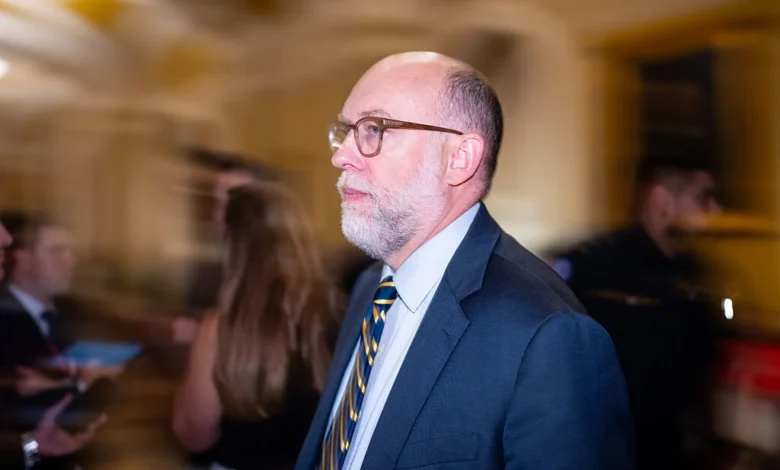
The landscape of American biomedical research faces a seismic shift as the administration prepares a sweeping executive order that would grant Russell Vought, the head of the Office of Management and Budget (OMB), unilateral veto power over every individual research grant awarded by the National Institutes of Health (NIH). This unprecedented move, which follows intense internal deliberations within the White House, marks the latest escalation in a multi-year effort by the administration to exert direct political control over federal scientific funding. The development, confirmed by multiple reports from the Washington Post, the New York Times, and Politico, places the NIH—the world’s largest public funder of biomedical research—at the center of a volatile collision between executive political agendas and the long-standing tradition of merit-based scientific inquiry.
A Timeline of Escalating Intervention
The attempt to centralize control over NIH funding is not an isolated incident but the culmination of a systematic campaign that began early in the administration’s second term. Shortly after the inauguration, the administration initiated a series of aggressive measures to reshape the federal research apparatus. In July 2025, the government terminated a wide array of research grants, citing a desire to curb what officials termed "woke" research, specifically targeting projects related to pandemic preparedness and health disparities.
The administration’s initial efforts were met with significant pushback. Congress, exercising its power of the purse, rejected proposals to slash the NIH budget by nearly 50 percent. Simultaneously, the judicial branch intervened; in mid-2025, federal courts voided the policy behind the grant terminations, ruling that the process lacked the necessary scientific rigor and legal foundation. Undeterred, Vought and the OMB pivoted toward administrative rule-making in May 2026, proposing new guidelines that would have elevated political criteria as a primary determinant for funding. That effort was also stalled in September 2026, when a bipartisan budget deal placed a moratorium on such changes until at least December.
The current move represents a strategic pivot. Faced with legislative and judicial roadblocks, the administration is now bypassing traditional bureaucratic channels in favor of an executive order. The proposed mechanism would install a committee—chaired by Vought and including NIH Director Jay Bhattacharya—with the authority to veto any grant. A unanimous agreement would be required for a project to proceed, effectively granting Vought, a political appointee, the ability to block any research initiative with which he disagrees.

The NIH Budget and the Scope of Influence
To understand the stakes of this potential policy, one must consider the sheer scale of the NIH’s operations. With an annual budget of $47 billion, the NIH distributes more funding than the next ten largest research institutions combined. Its grants are the lifeblood of the American biotechnology sector and the primary engine for academic research across hundreds of universities. These funds support critical infrastructure, ranging from basic molecular biology to late-stage clinical trials that lead to life-saving pharmaceuticals.
The current system relies on a rigorous peer-review process. Applications are scored based on scientific merit, innovation, and potential impact by panels of experts in the relevant fields. This "merit-based" system has been the gold standard for global scientific research for decades, designed to insulate public health goals from the shifting winds of partisan politics. By introducing a political veto, the administration risks dismantling this infrastructure, potentially creating a bottleneck that could prevent the NIH from utilizing its full congressional appropriation. If thousands of grants are subject to review by a committee that lacks the bandwidth or the scientific expertise to evaluate them, the resulting administrative paralysis could leave billions of dollars in allocated funds unspent, effectively de-funding essential research by default.
The Harvard Connection: Political Vendettas and Science
The push for direct oversight appears to be intertwined with the administration’s ongoing conflict with Harvard University. Since the beginning of the second term, the White House has actively sought to pressure high-endowment academic institutions, specifically targeting Harvard with funding suspensions and investigations. When the university successfully challenged these measures in court and secured a $2.6 billion restoration of funding in September 2025, the administration’s focus shifted to financial extraction.
Reports indicate that Vought presented the control of NIH grants to the President as a "Plan B" to exert leverage over Harvard. By controlling the flow of biomedical research funding, the administration gains a powerful tool to demand concessions or payments from institutions that are heavily reliant on federal grants. The involvement of NIH Director Jay Bhattacharya in these discussions has been complex. While Bhattacharya has historically been a critic of mainstream pandemic response strategies and has sought to implement his own vision of a "scientific revolution" within the agency, his reported resistance to Vought’s proposal highlights the tension between ideological alignment and the practical management of a federal research agency. Even for those within the administration who agree on the need for reform, the prospect of an OMB-led veto committee appears to be a bridge too far, as it threatens the basic functionality of the nation’s health research portfolio.
Legal and Administrative Implications
Legal experts suggest that the proposed executive order would face immediate and severe challenges in court. Under the Administrative Procedure Act, federal agencies are prohibited from taking actions that are "arbitrary and capricious." For a policy to be legally defensible, it must be supported by a rational connection between the facts and the choice made.

"Vought wants to stop the NIH from spending its budget is not a legal justification," said one constitutional scholar familiar with federal administrative law. Because the NIH is funded by specific legislative appropriations, the executive branch does not have the constitutional authority to unilaterally refuse to spend those funds for political reasons. The move is expected to be challenged on the grounds that it violates the separation of powers and the core mandate of the NIH as established by Congress.
However, the path to judicial intervention is fraught with obstacles. Potential plaintiffs—such as universities or individual principal investigators—must prove they have "standing," meaning they must demonstrate concrete, particularized injury resulting from the policy. Until a specific grant is denied and a lawsuit is filed, the policy could remain in effect, potentially causing significant disruption to ongoing research projects and long-term scientific planning.
Broader Impact on the Scientific Community
The global scientific community is watching these developments with alarm. The United States has long been the leader in biomedical innovation, a position underpinned by the stability and predictability of NIH funding. The introduction of political, rather than scientific, gatekeeping threatens to drive researchers toward safer, less controversial topics, stifling the innovation that drives the biotechnology industry.
Furthermore, the uncertainty created by this potential executive order may have a chilling effect on the next generation of scientists. If research priorities are subject to the whims of an OMB director, the brightest minds may increasingly look to the private sector or to international institutions that offer more stability. As the administration continues to frame the NIH as a target for "de-woking," the long-term impact on the country’s public health preparedness remains a significant concern for both domestic and international stakeholders.
As the December deadline approaches and the administration pushes forward with its plans, the scientific community and the halls of Congress remain at a standoff. Whether this maneuver results in a lasting change to the structure of American science or is overturned as a reach of executive power, the events of the past several months have fundamentally altered the relationship between the White House and the scientific establishment. The outcome of this struggle will likely define the parameters of federal research policy for the remainder of the decade.