Meta Expands Muse AI Capabilities With Real-Time Voice, Expressive Avatars, and Custom Audio Features

Meta is rolling out significant updates to its Muse artificial intelligence ecosystem, equipping its personal AI agents with advanced speaking capabilities, dynamic vocal inflection, and expressive visual avatars. The update is designed to transform the user experience from text-heavy prompt generation to fluid, conversational dialogue. By allowing users to select personalized voices and interact with AI avatars that respond with real-time facial expressions and gestures, Meta aims to make digital assistants more engaging and practical for complex professional and personal tasks. However, this push into conversational audio arrives as the tech giant attempts to navigate a complex history of consumer apathy and past missteps regarding novel AI personalities and celebrity-voiced chatbots.
The Evolution of Conversational AI Interaction
Under the latest update, users can verbally interact with their Muse AI agents to brainstorm concepts, draft outlines, and manage workflows without the friction of typing precise prompts. Meta’s design philosophy hinges on the cognitive principle that thinking out loud often accelerates problem-solving. In official product statements, the company noted that brainstorming abstract ideas is frequently more efficient when spoken aloud, enabling thoughts to take shape organically rather than through rigid, structured text commands.
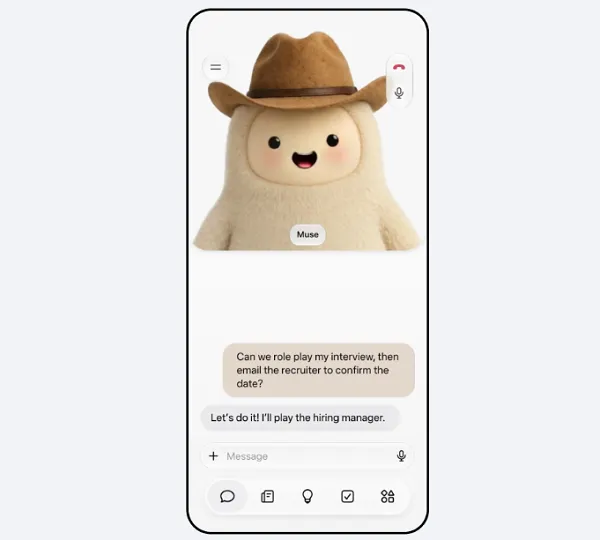
This capability is particularly targeted toward preparation-heavy scenarios. Professionals and students alike can use the voice-enabled Muse agents to simulate high-stakes environments, such as rehearsing for upcoming job interviews, running through slide-deck presentations, or pitching new business ideas. Because the AI provides immediate, spoken feedback and responds in real time, the interaction mirrors a live conversation with a human coach, thereby increasing the utility of the tool beyond simple productivity tasks.
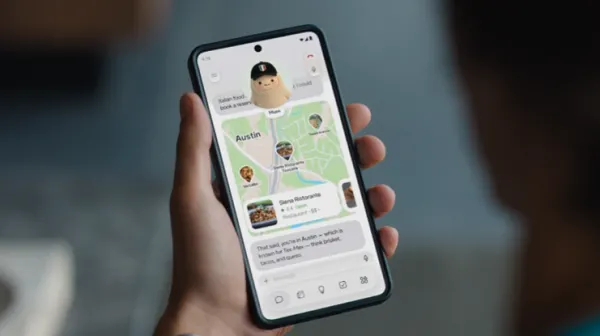
In tandem with audio functionality, Meta has integrated expressive avatars designed to heighten immersion. These avatars do not merely output static audio; they react dynamically to user speech, displaying subtle micro-expressions, nods, and gestures that match the emotional and conversational tone of the exchange. Meta emphasizes that users retain control over how prominent the AI is during any given session. Individuals can choose between a purely auditory experience, a floating avatar alongside other tasks, or a full-screen, face-to-face interaction mode.
Navigating the Legacy of Novelty Voices and Celebrity Bots
Despite the functional utility of voice-driven brainstorming, the feature also includes eccentric personalization options, such as assigning regional accents—like a distinct New York accent—or styling the agent to speak like a pirate. This inclusion raises questions within the tech industry regarding consumer demand for novelty voices, especially given Meta’s checkered track record with similar experimental features over the past several years.
The timeline of Meta’s conversational and personality-driven AI initiatives reveals a pattern of aggressive experimentation followed by rapid scaling back:
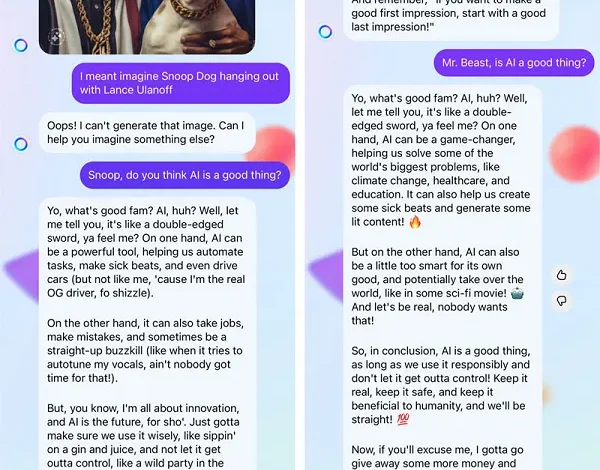
- September 2023: Meta launched a suite of celebrity-styled AI chatbots on Messenger and Instagram. These bots allowed users to chat in text form with personas modeled after and styled by prominent cultural figures.
- Mid-2024: Due to a distinct lack of organic user interest and engagement, Meta quietly retired its celebrity-styled text chatbots less than a year after their debut.
- August 2024: Undeterred by the failure of the text-based experiment, Meta pivoted to an audio format, investing millions of dollars to secure the recorded voices of high-profile actors—including Judi Dench, Keegan-Michael Key, and Awkwafina—for AI interactions.
- April 2025: Investigative reports from publications such as The Wall Street Journal revealed that certain users had bypassed safety guardrails to generate explicit or unauthorized content using the celebrity-voiced bots. This misuse, coupled with lukewarm market adoption, prompted Meta to scrap the expanded roll-out before it reached the general public.
The introduction of customizable accents and stylized speech profiles in the current Muse update demonstrates that Meta remains committed to personality-driven AI customization, despite previous headwinds. Industry analysts point out that while customizable voices appeal to a niche demographic looking for entertainment, mainstream enterprise and productivity users typically prioritize reliability, accuracy, and professional tone over novelty audio filters.
Technical Architecture and Accessibility
The underlying architecture supporting Muse’s new expressive capabilities leverages advanced large language models combined with real-time speech synthesis and generative animation pipelines. By synchronizing audio generation with facial rig animations, Meta has attempted to minimize the latency that typically plagues conversational AI systems, ensuring that interruptions and back-and-forth dialogue feel natural.
Accessibility remains a core pillar of the rollout. By supporting hands-free voice queries, the feature lowers the barrier to entry for users who may find typing cumbersome or inefficient on mobile devices. However, the social implications of widespread voice-based AI interaction in public spaces present a new frontier for consumer technology. As users increasingly walk through public areas talking aloud to digital agents via smartphones and wearable accessories, social norms regarding public device usage will inevitably be tested.
Market Implications and Competitive Landscape
Meta’s expansion of Muse places it in direct competition with conversational voice assistants from major technology firms, including OpenAI’s advanced voice mode, Google’s Gemini Live, and Apple’s Siri integrations. While competitors have largely focused on natural human-sounding delivery and utilitarian task execution, Meta’s emphasis on expressive avatars and deep visual customization represents a distinct product strategy.
By blending productivity tools—such as interview preparation and presentation practice—with deep personalization features, Meta is attempting to capture both the professional software market and the consumer entertainment sector. Whether users embrace the avatar-driven approach or gravitate toward minimalist, voice-only interfaces remains to be seen.
As the tech industry continues to refine generative voice technology, user privacy, data governance, and safety guardrails will remain critical areas of scrutiny. Meta’s past challenges with user-generated content misuse underline the necessity of robust moderation frameworks, particularly when AI agents are given expressive, human-like personas capable of dynamic improvisation. For now, the rollout of Muse’s speaking capabilities marks a decisive step forward in Meta’s broader strategy to weave artificial intelligence into the fabric of everyday digital communication.