Google DeepMind Introduces Gemini Decisions API and Gemini Decision 1 Model for High-Speed Multimodal Intelligence

Google DeepMind has officially announced the launch of the Gemini Decisions API alongside its newly developed Gemini Decision 1 model, marking a significant shift in how artificial intelligence handles closed-set classification, evaluation, and decision-making tasks. Unveiled through Google AI Studio, the new endpoint is engineered to process up to 1,000 distinct yes/no, multiple-choice, or rubric-scoring queries in a single forward pass across multiple data modalities, including text, images, audio, video, and PDF documents.
Unlike traditional generative language models that construct responses token by token, the Gemini Decision 1 architecture evaluates candidate options directly. By bypassing standard text generation pipelines, the system delivers probabilities and confidence scores with an end-to-end latency of 150 to 250 milliseconds. This design addresses a long-standing challenge in software engineering and enterprise automation: executing fast, reliable, and cost-effective machine-learning evaluations without the overhead of heavy text decoding or custom classifier training.
Technical Architecture and Operational Mechanics
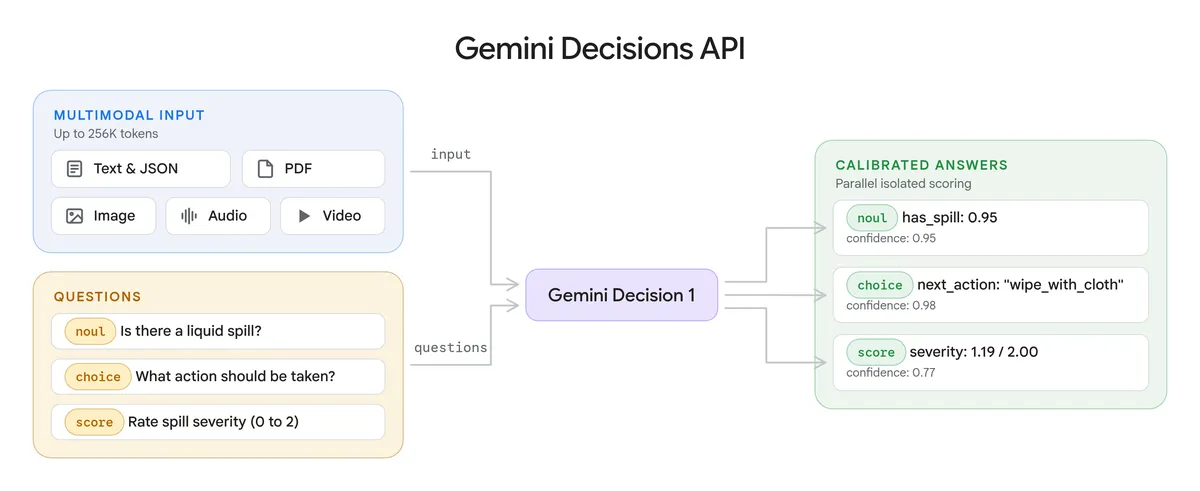
At the core of the new offering is a specialized multi-task scoring mechanism. Traditional large language models require sequential token generation, which introduces latency and variable computational costs when performing routing, policy enforcement, or context grading. The Gemini Decision 1 model evaluates multiple structured questions against a shared multimodal context simultaneously.

The system supports inputs up to 256,000 tokens, allowing developers to supply extensive documents, high-definition visual media, or prolonged audio and video recordings. For example, an application can ingest a customer service call recording paired with account ledger PDFs and visual verification logs, then query the dataset across a thousand distinct parameters in a single API call.
Every evaluation returns a calibrated probability alongside a confidence score ranging from 0 to 1. This metric enables downstream software architectures to handle ambiguous scenarios automatically, routing low-confidence outputs to human reviewers or fallback routines. Furthermore, the pricing structure reflects this architectural departure: input tokens are billed at $0.10 per million, while output tokens incur no charges, significantly reducing operational expenses for high-volume enterprise workflows.
Comparative Benchmarking and Performance Metrics
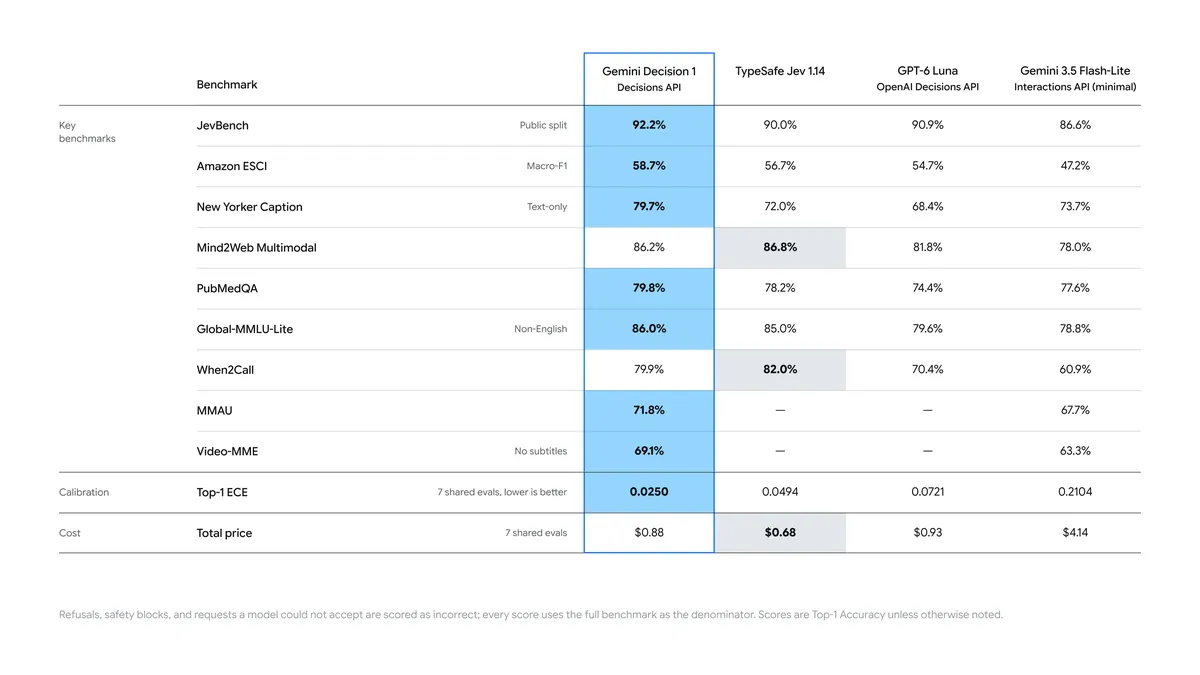
Internal evaluations released by Google DeepMind indicate that Gemini Decision 1 achieves state-of-the-art performance across agent routing, reasoning, ranking, and multimodal understanding benchmarks. Notably, the model exhibits lower calibration error than comparable alternatives, meaning its stated confidence scores closely align with its actual accuracy rates.
In comparative cost and speed analyses, the system maintains a nearly flat computational latency profile whether evaluating a single question or scaling up to 100 concurrent questions per request. Because the shared input is processed only once and output token generation is eliminated, the architecture achieves a cost efficiency approximately five times greater than traditional inference configurations running on flash-tier generational models.
Real-World Implementation and Developer Ecosystem
Early deployment phases within Google and pilot partner organizations have demonstrated the versatility of the Decisions API as a low-latency control plane. Development teams are utilizing the endpoint to automate policy enforcement, manage agentic tool selection, and grade complex operational environments in real time.
For instance, automated monitoring workflows can analyze continuous video feeds or inspection photographs alongside text logs to categorize environmental hazards, evaluate safety protocols, and dictate immediate operational responses. In software development tooling—such as automated interface generators and rapid prototyping frameworks—the API enables instant evaluation of visual and structural requirements without bottlenecking on heavy text synthesis.
To facilitate rapid adoption, Google DeepMind has launched the API with native support in Google AI Studio, accompanied by comprehensive documentation and SDK support for Python, JavaScript, and RESTful architectures. Ecosystem integrations are simultaneously rolling out across major developer platforms, including OpenRouter, LangChain, Vercel, LiteLLM, Pydantic AI, Pipecat, LiveKit, and OpenCode, with enterprise availability for Gemini in Google Cloud scheduled for release.
Broader Industry Implications and Market Analysis
The introduction of the Gemini Decisions API signals a broader industry trend toward specialized, task-specific inference endpoints. While large generative models remain essential for creative writing, complex synthesis, and open-ended dialogue, enterprise applications frequently require deterministic, structured, and lightning-fast classification.
By separating the function of classification from generative text production, Google DeepMind has established a new paradigm for deterministic AI integration. Organizations that previously relied on resource-intensive model fine-tuning or costly chain-of-thought prompting can now implement rigorous governance, compliance checks, and automated decision-making pipelines at a fraction of the historical latency and financial cost.
As enterprises increasingly demand predictable, calibrated, and auditable outputs from machine learning systems, specialized evaluation endpoints like Gemini Decision 1 are expected to play a foundational role in the next generation of scalable autonomous software agents and operational control systems.