PCloud Pass Password Manager Security Breach Exposes User Data and Triggers Global Alert


The security infrastructure of pCloud Pass, the dedicated password management service provided by cloud storage firm pCloud, has been compromised in a recent cyberattack that saw unauthorized login attempts targeting customer accounts worldwide. Users began reporting suspicious activity late last week, characterized by email notifications detailing new, unrecognized device connections. These alerts occurred even among users who had strictly enforced two-factor authentication (2FA) protocols, raising significant concerns regarding the efficacy of existing security measures and the potential exposure of sensitive, albeit encrypted, credential vaults.
The incident has drawn immediate scrutiny from the cybersecurity community, particularly given the sensitive nature of the data managed by the platform. While pCloud has issued statements suggesting that the breach was quickly contained and that primary storage services remain unaffected, the event serves as a stark reminder of the escalating risks facing identity and password management providers in an era of increasingly sophisticated automated threats.
Chronology of the Breach and User Notifications
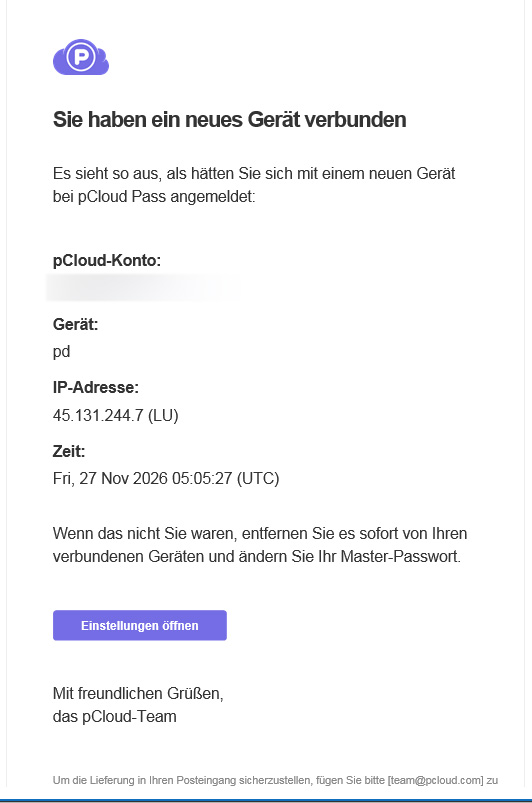
The first indicators of the breach emerged on social media platforms, specifically Reddit, where multiple users reported receiving automated emails from pCloud stating that a new device—identified as "pd"—had successfully authenticated into their accounts. Crucially, these alerts specified that the connection originated from an IP address (45.131.244.7) linked to Luxembourg, which users quickly identified as belonging to pCloud’s own server infrastructure.
For many, these notifications were confounding. Users who had never activated or even utilized the pCloud Pass service reported receiving the warnings. In one notable instance, an individual received the security alert via an email address associated with a pCloud storage account that had been officially marked for deletion nearly a year prior, suggesting potential inconsistencies in the company’s data retention or deletion practices.

As the reports proliferated, the confusion was compounded by discrepancies in the user interface. While the email alerts indicated a successful login, many customers logging into their dashboards found no evidence of an unauthorized device in their "Active Sessions" or "Authorized Devices" lists. This inconsistency suggests that the attackers may have been leveraging automated scripts to trigger the authentication flow—and the subsequent notification system—without necessarily gaining full, persistent control over the user accounts.
Technical Analysis and Vulnerability Concerns
A critical detail surfaced when security-conscious users inspected the "Open Settings" link provided within the security notification emails. The link pointed to passqa1.pcloud.com, a URL corresponding to a Quality Assurance (QA) environment rather than the production-facing environment typically used by customers. The use of a staging or testing environment in a live attack scenario is a significant red flag, implying that the threat actors may have exploited a misconfiguration or a lapse in security hygiene within pCloud’s development pipeline.
While pCloud asserts that the core data—passwords, private notes, and sensitive metadata—remains encrypted and theoretically secure behind a user’s master password, the industry remains wary. In the cybersecurity field, the "encryption" defense is not an absolute panacea. If an attacker manages to exfiltrate an entire encrypted vault, they can move the data to an offline environment, entirely bypassing the service’s rate-limiting, account lockout policies, and 2FA hurdles. Once offline, the attacker can use high-powered hardware to attempt brute-force or dictionary-style attacks against the master password.
This specific threat model was the catalyst for the catastrophic 2022 LastPass breach. In that instance, attackers stole backups containing encrypted vaults, which were later linked to a series of coordinated cryptocurrency thefts. The attackers allegedly cracked weak or reused master passwords, granting them access to private keys and seed phrases that were stored within the vaults. Whether pCloud Pass users have suffered a similar loss of data remains an open, yet critical, question that the company has yet to definitively answer.
Official Statements and Company Response
In response to the growing public pressure, pCloud released a statement confirming that a cyberattack had targeted the pCloud Pass infrastructure. The company emphasized that the incident was "promptly contained" by its internal security team. According to the firm, the scope of the exposure was limited to a "small number" of user email addresses, which were then used to facilitate the unauthorized login attempts that triggered the automated notifications.

"Our system sends a notification automatically to each of these addresses," the company explained, framing the deluge of alerts as a feature of their robust security architecture rather than a sign of a deeper system failure. Regarding the potential theft of encrypted data, pCloud maintained that all information stored within the vaults is encrypted on the client side, meaning only the user possesses the keys to decrypt the content.
However, the company’s response has been criticized for being notably silent on the issue of the QA environment link and the specific mechanism by which the attackers obtained the email addresses. By failing to disclose whether any encrypted vaults were successfully downloaded by the attackers, pCloud has left its user base in a state of uncertainty, forcing many to consider preemptive password resets as a safety precaution.
The Broader Landscape of Password Manager Security
The pCloud incident is not an isolated event but rather part of a broader, concerning trend affecting the password management sector throughout the month of November. The industry is currently facing a period of intense scrutiny as threat actors shift their focus toward these services, which represent a "single point of failure" for millions of digital identities.
Earlier in November, mSeven Software, the creators of the mSecure password manager, issued an urgent warning to its user base. Following the theft of an encrypted customer database, the company advised its users to perform a full reset of their credentials, including two-factor authentication tokens and passkeys, to mitigate the risk of a potential decryption attack.
Simultaneously, 1Password, an industry leader, disclosed a significant security incident of its own. In that case, an unauthorized actor gained access to a company employee’s GitHub account. By leveraging the stolen credentials, the attacker deployed malicious code to the company’s backend services, specifically targeting customer data. While 1Password was quick to reassure its users that their master passwords and encryption keys remained untouched, the event highlighted the fragility of even the most reputable security firms when faced with sophisticated social engineering or credential theft.
Implications and Recommended Best Practices
The repeated targeting of these services suggests that password managers have become high-value targets for organized cybercrime groups. The aggregation of data within these platforms makes them lucrative, even when the data is encrypted. For the average user, these incidents necessitate a shift in security posture. Relying solely on the encryption provided by a service provider is no longer considered sufficient.
Security professionals recommend the following actions for users of any password management service, including pCloud:
- Strengthen the Master Password: Given the risk of offline cracking, users should employ a long, complex, and unique master password that is not used for any other service. The longer and more random the passphrase, the higher the computational cost for an attacker attempting to brute-force the vault offline.
- Enable Hardware-Based 2FA: While 2FA can be bypassed in some scenarios, using hardware security keys (such as YubiKeys) provides a significantly higher level of protection against phishing and automated login attempts compared to SMS or app-based one-time passwords.
- Monitor for Phishing: As noted by pCloud in their advisory, attackers often follow up on these breaches with phishing campaigns. Users should exercise extreme caution with any communication claiming to be from their service provider, especially if it requests credentials or directs them to unusual subdomains like QA or testing environments.
- Audit Connected Devices: Regularly reviewing the list of authorized devices within a password manager is a vital hygiene practice. Any unrecognized device should be immediately revoked, and the master password should be changed as a precaution.
Conclusion
The breach of pCloud Pass serves as a sobering reminder of the digital security paradox: while password managers are essential tools for maintaining security in a fragmented internet landscape, they inherently concentrate risk. As pCloud works to restore confidence and conclude its forensic investigation, the broader industry must grapple with the reality that defensive measures are currently struggling to keep pace with the increasing sophistication of automated, AI-assisted, and targeted attacks. For users, the message is clear: vigilance, combined with a defense-in-depth approach to personal security, remains the only viable strategy in an increasingly hostile digital environment.
Related posts: