Social Media Marketing for Financial Services: Navigating Regulation and Maximizing Engagement


Social media marketing for financial services is the strategic application of digital platforms to educate audiences, cultivate trust, generate leads, and provide robust customer support within an inherently complex and highly regulated industry. This multifaceted approach applies across a broad spectrum of organizations, encompassing traditional banks, credit unions, insurance companies, wealth management firms, and agile fintech innovators. What fundamentally distinguishes social media engagement in financial services from other sectors is the delicate balancing act required: brands must remain authentic, engaging, and human, all while rigorously adhering to stringent regulatory mandates, safeguarding sensitive customer data, and meticulously building trust in an advisory capacity. Each digital interaction, from a simple post to a direct message, carries significant compliance weight, making a meticulously crafted strategy and robust governance as critical as creative content. When executed effectively, social media transforms into an indispensable channel for engaging individuals at the nascent stages of their financial journeys and maintaining brand prominence as their needs evolve.
The imperative for financial institutions to embrace social media has never been more pronounced, driven by a confluence of evolving consumer behaviors and technological advancements. Historically, the financial sector approached social media with caution, primarily due to the stringent regulatory environment and concerns over data security and compliance. Early adoption was often tentative, limited to basic informational posts or customer service inquiries. However, the rapid digital transformation of society, coupled with the rise of digitally native generations, has reshaped consumer expectations, making social media an undeniable force in financial decision-making.

The Evolving Landscape: A Chronology of Digital Adaptation
The journey of financial services on social media can be broadly understood through several phases:
- Early 2000s (Hesitation & Experimentation): With the advent of platforms like MySpace and early Facebook, financial institutions largely remained on the sidelines. The focus was on traditional marketing channels, and social media was perceived as an unregulated, risky space.
- Late 2000s (Cautious Entry): As Facebook and Twitter gained mainstream adoption, some forward-thinking banks and credit unions began to establish basic profiles, often limited to broadcasting news or handling very general inquiries. Compliance departments remained highly vigilant, severely restricting content and interaction.
- Early 2010s (Regulation Catch-Up & Mobile Shift): Regulatory bodies like FINRA and SEC started issuing initial guidance on social media use, providing a framework for compliance. Concurrently, the explosion of smartphones and mobile banking apps began to intertwine digital presence with daily financial management, increasing the pressure for institutions to meet customers where they were.
- Mid-2010s (Content & Community Building): As regulations became clearer and social media management tools matured, financial brands began to explore more proactive content strategies. Educational posts, community engagement, and even initial forays into visual platforms like Instagram started to emerge. The concept of "social selling" began to gain traction among advisors.
- Late 2010s to Present (Strategic Integration & AI): Social media is now recognized as a critical, cross-functional tool for marketing, customer service, and even sales. The rise of short-form video (TikTok, Reels), the influencer economy ("finfluencers"), and the integration of AI for content creation, sentiment analysis, and compliance monitoring mark the current era. Financial services are now striving for seamless integration of social media into their broader digital ecosystems.
Strategic Imperatives: Why Financial Services Must Engage

The benefits of a well-executed social media strategy for financial services are extensive and directly impact business outcomes:
-
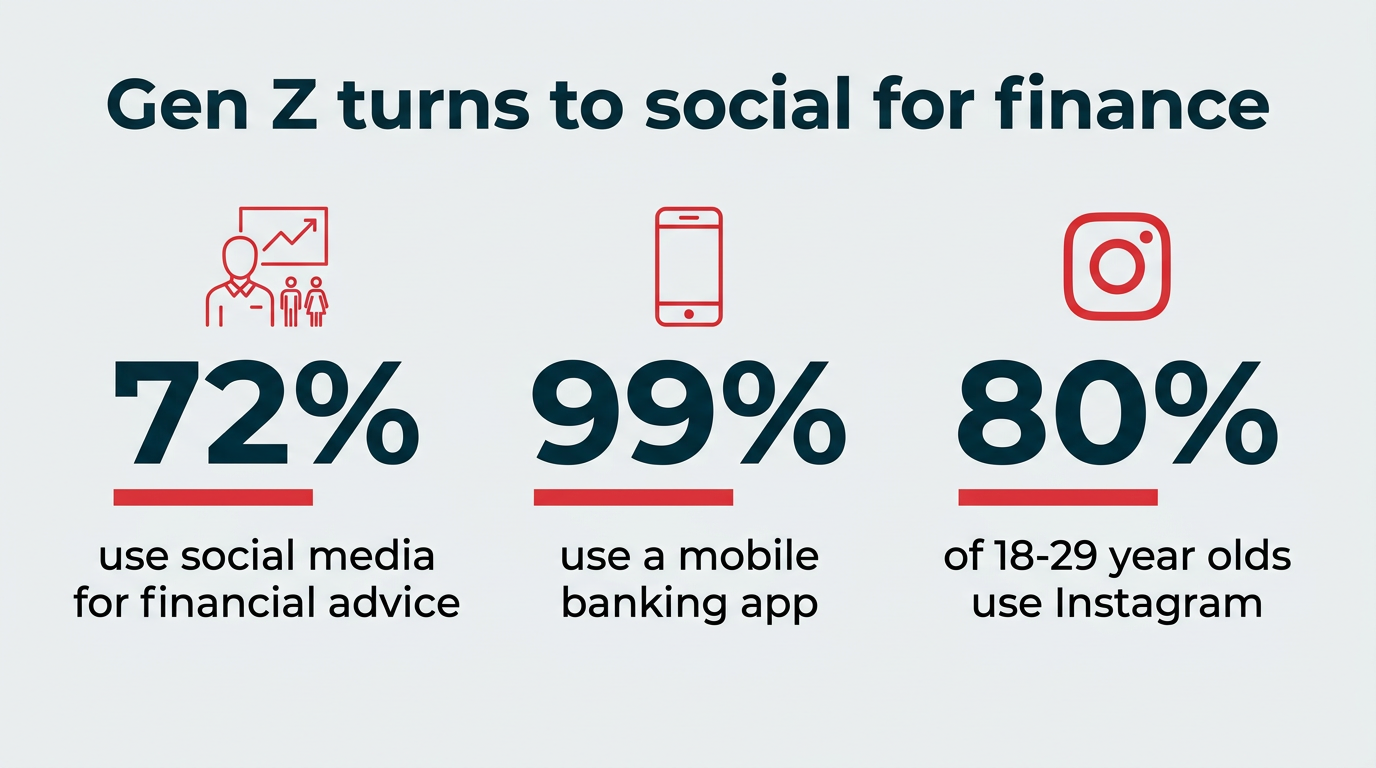
Reach New and Crucial Audiences: Younger generations, particularly Gen Z and Millennials, are digital natives who increasingly turn to social platforms for financial education and advice. Data from Pew Research indicates that over 80% of 18-29-year-olds use Instagram alone, a significant demographic for future financial planning. A Charles Schwab Modern Wealth Survey reveals that 72% of Gen Z consult social media for financial advice, underscoring the necessity for financial brands to establish an early, credible presence. Furthermore, 99% of Gen Z utilize mobile banking apps, demonstrating their comfort with digital financial interactions. By engaging on social media, institutions can connect with these audiences during formative financial milestones, from their first jobs to homeownership and retirement planning, with 47% of Gen Z workers already on track for successful retirement.
-
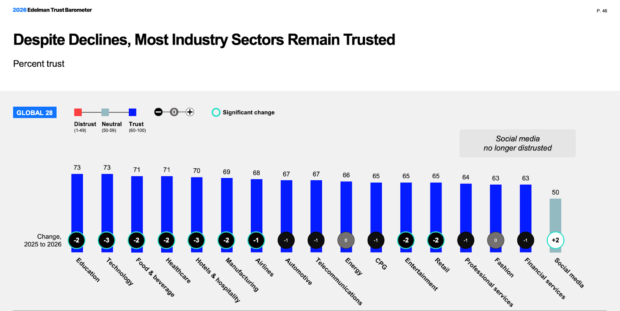
Strengthen Relationships and Foster Trust: Financial relationships are fundamentally built on trust and personal connection. Social media facilitates this by enabling ongoing, organic interactions. Platforms like LinkedIn, in particular, allow professionals to track milestones such as new jobs or business launches, creating opportunities for timely, personalized engagement without an immediate sales pitch. This approach, often termed "social selling," focuses on providing value and building rapport, leading to long-term client relationships rather than transactional sales. In an industry that, despite recent improvements, still struggles with trust according to the Edelman Trust Barometer (2026), social media offers a vital avenue to bridge this gap through transparent communication and responsive interaction.
-
Humanize the Brand and Highlight Values: Consumers today seek more than just financial returns; they want to align with brands that share their values and demonstrate a clear social conscience. The surge in interest in sustainable investing, with 99% of Gen Z and 97% of Millennials expressing interest (Morgan Stanley report), exemplifies this trend. Social media provides a platform for financial brands to articulate their mission, explain their investment philosophies, and showcase their commitment to ESG (Environmental, Social, and Governance) principles. Moreover, featuring senior executives actively on social media can significantly boost public trust, with 82% of people more likely to trust a company whose leaders are visible online (Entrepreneur). This humanizes what can often feel like a cold, institutional sector.
-
Gain Unparalleled Industry and Customer Insights: Social media acts as a real-time early warning system for market trends, competitive moves, and shifts in public sentiment. Social listening tools, such as Lumen within Hootsuite Social OS, allow financial firms to monitor conversations, identify emerging topics, and understand customer pain points, demographics, and interests. This continuous feedback loop is invaluable for refining products, services, and marketing messages. Furthermore, internal social media analytics provide actionable insights into content performance, enabling teams to optimize their strategies for maximum resonance and impact.
-
Enhance Operational Efficiency and Reduce Costs: Managing social media across diverse teams and individual advisors in a regulated environment can be resource-intensive. Centralized social media management platforms, like Hootsuite, streamline workflows, facilitate content approval processes, and ensure brand consistency. Employee advocacy apps, such as Parliament, empower employees to share pre-approved, compliant content, extending reach while mitigating risk. This centralized approach reduces manual effort, minimizes compliance errors, and ensures that all social media activities align with overarching business objectives.
-
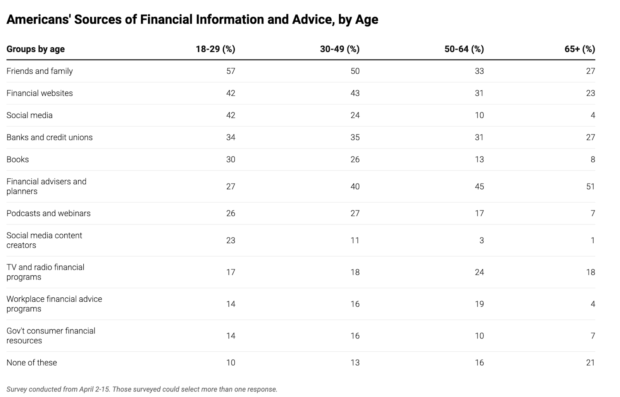
Drive Measurable Business Results: The ultimate goal of any marketing endeavor is to drive business results, and social media is increasingly proving its value in financial services. A Gallup poll reveals that 42% of Americans under 30 obtain financial advice from social media, with 23% following "finfluencers." Even clients already working with advisors are leveraging social media for additional financial planning insights (45% of U.S. consumers, according to an MDRT study). This demonstrates that social media is not just for awareness but plays a direct role in influencing financial decisions and guiding customers through their journey.
Optimizing Platform-Specific Strategies
The effectiveness of social media in financial services hinges on selecting the right platforms and tailoring content to their unique audiences and formats.
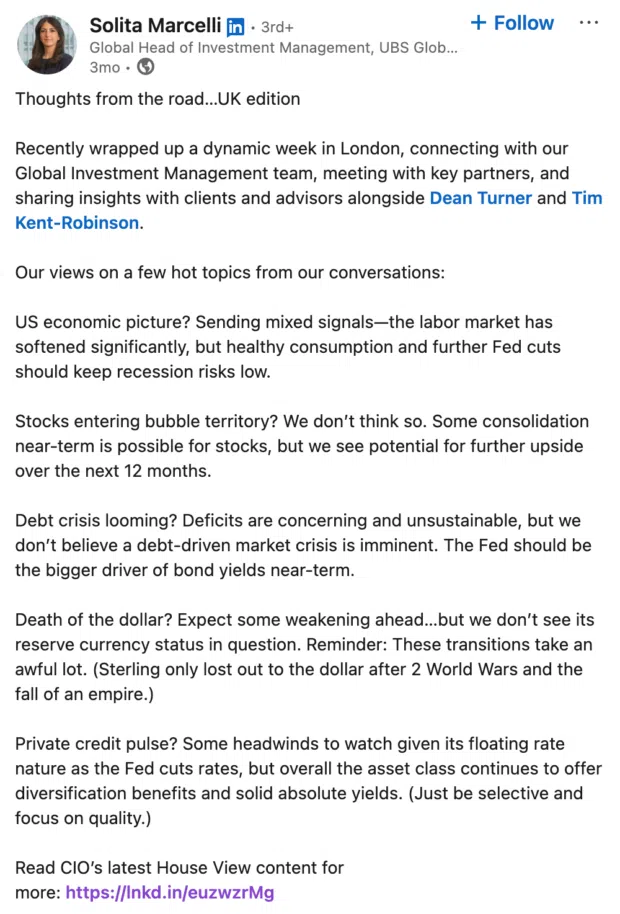
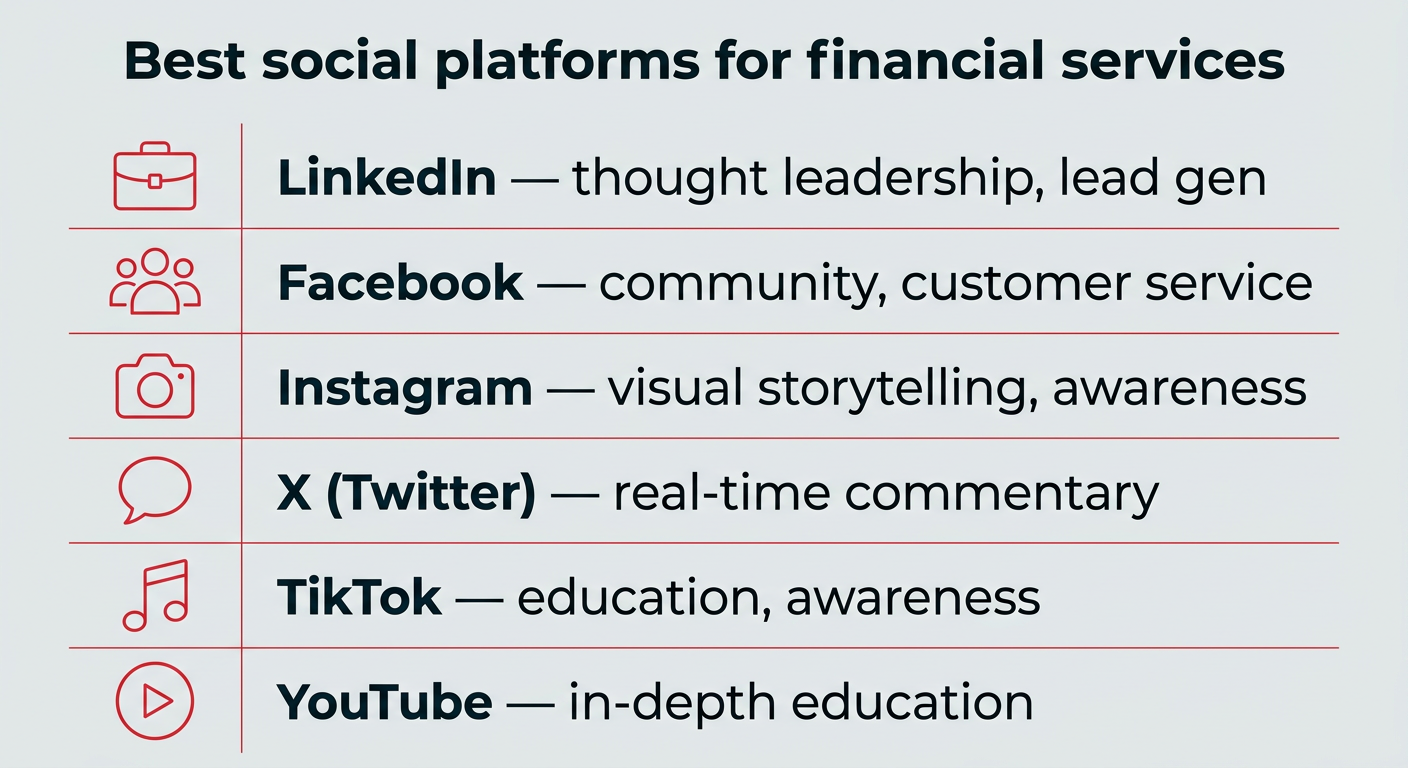
- LinkedIn: The premier platform for professional networking, LinkedIn boasts a community twice as likely to seek financial advice on the platform. It is ideal for thought leadership, B2B lead generation, showcasing company culture, and employee advocacy. Long-form articles, industry analyses, and executive insights thrive here, positioning brands and individuals as authoritative experts.
- Meta (Facebook & Instagram): Facebook remains the most-posted-to platform for financial institutions, excelling in community building, localized branch presence, and customer service. Its messaging capabilities make it a de facto support channel. Instagram, conversely, leads in engagement (3.8%) and follower growth (2.26%) within the financial services sector. It is perfect for visual storytelling, short-form video (Reels), brand awareness, and targeting younger demographics through engaging, aspirational content.
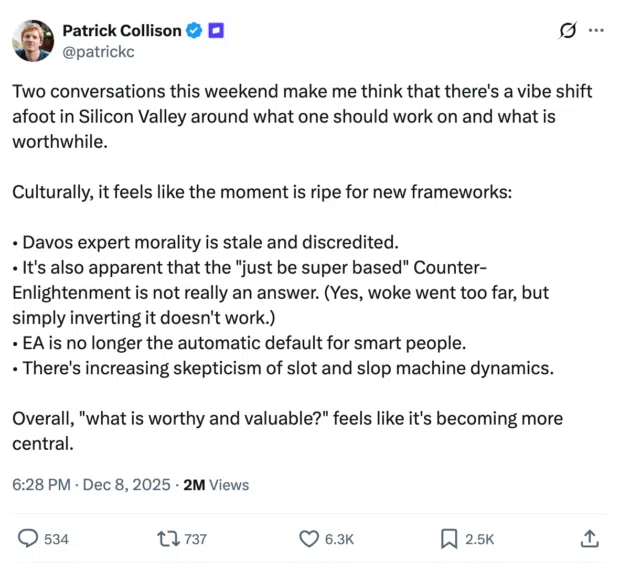
- X (Twitter): Known for its real-time nature, X is invaluable for breaking news commentary, rapid customer service responses, and participating in trending conversations. It allows financial brands to demonstrate agility, provide timely market reactions, and engage in direct, concise dialogue. Clear opinions and strong points of view, as exemplified by leaders like Stripe CEO Patrick Collison, often generate significant engagement.
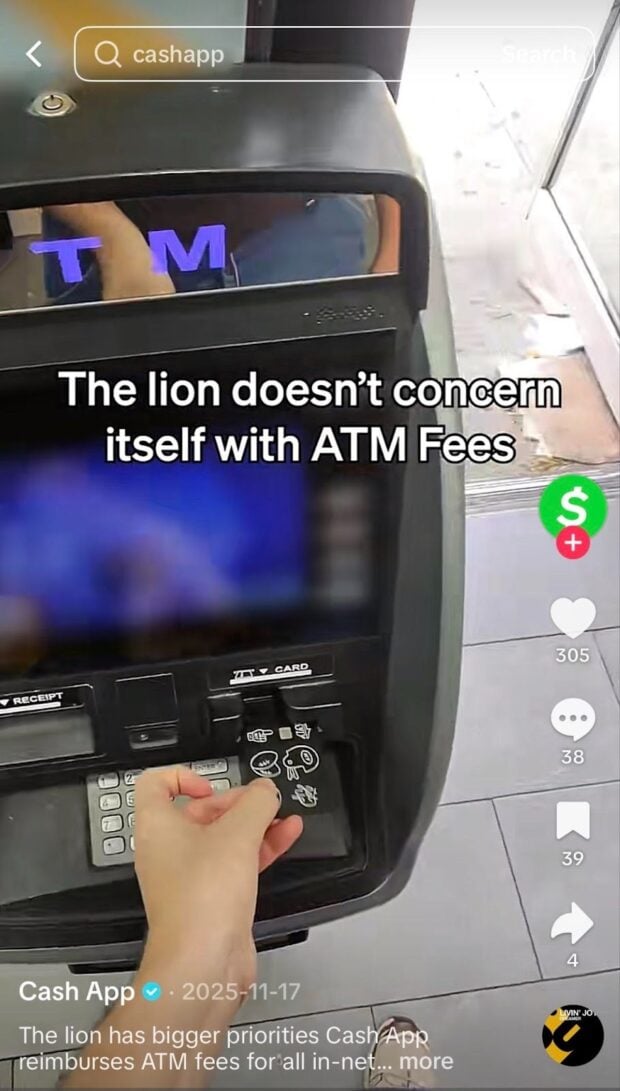
- TikTok: Rapidly gaining ground among Gen Z and younger Millennials, TikTok is a powerful platform for educational content delivered in an accessible, short-form video format. It allows brands to demystify complex financial topics with humor and relatable scenarios, like Cash App’s native-feeling content. While its regulatory status in some regions remains dynamic, a diversified strategy can leverage TikTok’s reach for awareness and education.
- YouTube: As the leading platform for long-form video, YouTube is ideal for in-depth explainers, webinars, tutorials, and podcasts. Its content has a longer shelf life and significant SEO value, making it a cornerstone for comprehensive financial education and trust-building, as seen with Coinbase’s educational webinars.
Performance Benchmarks and Measurement
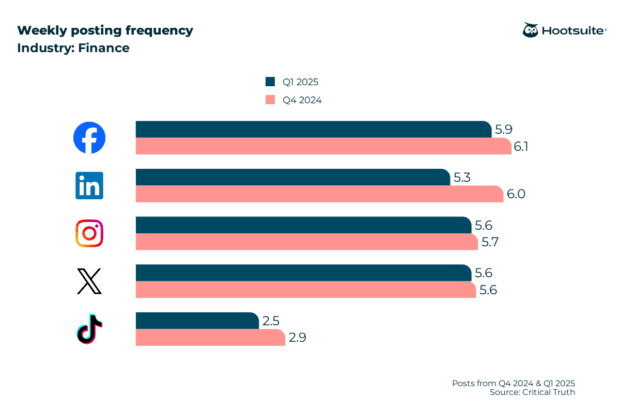
To gauge effectiveness, financial institutions must track performance against industry benchmarks. Based on early 2025 data, financial institutions post most frequently on Facebook (average 5.9 times/week), followed closely by Instagram (5.6 times/week) and LinkedIn (5.3 times/week). However, engagement rates vary significantly: Instagram leads with 3.8%, followed by LinkedIn at 3.2%, Instagram Reels at 3.1%, X (Twitter) at 2.1%, Facebook at 1.8%, and TikTok at 1.6%. Follower growth is highest on Instagram (2.26%), while X (Twitter) often sees 0% growth. These benchmarks serve as a starting point for optimizing posting frequency, content formats, and platform focus. Continuous A/B testing and analysis of network-specific data are crucial for refining strategy.
Crafting a Compliant and Effective Social Media Strategy
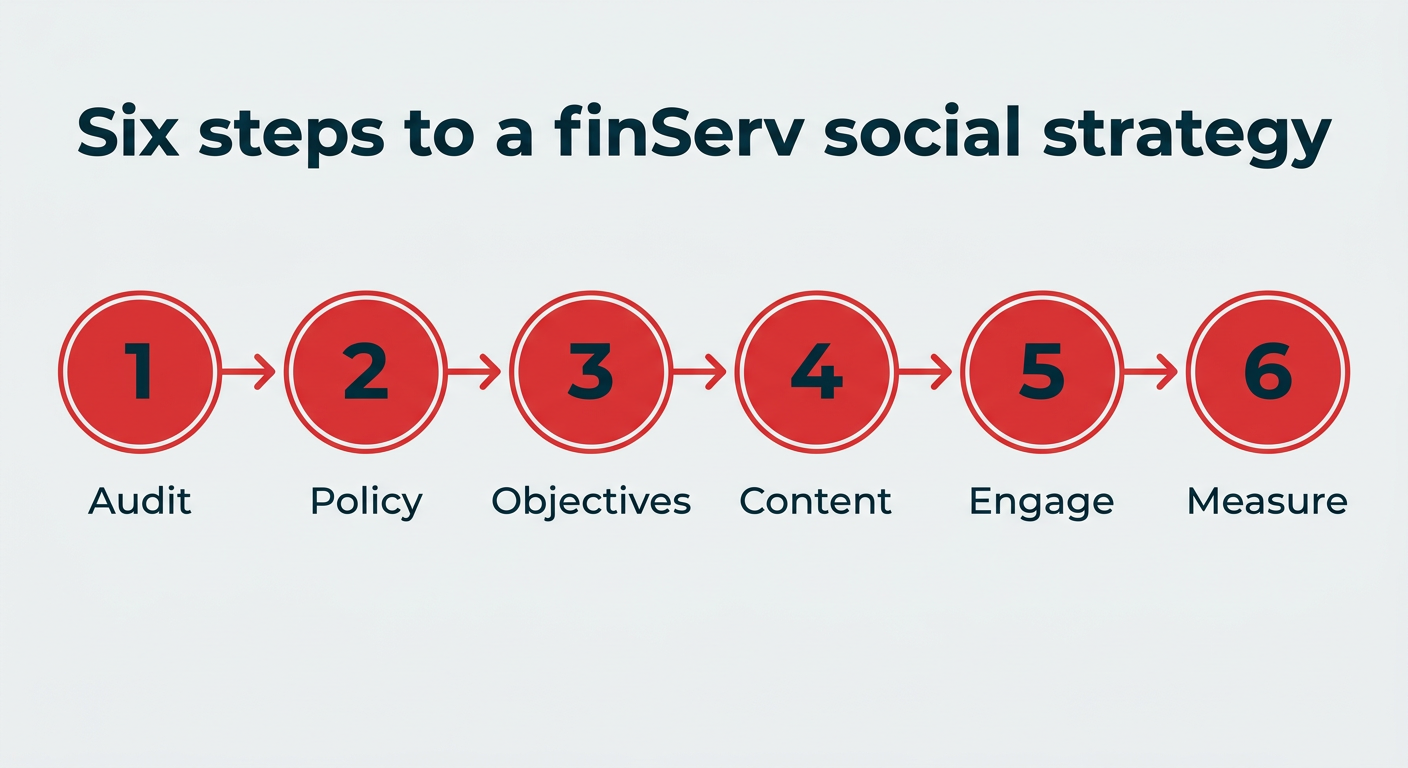
Developing a robust social media strategy in financial services requires a structured, multi-step approach:
-
Conduct a Thorough Social Media Audit: Begin by inventorying all existing social profiles—official brand accounts, departmental pages, and individual advisor accounts. Simultaneously, identify and address any imposter or unauthorized accounts. This audit should also identify platforms where a presence is lacking but might be strategically beneficial, securing brand handles even if immediate posting isn’t planned.
-
Implement a Comprehensive Social Media Policy: A clear and enforceable social media policy is the backbone of compliant operations. This policy must be developed in collaboration with key stakeholders including legal, compliance, marketing, human resources, and IT. It should define content guidelines, disclosure requirements, approval workflows, roles and responsibilities, personal vs. professional use, data privacy protocols, and security measures (e.g., password policies, access controls). Tools like Hootsuite’s Vigil compliance layer can help enforce these policies and approval chains.
-
Establish Clear Objectives and Define Your Target Audience: Before any content creation, articulate measurable goals tied to specific business outcomes (e.g., brand awareness, lead generation, customer service efficiency). Define granular audience segments—retail customers, high-net-worth individuals, B2B clients—and map their needs to appropriate platforms and content strategies. This ensures resources are allocated effectively.
-
Create Compliant, Engaging Content: Content must strike a delicate balance between education, engagement, and strict compliance. Tailor content to each platform’s strengths: long-form thought leadership for LinkedIn, visually rich stories for Instagram, and concise, timely updates for X. Leverage AI-powered tools for content ideation and drafting, and utilize platforms like Perch (within Hootsuite Social OS) for streamlined content planning and approval workflows, ensuring brand consistency and regulatory adherence.
-
Engage and Nurture Relationships: Publishing content is only half the equation; active engagement is paramount. Customers expect seamless communication on their preferred channels, including direct messages on Facebook or Instagram. Social customer service tools and unified customer care apps like Nest (in Hootsuite Social OS) integrate private messages, public comments, and mentions into a single workspace, often connecting with CRMs like Salesforce or Microsoft Dynamics. This provides context for personalized replies, ensures timely responses, and maintains compliant record-keeping.
-
Measure, Report, and Optimize: Continuously monitor performance against established goals, reporting key metrics like reach, engagement, lead generation, and response times to leadership. Social media analytics, such as those within Hootsuite Social OS, offer real-time insights to identify successful content, refine strategies, and demonstrate ROI. Treat the social media strategy as an iterative loop, constantly adapting to performance data and market shifts.
The Bedrock of Trust: Compliance and Risk Management
Compliance in financial services social media is non-negotiable, requiring adherence to a complex web of regulations and meticulous record-keeping.

-
Regulatory Requirements:
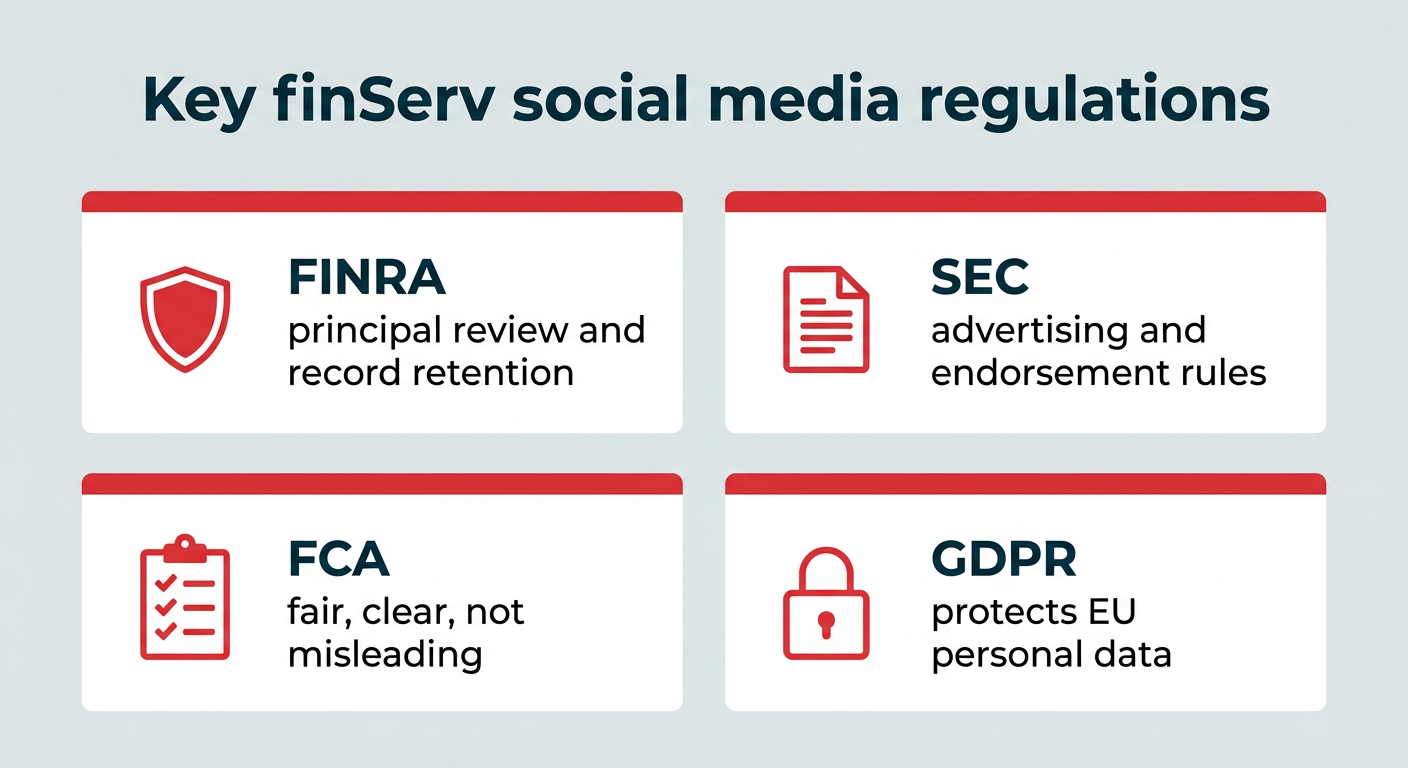
- FINRA (Financial Industry Regulatory Authority): In the U.S., FINRA governs broker-dealers, mandating that registered principals review business-related social media content before use and requiring archiving of all communications for at least three years.
- SEC (U.S. Securities and Exchange Commission): Oversees investment advisors and funds, requiring truthful and non-misleading communications, appropriate disclosures, and record retention.
- FCA (Financial Conduct Authority): In the UK, the FCA sets similar standards for financial firms, emphasizing clear, fair, and not misleading communications and robust record-keeping.
- GDPR (General Data Protection Regulation): Impacts any firm handling data of EU citizens, imposing strict rules on data privacy, consent, and protection, which directly applies to social media interactions.
- Other relevant regulations include FFIEC, IIROC, PCI, and AMF, each adding layers of complexity.
-
Archiving and Record-Keeping: Financial firms are legally obligated to retain records of all business-related communications, including social media interactions, for specified periods (e.g., three years for FINRA). Integrations with compliance solutions like Brolly and Smarsh, often found within platforms like Hootsuite, automatically archive all social media content, ensuring it is stored in a secure, searchable, and compliant database with full original context.
-
Social Media Risks and Challenges: Beyond regulatory non-compliance, financial services face several critical risks:
- Reputational Damage: A public misstep, poorly handled complaint, or controversial post can quickly erode public trust in a low-trust industry.
- Fraud and Impersonation: Scammers frequently create fake accounts mimicking legitimate brands or advisors to solicit sensitive information or perpetrate financial scams, causing direct harm to customers and brand reputation.
- Customer Privacy Violations: Accidental or intentional exposure of personal financial information on social media can lead to severe legal penalties, hefty fines, and a catastrophic loss of trust.
- Employee Misconduct: Unauthorized or non-compliant posts by employees, even on personal accounts that touch on business, can create significant liability.
Mitigating these risks requires a combination of robust governance frameworks, continuous monitoring, stringent access controls, and ongoing employee training.
Future Trajectories: Key Trends for 2026 and Beyond
The social media landscape for financial services is continually evolving, with several key trends shaping its future:
-
AI-Powered Content Creation and Social Intelligence: Artificial intelligence is revolutionizing how financial brands operate on social media. AI tools are accelerating content drafting, generating personalized messages, and optimizing posting schedules. Furthermore, advanced AI-driven social listening platforms like Lumen provide contextual intelligence, enabling teams to detect shifting sentiment, identify potential crises earlier, and understand complex market dynamics. AI orchestration layers, such as Wisdom in Hootsuite Social OS, connect these insights to actionable workflows, providing a significant advantage in a regulated industry where speed and compliance are paramount.
-
Short-Form Video and Creator Partnerships: The dominance of short-form video on platforms like TikTok, Instagram Reels, and YouTube Shorts continues to grow. Financial brands are increasingly leveraging this format to deliver digestible educational content. A significant aspect of this trend is the rise of "finfluencers"—personal finance content creators—whom 23% of Americans under 30 follow. Strategic partnerships with these trusted creators allow financial services firms to explain complex products in relatable language, reaching audiences who are often disengaged by traditional advertising. Authenticity and transparency are crucial for successful finfluencer collaborations.
-
Employee Advocacy as a Growth Channel: Financial services firms are increasingly recognizing the power of their employees’ voices. Advisors, branch managers, and executives who share compliant, pre-approved content on their personal social media profiles are often perceived as more credible and relatable than corporate accounts. Platforms like Parliament empower organizations to scale employee advocacy, providing ready-to-post content that maintains brand messaging and compliance. This approach transforms a large workforce into an authentic and effective growth channel, extending reach and deepening trust.
Illustrative Case Studies in Action
Successful social media marketing campaigns in financial services consistently prioritize education, authentic storytelling, and unwavering consistency.
-
Current x MrBeast: Current, a mobile banking services provider, effectively built brand awareness by partnering with high-profile influencers. Their collaboration with YouTube sensation MrBeast resulted in highly engaging social videos that significantly boosted app activity and visibility in the Apple App Store. This campaign succeeded by meeting a young audience on their preferred platform, leveraging a trusted creator to make the brand relevant and shareable.
-
BNY Mellon #DoWellBetter: BNY Mellon’s #DoWellBetter campaign highlighted the positive societal impact of its clients through compelling portraits and video interviews. This initiative demonstrated how intelligent investing and thoughtful wealth management could drive positive change. The campaign resonated by using real client stories to forge an emotional, human connection, moving beyond purely product-focused messaging.
-
Vanguard Group #GettingSocial: Investment giant Vanguard Group maintains a weekly social video series, #GettingSocial, offering clear and helpful insights into investing and financial topics. The campaign’s strength lies in its consistency, establishing a regular cadence that encourages followers to return for valuable, concise takeaways. This approach positions Vanguard as a reliable educational resource and reinforces trust. Additionally, Vanguard complements this organic content with targeted social ads, creating a synergistic effect between educational and conversion-oriented messaging.
In conclusion, social media is no longer an optional appendage for financial services but a fundamental component of a comprehensive digital strategy. While the regulatory environment presents unique challenges, the immense opportunities for audience engagement, trust-building, and business growth are undeniable. By adopting a disciplined, compliant, and integrated approach, leveraging advanced tools, and embracing evolving trends, financial institutions can successfully navigate the complexities of social media to drive meaningful and sustainable results.