The Evolution and Cultural Impact of the My City Now Meme From 4chan Roots to Mainstream Fandom Lexicon

The digital landscape is a vast ecosystem where vernacular, imagery, and humor constantly evolve through crowdsourced participation. Among the enduring artifacts of early 2010s internet culture is "My City Now," an image macro, exploitable, and catchphrase that has quietly permeated various digital enclaves for well over a decade. Originating from an obscure, poorly rendered parody thread on the imageboard 4chan, the phrase and its accompanying low-fidelity graphic have transitioned into a versatile shorthand for dominion, territorial claim, and the rejection of established narratives across platforms like Tumblr, Reddit, and Archive of Our Own (AO3).
To understand the longevity of "My City Now," one must examine its humble beginnings in the subcultural fringes of anime fandom, its organic spread across multiple social media networks, and its transformation into a flexible psychological and cultural signifier used by netizens to express creative autonomy.
Chronology and Origins on 4chan
The genesis of "My City Now" dates back to February 2011, a period characterized by rapid meme generation and the cross-pollination of niche fandoms on anonymous imageboards. Specifically, the meme emerged from the /a/ (anime and manga) board on 4chan during a user-generated retelling of the critically acclaimed psychological thriller anime series Puella Magi Madoka Magica.
The source material, Puella Magi Madoka Magica, premiered in late 2010 and quickly became a cultural touchstone for its deconstruction of the magical girl genre. By February 11th, 2011, users on 4chan organized a collective storytelling exercise that spanned five separate threads, comprehensively covering the narrative arc of the show. However, this retelling—subsequently archived and cataloged by internet historians as Meduka Meguca—was defined by an intentionally crude aesthetic. Participants utilized low-quality, heavily compressed animation frames borrowed from the series and paired them with deliberately atrocious spelling, grammar, and syntax. Character names, specialized terms, and dialogue were intentionally butchered for comedic effect, resulting in a surreal, parodic low-effort pastiche.
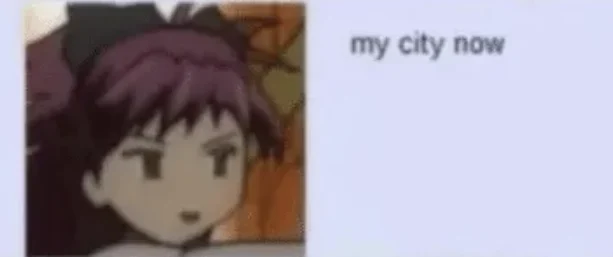
Within these threads, a specific panel featuring a poorly cropped, heavily pixelated image of the character Kyoko Sakura alongside the raw, uncapitalized declaration "my city now" struck a chord with the community. While the Meduka Meguca project as a whole became a legendary piece of internet lore, this singular panel possessed a unique modularity. It captured a raw, aggressive, yet inherently humorous assertion of ownership that transcended the specific context of the Madoka Magica parody.
Transition to Tumblr and the Mechanics of Decontextualization
As is common with resilient internet memes, "My City Now" eventually bled out of its insular 4chan environment and found a second life on Tumblr, a platform renowned for its affinity for reaction images, surreal humor, and fandom subcultures. Throughout the mid-2010s, users began employing the low-resolution Kyoko Sakura image completely out of its original context.
The meme’s utility lay in its dual interpretation: it could be used literally to signify a user being home alone and feeling a comedic sense of absolute rule over their immediate living space, or metaphorically to represent a hostile takeover of a conversation, a concept, or a digital territory.
Between 2016 and early 2017, the meme achieved a new level of viral visibility when Tumblr user tempestrune paired the reaction image with an absurd photograph of a restaurant roadside sign reading, "GET BIG SANDWICH YOUR CITY NOW." This juxtaposition—melding mundane corporate fast-food advertising with an aggressive, low-quality anime reaction macro—cemented the phrase’s potential for surrealist humor.
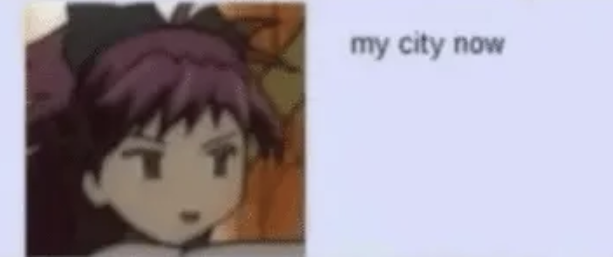
By the late 2010s, the application of "My City Now" had diversified significantly. Users across Reddit and Tumblr began adapting the macro to comment on institutional irony, historical shifts, and creative subversion. In May 2017, a Reddit user deployed the image to mock public discourse surrounding actor Mark Hamill’s complex relationship with the Star Wars franchise and Disney’s corporate control over canon. Subsequent viral iterations utilized the macro to humorously depict historical epochs, such as the ancient Roman practice of absorbing foreign deities into their domestic pantheon ("my gods now"), or the internal monologue of pet owners observing human evolutionary history.
Fandom Subcultures and the "Fuck Canon" Phenomenon
Perhaps the most culturally significant evolution of the "My City Now" phenomenon manifests within literary and fan-fiction communities, most notably on the archival platform Archive of Our Own (AO3). In April 2024, discussions on Reddit highlighted the widespread adoption of the tagging convention "Fuck Canon My City Now" (and variations thereof) within fan-fiction categorization.
In the context of serial storytelling, "canon" refers to the officially accepted material established by an original author or copyright holder. Within fandom spaces, tensions frequently arise when official narratives alienate consumers—through controversial character deaths, unsatisfying endings, or perceived declines in writing quality. The adoption of the "My City Now" ethos functions as a direct ideological rejection of these constraints.
When a creator tags a work with variations of the phrase, they are signaling an active departure from established continuity in favor of headcanons, alternate universes (AUs), and personal reinterpretations. Media analysts note that this trend reflects a broader shift in modern media consumption: audiences no longer view themselves as passive consumers of monolithic corporate media products, but rather as active participants capable of subverting, rewriting, and claiming ownership over intellectual properties. The phrase effectively encapsulates the modern fandom sentiment of "I reject your reality and substitute my own," transforming passive disappointment into active, localized creative reclamation.
Broader Impact and Digital Semiotics
The longevity of "My City Now" offers valuable insights into digital semiotics and the life cycle of internet memes. Unlike algorithmic trends driven by short-form video platforms that spike and vanish within days, text-and-image macros originating from early-2010s message boards often possess a structural resilience rooted in their versatility.
Communication scholars observing internet vernacular point out that phrases like "My City Now" function similarly to traditional linguistic idioms. They provide netizens with a pre-packaged emotional and rhetorical package that communicates complex attitudes—such as satirical territorialism, playful arrogance, or creative rebellion—with minimal cognitive overhead. The intentional degradation of the image quality—retaining the pixelation and compressed artifacts of the 2011 4chan thread—serves as a visual badge of authenticity, signaling the user’s affiliation with deep-internet history and lore.
Furthermore, the migration of the meme across diverse demographic groups—from anonymous imageboard users to mainstream Reddit communities and progressive fandom spaces on Tumblr and AO3—demonstrates the fluid boundaries of contemporary digital culture. Users who deploy the phrase today frequently have no historical awareness of Puella Magi Madoka Magica or the specific nuances of the 2011 Meduka Meguca threads. Instead, the meme has achieved a state of cultural autonomy, sustained entirely by the communicative power of its core message.
Conclusion
More than a decade after its accidental inception on an anonymous forum board, "My City Now" remains a fascinating case study in digital folklore. What began as a poorly spelled, low-resolution parody of a magical girl anime has matured into a flexible linguistic and visual tool for expressing autonomy, humor, and resistance to established authority. Whether used to joke about being home alone, mock corporate media management, or boldly rewrite the canon of a beloved fictional universe, the meme endures as a testament to the creativity of internet communities who continually shape, reshape, and claim digital spaces as their own.
Related posts: