LimeWire Redefined: The Evolution of a Digital Icon into a Generative AI Content Powerhouse

The digital landscape is currently witnessing a paradigm shift in how creative content is produced, distributed, and monetized. LimeWire, a brand once synonymous with the peer-to-peer file-sharing era of the early 2000s, has successfully completed a comprehensive pivot, re-emerging as a sophisticated generative AI studio and content publishing platform. By integrating advanced machine learning models with blockchain-based ownership structures, the platform aims to provide a bridge between the burgeoning world of artificial intelligence and the creator economy. This transformation represents one of the most significant brand rehabilitations in recent tech history, shifting from a controversial file-sharing utility to a structured ecosystem designed for professional and amateur creators alike.
A Chronology of Transformation: From P2P to AI Innovation
The history of the LimeWire brand is marked by two distinct eras. From its inception in 2000 until its court-mandated shutdown in 2010, the original LimeWire software was a primary vehicle for the decentralized distribution of digital files, eventually succumbing to legal challenges regarding copyright infringement. The hiatus lasted over a decade. In 2022, the brand was acquired by brothers Julian and Paul Zehetmayr, who sought to leverage the brand’s high name recognition for a new venture.
The relaunch was not a return to the platform’s roots, but an entirely new technological architecture. The company initially focused on the NFT marketplace sector, capitalizing on the peak of digital collectibles. However, recognizing the rapid acceleration of generative AI, the leadership pivoted toward the LimeWire AI Studio. This strategic evolution allowed the platform to move beyond simple asset trading, providing users with the tools to generate the content that would ultimately populate its marketplace.
Current Capabilities and Technical Infrastructure
At the core of the modern LimeWire platform is its AI Studio, which provides users with access to industry-standard generative models. By integrating Stable Diffusion 2.1, Stable Diffusion XL, and DALL-E 2, the platform offers a multifaceted approach to image synthesis. The technical integration allows users to experiment with various artistic styles, ranging from photorealistic and cinematic renderings to stylized anime and pixel art, without requiring a local high-performance GPU.
The platform’s user interface acts as an abstraction layer over these complex models, enabling both novice users and experienced digital artists to iterate on visual concepts through text-based prompts. Beyond the generation process, the platform incorporates sophisticated samplers and refinement tools that allow for granular control over the final output. The company has publicly disclosed plans to release a proprietary AI model, signaling a move toward vertical integration to reduce reliance on third-party APIs and improve speed and output consistency.
The Monetization Model and Blockchain Integration
LimeWire’s business model is built on the premise that digital content should be both liquid and profitable for the creator. Unlike traditional social media platforms where monetization is often indirect or heavily mediated by platform-wide algorithms, LimeWire utilizes blockchain technology to ensure direct value capture.
When a user publishes content—whether an AI-generated image or, in the near future, music and video—the platform automatically mints that asset as an NFT on either the Polygon or Algorand blockchains. This process provides a cryptographically verifiable proof of ownership and authenticity. By recording these assets on a distributed ledger, the platform enables a secondary market. A key feature for creators is the 2.5% royalty structure, which ensures that original authors receive a commission every time their work is traded between collectors.
The platform’s revenue-sharing mechanism is particularly notable for its integration of the native LMWR token. By rewarding users with 50% to 70% of the ad revenue generated by their content views, LimeWire incentivizes high-quality contributions. These earnings are disbursed in LMWR, a utility token that can be traded on major global exchanges such as Kraken and ByBit, or reinvested back into the platform to purchase additional generation credits.
Data-Driven Analysis of the Creator Economy
The rise of platforms like LimeWire coincides with a broader market trend: the professionalization of generative AI. According to industry analysis from firms like ARK Invest, the integration of AI tools into content workflows is expected to increase the productivity of creative professionals by up to 10 times over the next five years. LimeWire is positioning itself to capture this demographic by offering a "freemium" entry point.
The current pricing structure is tiered to accommodate different levels of output. A free-tier user receives 10 credits daily, sufficient for approximately 20 image generations, while professional tiers (ranging from $9.99 to $99.00 per month) offer significantly higher credit limits, access to faster processing speeds, and larger shares of ad revenue. This tiered approach is a standard industry practice, yet the inclusion of blockchain royalties sets it apart from subscription-only services like Midjourney or Adobe Firefly.
Industry Implications and Future Roadmap
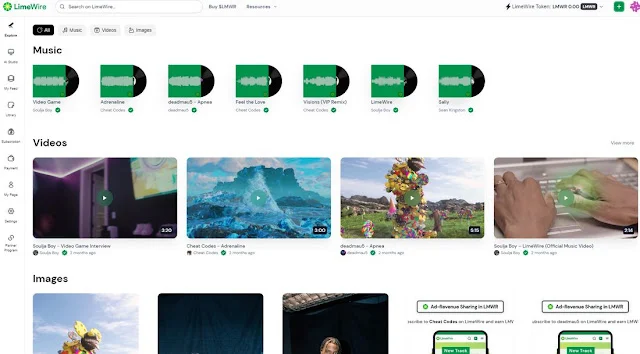
The implications of LimeWire’s model extend beyond individual creators. By providing a curated space where artists like Deadmau5 and Soulja Boy can distribute NFT-based music and imagery, the platform is attempting to solve the "discoverability" problem that plagues decentralized NFT markets. By blending the social features of a content-sharing network with the utility of an AI studio, LimeWire is effectively creating a closed-loop economy.
However, the platform faces significant challenges in an increasingly competitive landscape. As giants like Google, Meta, and OpenAI continue to refine their own generative tools, the "platform-as-a-service" model for AI creation must continuously innovate to retain users. The upcoming rollout of AI-driven music and video generation tools will be the true test of LimeWire’s scalability. If successful, these tools could lower the barrier to entry for independent musicians and filmmakers in the same way its image generator has for digital artists.
The ethical considerations of AI-generated content also remain a primary concern for the company. As the industry grapples with copyright issues surrounding training data, LimeWire must maintain rigorous compliance standards to ensure that its platform remains a viable long-term home for creative professionals. The shift toward a proprietary model may assist in this regard, as it allows the company more control over the provenance of its training data.
Conclusion: A New Chapter in Digital Creativity
LimeWire’s evolution serves as a case study in the resilience of digital brands. By shedding its association with legacy file-sharing and embracing the structural shift toward artificial intelligence and decentralized finance, the platform has successfully reinvented its value proposition.
The integration of AI-powered creation tools, automated NFT minting, and a crypto-based revenue-sharing system creates a comprehensive environment for digital expression. While the platform continues to expand its feature set to include video and audio, its current success hinges on its ability to democratize high-end creative tools for a global audience. Whether LimeWire will become the definitive home for AI-generated media remains to be seen, but its current trajectory suggests a significant role in the ongoing transformation of the digital creator economy. As the technology matures, the platform stands as a primary example of how legacy tech brands can successfully transition into the era of artificial intelligence.