Meta Expands Test Limiting Non-Paying Professional Facebook Accounts to Two Link Posts Per Month Following Meta One Launch

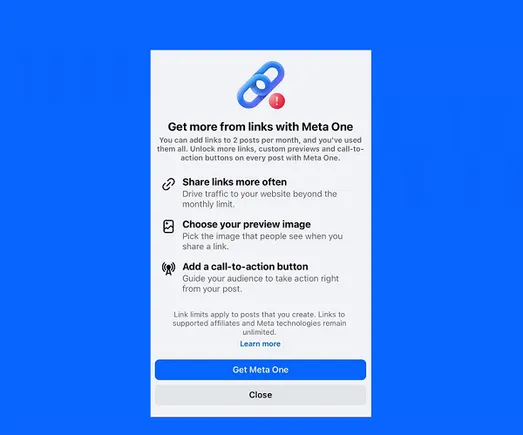
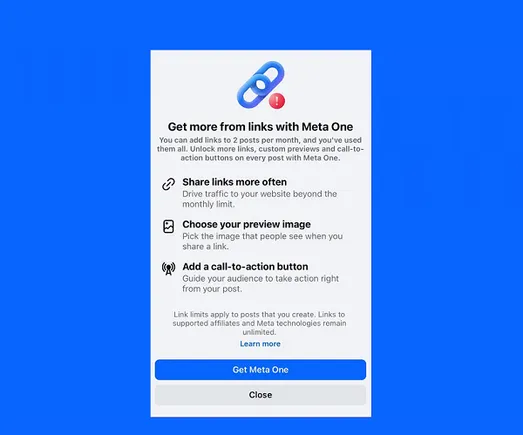
Meta is escalating its efforts to monetize professional features across its social media ecosystem, with a growing number of Facebook Pages reporting restrictions on external link sharing. Following the rollout of the Meta One for Business paid subscription packages, social media managers have increasingly encountered platform notifications limiting unpaid professional accounts to just two link-containing posts per month. This development signals a broader integration of Meta’s testing phase into its commercial subscription tier, forcing businesses and content creators to reevaluate their organic distribution strategies on the platform.
The expansion of this policy follows the initial debut of Meta One for Business, a tiered subscription model designed to offer enhanced functionality to professional accounts, including monthly allocations for external links on Instagram posts and Reels. While Facebook link restrictions were not formally listed among the core features of the initial subscription tiers upon launch, recent user reports indicate that the feature is actively rolling out as a mechanism to drive subscription adoption among non-paying business accounts.
Background Context and Evolution of the Link Restriction Policy
The restriction of external links on professional Facebook Pages is not entirely unprecedented. In December 2025, Meta initiated a limited pilot program that restricted select business pages to a maximum of two link posts per month. At the time, the tech conglomerate stated that the pilot was designed to evaluate whether permitting an increased volume of outbound links added tangible value for users, while maintaining a healthy ecosystem of content within the feed.
Crucially, Meta’s initial iteration of the test included explicit exemptions for publisher pages, ensuring that news organizations and high-volume media outlets could continue distributing external content without interruption and maintain the standard flow of information on the application. However, as the newly introduced Meta One for Business subscription packages take effect, the test appears to be transitioning from a restricted trial into a more widespread operational framework for commercial accounts.
For years, the ability to share external URLs freely has been a cornerstone of digital marketing, enabling brands, publishers, and e-commerce enterprises to drive web traffic directly from social media platforms. The systematic restriction of this capability to paid tiers represents a significant pivot in how Meta manages the relationship between organic business activity and platform monetization.
Chronology of Meta’s Commercialization Strategy
To understand the current shift toward paywalled features, industry analysts frequently reference Meta’s long-term commercialization blueprint. Dating back to 2016, Meta CEO Mark Zuckerberg outlined a structured three-stage monetization strategy for the company’s family of apps.
The first stage involves building utility and driving massive consumer adoption, establishing the platform as an indispensable communication tool. The second stage focuses on organically growing engagement and scaling the user base to critical mass. The third and final stage centers on systematically unlocking monetization vectors by introducing paid utility, advanced business tools, and targeted advertising frameworks.
The rollout of Meta One for Business aligns directly with this historical trajectory. By initially offering robust, uninhibited business tools at no cost for over a decade, Meta cultivated an entire ecosystem of businesses dependent on Facebook for customer acquisition. Now, as organic reach continues to shift toward paid models, businesses are increasingly asked to shoulder subscription costs to maintain standard marketing workflows.
Data and Insights: The Declining Reach of Link Posts on Facebook

Despite the operational friction these restrictions may cause for social media managers, platform metrics suggest that the practical impact on overall audience reach may be more psychological than functional. Meta’s own transparency data reveals a profound, multi-year decline in the organic visibility of link-containing posts across its network.
According to Meta’s Widely Viewed Content report for the first quarter of 2026, a staggering 98.7% of all post views in the United States during that period did not include an external link to a destination outside of Facebook. Outbound link posts accounted for a minuscule 1.3% of total viewed content—a dramatic drop from historical highs. When Meta first began publishing transparency metrics in 2022, external links comprised approximately 9.8% of viewed content, illustrating a steady, algorithmic deprioritization of outbound URLs over a four-year period.
Algorithmic Shift Toward Native Content
The systematic deprioritization of links is not accidental. Meta’s ranking algorithms have consistently favored native content—such as text updates, native video, Reels, and photo carousels—that keeps users engaged within the platform environment, rather than directing them to external websites.
Because the algorithm already suppresses the reach of posts containing external links, marketing professionals have long argued that organic link posts yield diminishing returns. Consequently, industry analysts suggest that limiting unpaid accounts to two link posts per month may have a negligible impact on the overall visibility of brands that have already diversified their content mix to emphasize native video and community engagement.
Implications for Businesses and Digital Marketers
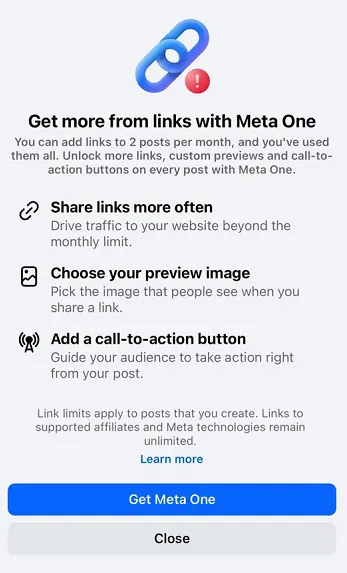
The formal integration of link restrictions into the Meta One for Business subscription model forces brands to weigh the cost-benefit ratio of paid platform access. For small- and medium-sized enterprises (SMEs) that rely heavily on driving direct traffic to e-commerce stores, blogs, or booking portals via organic social media posts, the new policy introduces an added operational expense.
Social media managers now face three primary strategic alternatives:
- Subscribe to Meta One for Business: Organizations can absorb the recurring subscription fee to secure the higher monthly limits for link posts across Facebook and Instagram.
- Pivot to Native Content Strategies: Brands can restructure their publishing schedules to maximize native engagement, utilizing Reels, stories, and text-based updates to build brand awareness while reserving limited link posts for high-priority conversion campaigns.
- Leverage Paid Advertising: Rather than investing in subscription packages, businesses can allocate budgets toward Meta’s traditional advertising auction products, which continue to offer robust link-click capabilities and targeted audience delivery.
Industry Reaction and Broader Market Context
The reaction from the digital marketing community has been mixed. While many professionals view the shift as an aggressive monetization tactic—often characterized as a classic "bait-and-switch" approach to commercial platform utility—others view it as an inevitable maturation of social media business models.
As major platforms grapple with slowing user growth in saturated markets and mounting pressure from investors to diversify revenue streams beyond traditional digital advertising, subscription services have become the industry standard. Platforms ranging from X (formerly Twitter) to LinkedIn and TikTok have increasingly introduced tiered pricing structures for advanced professional and creator tools.
Meta’s introduction of Meta One for Business, coupled with the enforcement of link post caps, underscores a broader economic reality: the era of completely free, unrestricted business utility on major social media networks is rapidly drawing to a close. Whether businesses choose to absorb the cost of subscriptions or adapt their strategies to navigate algorithmic limitations, the rules of organic social media marketing are undergoing a fundamental transformation.
Related posts: