Ollama Brings Real-Time Text-to-Speech to Apple Silicon Macs with Native MLX Integration


The landscape of local artificial intelligence development shifted significantly today as Ollama, the wildly popular open-source platform for running localized machine learning models, announced full native support for text-to-speech generation. Rolling out initially for macOS users via the platform’s Apple Silicon optimization framework, the update marks a major milestone for Ollama, expanding its core capabilities far beyond traditional text-based large language models (LLMs). By integrating advanced audio synthesis directly into local hardware workflows, the platform continues to bridge the gap between heavy enterprise-grade AI infrastructure and consumer-level desktop computing.
The initial rollout introduces support for Phonon, a state-of-the-art family of compact text-to-speech models developed by Gradium. Designed to operate with high efficiency on edge devices, these models enable local audio generation without relying on cloud-based APIs, remote servers, or persistent internet connections. According to development roadmaps released alongside the update, accompanying support for Windows and Linux operating systems is currently in active development and will be released in subsequent updates.
Background Context and the Rise of Localized AI Infrastructure
To understand the weight of this development, one must examine the meteoric rise of Ollama within the global developer community. Launched as a streamlined utility for deploying open-weight machine learning models directly onto personal computers, Ollama quickly captured the imagination of software engineers, hobbyists, and researchers alike. On GitHub, the project has amassed nearly 185,000 stars and approximately 18,600 forks, positioning it as one of the most widely adopted developer tools in the contemporary AI ecosystem.

Historically, running advanced generative artificial intelligence required expensive cloud-based graphic processing units (GPUs) hosted by major technology conglomerates. While these remote servers offered immense computational power, they introduced significant privacy concerns, data governance issues, and persistent subscription costs. Ollama disrupted this paradigm by allowing users to download open-source models—originating from repositories such as Hugging Face—and execute them locally. This local-first approach guarantees complete data privacy, offline usability, and zero latency fees, making artificial intelligence accessible to anyone with competent hardware.
The addition of speech synthesis represents a natural evolutionary step for the platform. As voice-driven interfaces, conversational agents, and accessibility tools become standard requirements for modern software applications, developers increasingly require multimodal local capabilities. By moving text-to-speech processing off remote servers and onto local silicon, Ollama empowers developers to build completely offline, voice-enabled AI applications that respect user privacy down to the audio wave level.
Technical Architecture: Leveraging Apple’s MLX Framework
A critical factor driving the performance of Ollama’s new text-to-speech feature on macOS is its deep integration with MLX, Apple’s open-source machine learning framework specifically engineered for Apple Silicon architecture. Traditional cross-platform machine learning frameworks often struggle to extract maximum performance from custom system-on-chips (SoCs) like Apple’s M-series processors. In contrast, MLX is built from the ground up to take full advantage of Apple Silicon’s unified memory architecture.
The unified memory design allows the CPU, GPU, and Neural Engine to share a single pool of high-bandwidth memory. This architectural advantage eliminates the traditional bottleneck of copying data back and forth between system RAM and discrete VRAM. Consequently, large machine learning models—and now, complex text-to-speech synthesis networks—can execute with remarkable speed and minimal energy consumption.
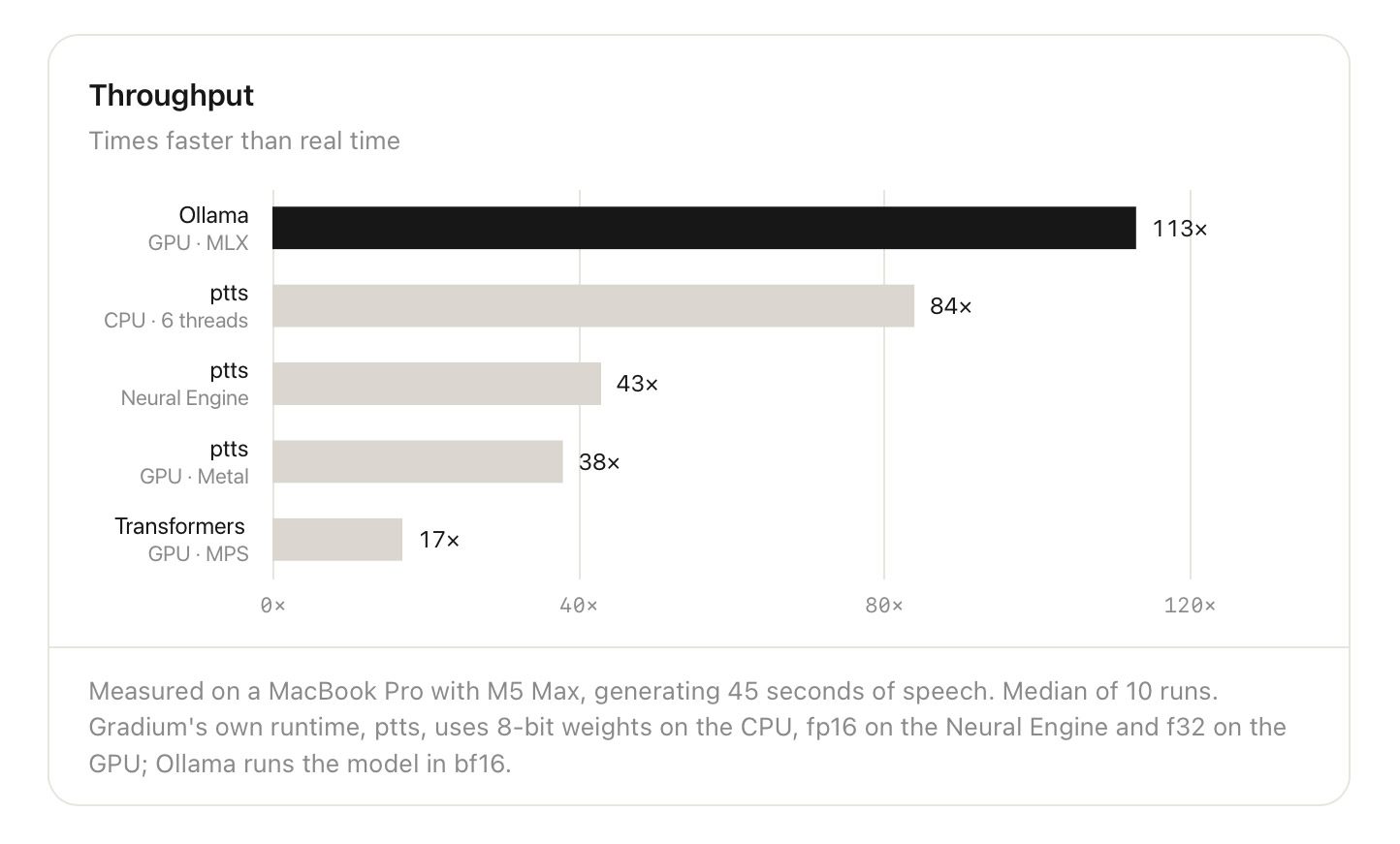
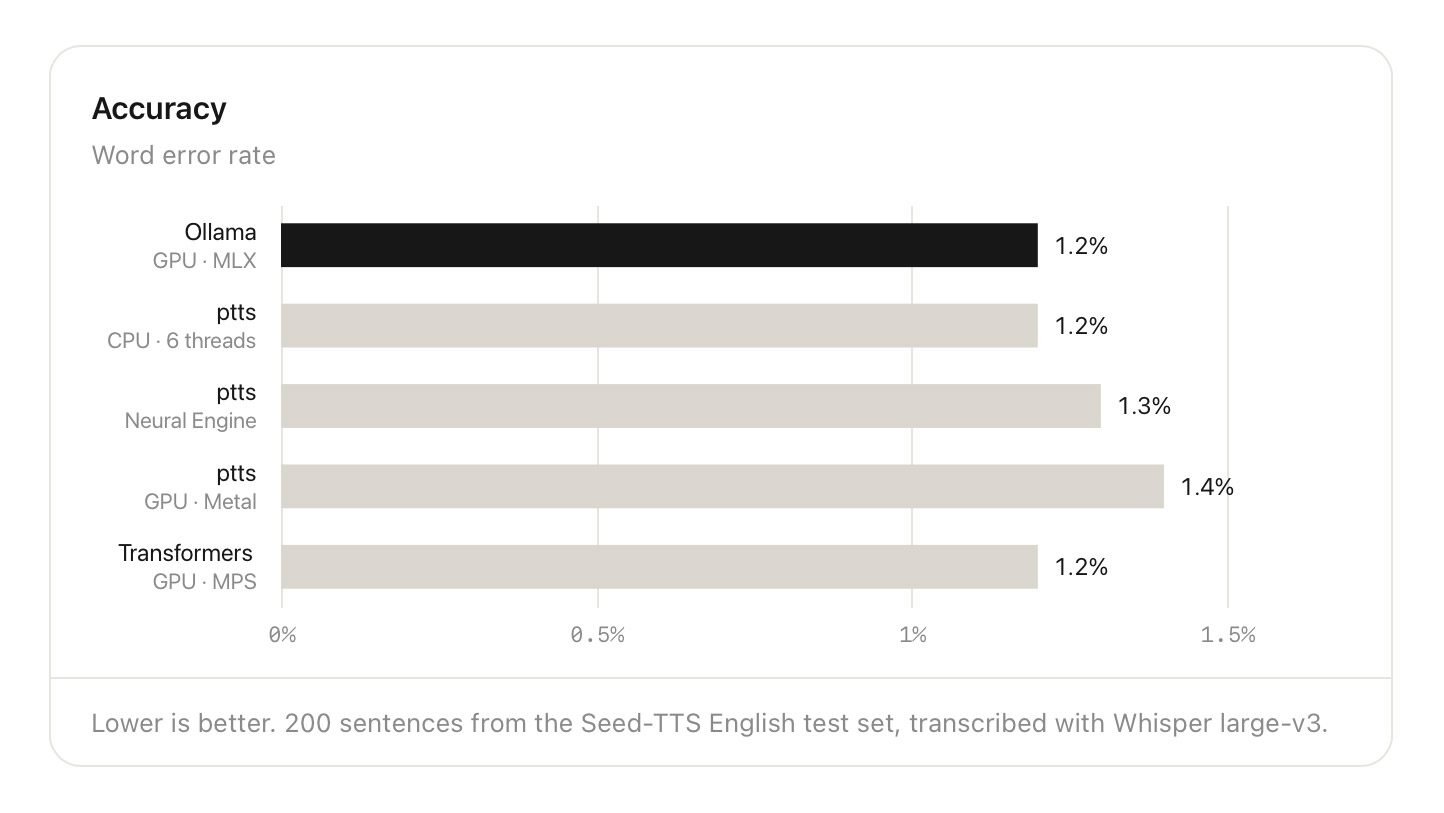
In performance benchmarks published by the Ollama team, the benefits of this native integration are stark. During rigorous evaluations conducted on a MacBook Pro equipped with an M5 Max processor, Ollama’s MLX-backed implementation of the Phonon speech models achieved a 35% increase in generation speed compared to Gradium’s native reference implementation. Crucially, this dramatic performance enhancement was achieved without sacrificing output fidelity, matching the word error rate benchmarks set by standard reference implementations in Hugging Face Transformers.
Furthermore, Ollama has engineered the system to generate speech in real time. Rather than forcing users to wait for an entire block of text to be fully processed before hearing any audio, the application begins streaming synthesized voice output dynamically as the model produces text tokens. This streaming capability is essential for fluid, natural-sounding conversational interfaces where lag between thought and speech must be kept to an absolute minimum.
Language Support, Voice Variety, and Accessibility
The newly integrated Phonon model family is designed to cater to a diverse global user base right out of the box. At launch, the speech models support five major languages: English, French, German, Spanish, and Portuguese. Gradium and Ollama have structured the release to include both dedicated, single-language models optimized for specific linguistic nuances, as well as a comprehensive multilingual model capable of seamlessly handling all five supported languages within a single workflow.
In addition to linguistic diversity, the platform offers users a variety of distinct vocal profiles and regional accents. Depending on the specific configuration chosen, users can select between American and British English accents, allowing for greater customization in application development. This flexibility ensures that developers can tailor the voice output to match the specific tone and persona of their local AI assistants.
The implications for accessibility are profound. By bringing high-quality, real-time voice synthesis to local environments, developers can create specialized assistive technologies for visually impaired users or individuals with reading difficulties without routing sensitive personal text data through third-party cloud transcription services. Because the entire pipeline runs locally on the device, medical, legal, or personal documents processed through the text-to-speech engine never leave the user’s hard drive.
Timeline, Availability, and Getting Started
The deployment of Ollama’s text-to-speech architecture follows a carefully coordinated release schedule. The feature is available immediately to users running macOS on Apple Silicon hardware, provided they update their software environment to Ollama version 0.40.11 or later.
To begin utilizing the new capabilities, developers and enthusiasts can pull the Phonon speech models directly through the command-line interface using standard Ollama syntax. Comprehensive documentation, code examples for API integration, and audio demonstration samples have been published on the official Ollama blog to assist developers in embedding real-time speech generation into their custom applications.
While the current release is strictly optimized for macOS and Apple Silicon, platform maintainers have confirmed that Windows and Linux integrations are progressing through final testing phases. Support for these operating systems—which will leverage alternative hardware acceleration frameworks such as CUDA for NVIDIA GPUs and DirectML—is slated for deployment in the near future.

Broader Industry Implications and Future Outlook
The introduction of native text-to-speech to a localized AI platform like Ollama signals a broader industry shift toward multimodal edge computing. For years, the conversation surrounding localized artificial intelligence has focused primarily on text generation, coding assistants, and small-scale image recognition. By successfully incorporating low-latency, high-accuracy audio synthesis into the local stack, projects like Ollama are proving that consumer hardware is fully capable of handling complex sensory tasks that were once the exclusive domain of massive data centers.
This decentralization of AI capabilities carries profound implications for software development economics. Independent developers and small startups can now build sophisticated, voice-interactive applications without incurring the recurring, scale-dependent API costs charged by major cloud providers. Furthermore, enterprises operating under strict data sovereignty regulations—such as those governing healthcare, finance, and government sectors—now have a viable, secure pathway to deploy fully conversational AI systems that operate entirely behind corporate firewalls.
As the open-source community continues to refine model architectures like Phonon and hardware manufacturers push the boundaries of on-device neural processing, the line between cloud-hosted intelligence and local computing will continue to blur. With Ollama leading the charge on desktop platforms, the future of artificial intelligence is increasingly local, private, and vocal.