Google Rolls Out Immersive Explorations for Gemini Student Hub, Offering Layered Visual Learning

Google has officially introduced a groundbreaking educational feature titled "Immersive Explorations" to the Gemini student hub, signaling a significant shift in how artificial intelligence can be leveraged for interactive digital learning. Designed to move students away from traditional, text-heavy study materials, the new feature enables users to explore complex concepts layer-by-layer through interactive, high-resolution visuals.
The rollout represents the latest expansion in Google’s ongoing initiative to integrate advanced generative artificial intelligence tools into educational environments worldwide. By blending detailed visual breakdowns with concise explanatory text, the tech giant aims to transform how students interact with difficult subjects across the natural sciences, astronomy, and biology.
Main Facts and Core Mechanics of Immersive Explorations
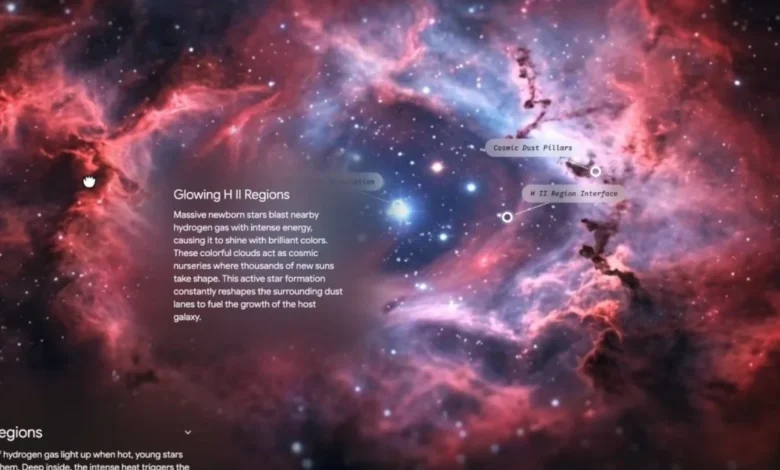
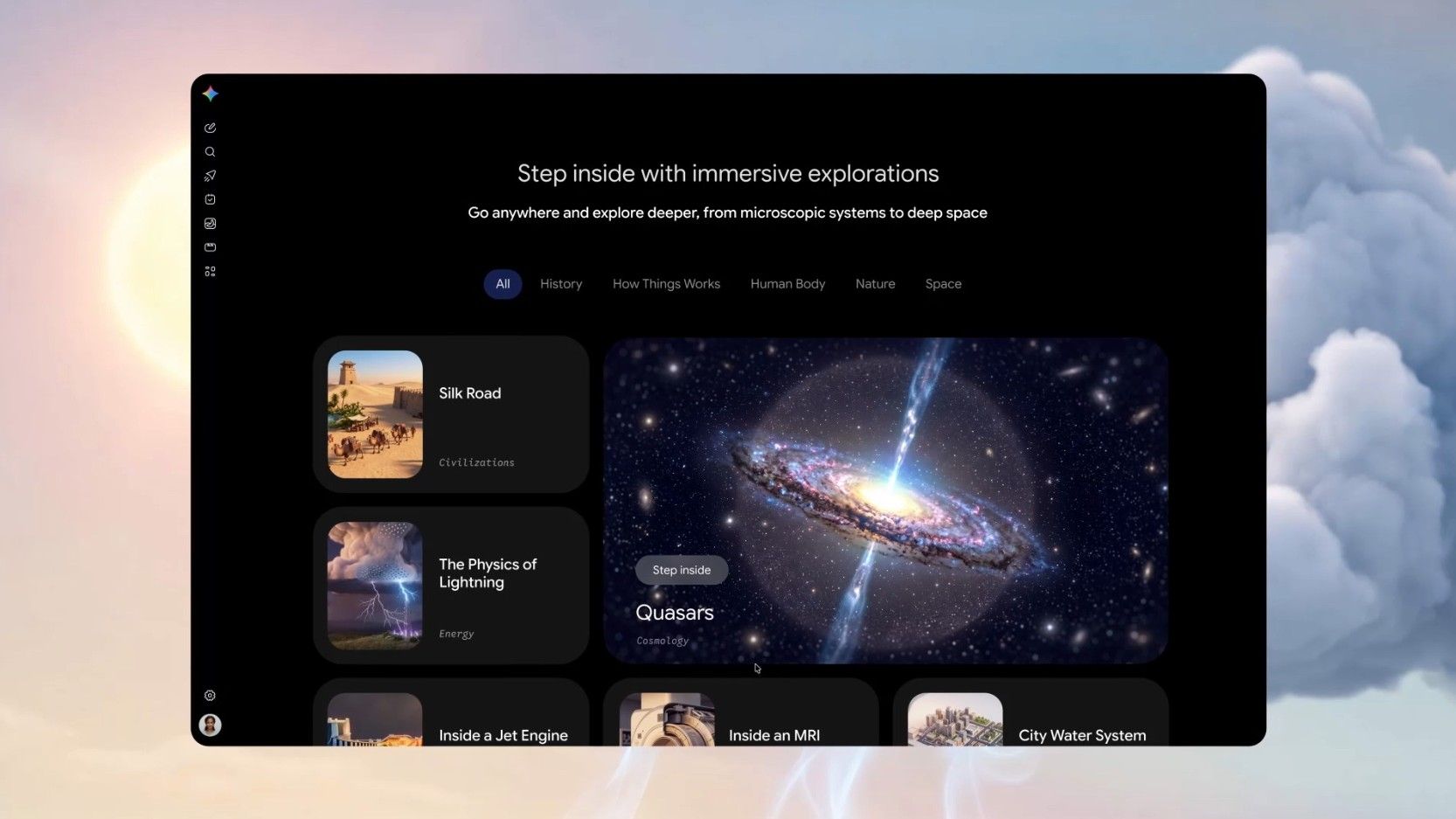
The newly launched Immersive Explorations library redefines digital comprehension by replacing endless walls of text with interactive graphics. Rather than passively reading about a complex scientific phenomenon, students can click through multi-layered digital models to understand both the macro-level structure and the microscopic details of a given subject.
For instance, when studying astronomy, a user exploring a quasar can zoom past the overarching cosmic structure to inspect individual components such as host galaxies or interstellar dust lanes. Selecting specific elements within the digital image unlocks contextual data cards, allowing learners to dissect the anatomy of complex systems piece by piece.
Beyond cosmic phenomena, the initial curriculum within the Immersive Explorations hub covers a diverse array of foundational scientific topics, including the biological structures of plant cells, prehistoric dinosaur anatomy, and the intricate physics governing atmospheric lightning. Google has confirmed that the tool is accessible immediately through the official Gemini app and the dedicated student web portal.
To maximize accessibility for a global student body, the feature is launching with support for six major languages: English, Indonesian, Hindi, Brazilian Portuguese, French, and simplified Chinese. Google noted that users operating the app in unsupported languages will temporarily default to English until localized rollouts are completed in subsequent updates.
Background Context and Chronological Development
The introduction of Immersive Explorations does not occur in a vacuum; it is the culmination of a multi-year strategy by Google to establish Gemini as a dominant fixture in classrooms and academic institutions. The journey began in earnest when Google expanded Gemini access to younger demographics, specifically targeting teens using school-issued Google Workspace accounts.
To ensure safety and academic integrity, that initial rollout was accompanied by robust administrative guardrails and dedicated fact-checking mechanisms. Google simultaneously introduced "Coach," a conversational, step-by-step assistant designed to guide students through difficult subjects using pedagogical techniques like interactive quizzes and guided problem-solving rather than simply supplying direct answers.
Concurrently, Google focused heavily on empowering educators through integrations with Google Classroom and NotebookLM (recently rebranded as Gemini Notebook). These tools allowed teachers to ingest existing curriculum materials to generate customized study guides, automated rubrics, and tailored quizzes. Furthermore, educators gained the ability to spin up specialized AI "experts" trained on specific course materials to assist students needing extra help outside of normal classroom hours. Immersive Explorations serves as the visual and interactive counterweight to these text- and data-heavy administrative tools, completing a comprehensive ecosystem of AI-driven learning aids.
Supporting Data and Technical Scope
Google’s broader educational ecosystem currently spans more than 100 countries, making the platform one of the most widely distributed generative AI initiatives in global education. The integration of spatial and layered visual processing into Gemini leverages Google’s cutting-edge multi-modal capabilities, which allow the underlying neural networks to seamlessly connect textual descriptions with precise graphical coordinates.
Market research into digital education highlights a growing demand for multi-sensory learning tools. According to educational technology analysts, student engagement increases significantly when complex scientific concepts are presented through interactive visualizations rather than static textbooks or standard video lectures. By targeting foundational STEM subjects—astronomy, botany, paleontology, and physics—Google is addressing areas of the curriculum where students traditionally experience high cognitive friction.
Industry Implications and Analytical Perspective
The launch of Immersive Explorations carries notable implications for the future of EdTech and instructional design. For decades, digital learning has struggled to bridge the gap between passive consumption (watching educational videos or reading e-books) and active experimentation (handling physical models or conducting laboratory experiments).
By offering a scalable, software-based approximation of hands-on exploration, Google is lowering the resource barrier for schools that lack advanced laboratory infrastructure or up-to-date physical teaching aids. Students in underfunded districts gain access to intricate 3D-style breakdowns of complex scientific phenomena directly from their mobile devices or Chromebooks.
However, educational experts point out that the integration of generative AI tools into schools must be managed carefully. While features like Immersive Explorations and Gemini Coach enhance engagement, educators stress the continued necessity of human oversight to ensure that students develop critical thinking and foundational research skills independently. The reliance on AI-generated context, even when heavily guarded, requires continuous evaluation by teachers to prevent over-reliance on automated answers.
Looking Ahead
As Google continues to refine its educational suite, the company is expected to expand the content library of Immersive Explorations to encompass advanced chemistry, human anatomy, and earth sciences. Future updates will likely introduce broader language support and deeper integration with Google Classroom, allowing teachers to assign specific visual explorations as part of weekly homework modules.
The swift evolution of the Gemini student hub underscores a broader industry trend: artificial intelligence is rapidly transitioning from a novelty chatbot interface into specialized, purpose-built educational infrastructure. As tools like Immersive Explorations mature, they promise to reshape modern pedagogy, offering a glimpse into a future where every student possesses an interactive, infinitely adaptable visual laboratory in the palm of their hand.