As large language models (LLMs) transition from experimental curiosities to core components of enterprise software, the industry faces a significant challenge: standard benchmarks like MMLU (Massive Multitask Language Understanding) or GSM8K are increasingly insufficient for specialized business needs. While these public benchmarks provide a baseline for general reasoning, they fail to account for the nuance of domain-specific tasks, such as ensuring a customer support agent adheres strictly to a company’s refusal policy or verifying that a Retrieval-Augmented Generation (RAG) pipeline is pulling accurate context from proprietary databases. To bridge this gap, organizations are shifting toward building custom evaluation harnesses—bespoke testing frameworks that offer full visibility into model performance, cost, and alignment.
The Necessity of Proprietary Evaluation Frameworks
In the current landscape of generative AI, relying solely on third-party leaderboard scores is akin to testing a production software system only with synthetic unit tests. Public benchmarks offer a broad snapshot of capability, but they do not measure the specific "failure modes" relevant to a business. A model that scores in the 95th percentile on a coding benchmark might still fail to format a JSON response correctly for an internal API or might inadvertently disclose PII (Personally Identifiable Information) in a customer interaction.
Software engineering has long relied on test harnesses—scaffolding that feeds inputs to a system, captures outputs, and compares them against known baselines. When applied to LLMs, this practice transforms evaluation from an abstract metric into a repeatable, audit-ready pipeline. By tracking pass rates, latency, and cost-per-query, engineering teams can move away from "vibe-based" testing and toward data-driven deployment strategies.
Architecture: A Four-Component Approach
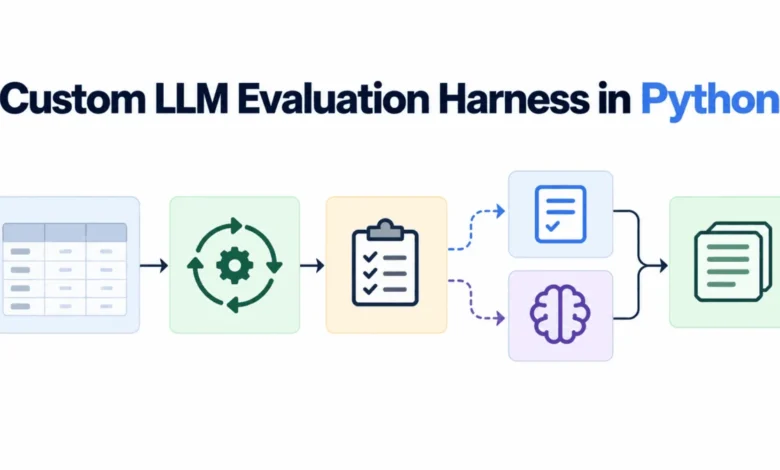
Building a custom evaluation harness requires a modular architecture that separates the collection of data from the evaluation of that data. The most effective frameworks generally consist of four distinct components: a golden dataset, an inference runner, a judge layer, and a structured logging system.
1. Establishing the Golden Dataset
The foundation of any robust harness is the "golden dataset." This is a curated repository of test cases that reflect the actual, messy reality of user interactions. Rather than relying on synthetic prompts—which often only test the "happy path"—developers should draw from historical user logs and documented edge cases.
Each entry in this dataset should be structured, typically featuring a unique identifier for longitudinal tracking, the input prompt, and the expected outcome or "ground truth." For instance, a test case for a financial chatbot might include an input querying for a refund, with an expected_concept tagged as "policy_compliant_refusal." Keeping these tags clear and objective is critical, as vague expectations inevitably lead to noisy, unreliable scoring.
2. The Inference Runner
The runner serves as the execution engine. By leveraging libraries such as LiteLLM, developers can maintain a unified interface for interacting with diverse model providers, including OpenAI, Anthropic, and Google, as well as locally hosted open-source models like Llama 3 or Mistral.
The primary goal of the runner is to achieve consistency and speed. Using asyncio in Python allows the harness to fire multiple requests concurrently, significantly reducing the "wall-clock" time required for large-scale evaluations. Industry-standard practices for production-ready runners include setting explicit num_retries and timeout thresholds. These settings ensure that network jitter or transient API failures do not result in false negatives in the evaluation report.
3. The Judge Layer: Deterministic vs. Semantic
The judge layer is the intelligence of the harness, tasked with determining whether a model’s output is a "pass" or "fail." Two primary methodologies exist:
- Deterministic Judges: These are best suited for tasks requiring exact matches or specific structural integrity, such as checking if a response contains a specific keyword or adheres to a required schema. They are computationally inexpensive and provide 100% consistency.
- LLM-as-a-Judge: This approach uses a more capable model (often a high-end frontier model) to evaluate the output of the model under test. This is essential for semantic tasks, such as assessing the tone of a response or the logical correctness of an answer that doesn’t follow a rigid template.
To ensure the judge layer remains reliable, developers should use structured output enforcement, such as Pydantic models. By forcing the judge to return a JSON object with fields like passed (boolean) and reason (string), the harness avoids the unpredictability of unstructured text, preventing parser errors that could crash the evaluation run.
4. Logging and Decoupling
Logging is the final, vital component. Every result should be stored in a .jsonl (line-delimited JSON) format. This format is inherently crash-safe; should the system fail mid-execution, the progress made up to that point remains accessible.
Crucially, the raw output of the model should be saved alongside the judge’s score. This "decoupling" of inference and scoring is a best practice in AI engineering. It allows developers to re-run the judge layer with an updated rubric or a different evaluation model without incurring the costs or time associated with re-running the initial inference.
Chronology of a Typical Evaluation Run
A professional-grade evaluation lifecycle follows a structured sequence:
- Preparation: The golden dataset is updated with new failure modes discovered in production.
- Concurrency: The inference runner initiates batch calls to the target model, utilizing parallel processing.
- Judgment: The judge layer parses the raw outputs, applying the chosen logic (deterministic or LLM-based) and generating structured scores.
- Logging: Results are appended to the JSONL log file, creating an immutable history of performance.
- Summarization: A reporting utility calculates key performance indicators (KPIs) such as total pass rate, average latency per request, and cost-per-test-case.
Broader Implications and Industry Impact
The move toward custom evaluation harnesses marks a shift in how enterprises perceive AI reliability. As companies integrate LLMs into mission-critical systems, the ability to demonstrate, via historical logs, that a model has consistently met safety and accuracy criteria becomes a regulatory and operational necessity.
According to recent industry observations, firms that implement automated evaluation pipelines report a significant reduction in "regression cycles." By integrating these tests into CI/CD pipelines, engineering teams can catch regressions—where a new model version inadvertently breaks a previously working behavior—automatically before they reach the production environment.
Furthermore, this modular approach supports the "model-agnostic" development strategy. As the AI landscape evolves, the best model for a specific task may change frequently. An evaluation harness that treats the inference runner as a plug-and-play component allows a company to switch from one model provider to another with minimal friction, providing the agility required to stay competitive in a rapidly shifting market.
Conclusion and Future Outlook
Building a custom evaluation harness is an investment in the longevity of an AI product. By combining a robust golden dataset, a scalable asynchronous runner, a precise judge layer, and a durable logging strategy, developers create a feedback loop that is essential for long-term model optimization.
As the industry matures, the next step for many organizations will be to move beyond simple binary pass/fail metrics. Future enhancements will likely include "rubric-based" grading, where models are scored on a scale across multiple dimensions (e.g., conciseness, tone, accuracy, and safety). Additionally, building visual dashboards to monitor these trends over time will provide stakeholders with the clarity needed to make informed decisions about model deployment and budget allocation. Ultimately, the transition from opaque evaluation to transparent, data-backed testing is the hallmark of the transition from AI experimentation to sustainable, enterprise-grade AI infrastructure.