Google Introduces Playground: A Conversational AI Platform That Democratizes Custom Game Development Without Coding

For decades, the video game industry has operated under a strict dichotomy: millions of people consume interactive entertainment, but only a tiny fraction possess the technical expertise required to build it. Crafting even a modest digital experience historically demanded deep knowledge of complex game engines like Unreal or Unity, proficiency in programming languages such as C++ or C#, and specialized skills in 3D modeling, physics calculations, and UI design. These steep technical barriers have long left countless imaginative game concepts trapped in the minds of players who lacked formal software engineering backgrounds.
Seeking to shatter these long-standing creative constraints, artificial intelligence researchers and software engineers at Google have officially unveiled Playground. This experimental, browser-based gaming platform fundamentally transforms how interactive digital experiences are conceptualized, built, and shared. By leveraging advanced conversational artificial intelligence, Playground allows users to generate fully playable, custom video games simply by describing their ideas through natural language prompts. Operating under the empowering philosophy that if you can think it, you can play it, the platform eliminates the need for manual coding, opening up game development to an unprecedented demographic of everyday creators, hobbyists, and casual dreamers.
The Genesis of Conversational Game Creation
The development of Playground represents a massive leap forward in the convergence of generative AI and interactive media. Spearheaded by software engineer Maryam Karimzadehgan and the AI Innovation and Research division at Google, the project was born out of a desire to bridge the gap between imagination and execution. Traditional software development pipelines require developers to manually write thousands of lines of code to govern everything from gravity and collision detection to win conditions and asset rendering. Playground abstracts this technical friction entirely.
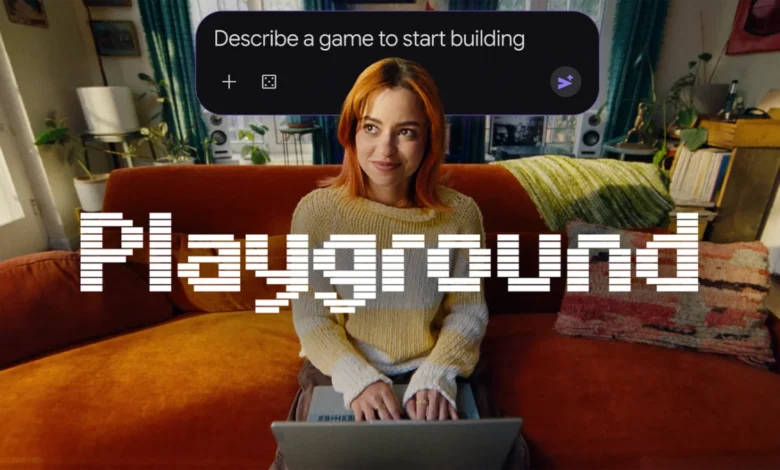
Instead of manipulating code blocks or configuring complicated node graphs in a traditional integrated development environment, users interact with Playground via a clean, conversational interface. A creator can start with a completely blank canvas, modify existing starter prompts, or utilize the platform’s guided support features to flesh out an abstract concept. For example, typing a prompt describing a cozy, food-themed arcade game about an ube latte instantly commands the AI to synthesize the core mechanics, visual assets, and rules into a functional prototype.
Once the initial generation is complete, the user maintains absolute creative control over the iteration process. If the creator decides that the gravity feels too heavy, that the protagonist needs a distinct visual overhaul, or that the scoring system requires an entirely new set of rules, they do not need to rewrite software scripts. They simply type their desired adjustments directly into the chat interface. The AI interprets these instructions in real time, updating the physics, tweaking the environmental parameters, and altering character behaviors instantaneously. This tight, rapid feedback loop allows creators to pivot from a rough concept to a polished, playable prototype in a matter of minutes.
A Multi-Device Ecosystem for Play, Competition, and Discovery
While the creation process is streamlined for accessibility, Playground does not skimp on the social and competitive elements that make modern gaming so engaging. Built entirely for the web, the platform operates seamlessly across a wide variety of devices, ensuring that users can transition effortlessly from designing a game on a desktop laptop to testing it on a smartphone while on the go.
Once a custom game is finalized, creators are given flexible deployment options. Users can choose to keep their creations strictly private for personal amusement, generate a secure shareable link to challenge friends and family members directly, or publish their titles to the public Playground Explore gallery. To ensure high standards of quality and maintain a safe digital environment, every game submitted to the public gallery must undergo rigorous automated safety screenings aligned with Google’s comprehensive Community Guidelines, in addition to supporting robust user-reporting mechanisms.
The public gallery itself is driven by dynamic discovery algorithms that prioritize player ratings, engagement metrics, and active play sessions. This system ensures that fresh, highly creative, and genuinely entertaining titles regularly bubble to the top of the discovery feed, giving independent creators a fighting chance to find an audience regardless of their marketing budget. Furthermore, Playground incorporates foundational community features such as in-game leaderboards and native multiplayer support for select game genres. By linking a standard Play Games profile, users can claim personalized custom handles, track their favorite titles, battle for top scores on competitive leaderboards, and follow individual creators to receive instant notifications whenever a new project drops.
Bridging the Gap to Professional Development Through Unity Spark
While Playground is explicitly designed to lower the barrier to entry for novice creators, Google recognizes that many users will eventually outgrow simple text-prompt mechanics as their creative ambitions scale. To address this natural progression, Google has announced a strategic integration with Unity, one of the most prominent and respected names in the global gaming industry.
Soon, Playground will introduce native support for Unity Spark, an upcoming ecosystem that unlocks professional-grade development capabilities for dedicated creators. Unity Spark introduces high-fidelity 3D rendering, robust physics simulations, complex gameplay logic, and the profound flexibility of the Unity runtime environment. This partnership creates a seamless developmental pipeline: a designer can conceptualize a simple 2D game using basic text prompts inside Playground, and later expand that exact concept into an immersive, high-end 3D experience using Unity’s advanced toolset. Crucially, these advanced games will remain fully accessible within the standard Playground ecosystem, ensuring that the broader community can enjoy professional-quality experiences without needing to leave the browser. While Unity Spark is currently undergoing closed beta testing, industry analysts anticipate that its eventual public rollout will significantly blur the line between casual generative AI tools and professional game development engines.
Market Implications and the Democratization of Software
The launch of Playground arrives at a critical juncture in the technology sector, where generative artificial intelligence is rapidly redefining creative industries. Over the past several years, generative models have revolutionized static visual arts, creative writing, and audio production. Interactive software and video games, however, have historically lagged behind in AI integration due to the complex, multi-layered dependencies required to make code executable and stable.
By successfully packaging game logic into a responsive, conversational AI framework, Google is positioning itself at the forefront of the democratization of software creation. Industry observers note that platforms like Playground could herald a new era of "citizen developers"—individuals who possess no formal technical training but can nonetheless architect complex digital systems through natural language alone. This shift mirrors the evolution of desktop publishing in the 1980s and web page builders in the late 1990s, both of which transitioned specialized programming tasks into accessible consumer activities.
However, the rapid rise of AI-generated content also introduces complex questions regarding intellectual property, platform moderation, and asset ownership. As millions of users begin generating custom games derived from billions of parameters of training data, questions surrounding copyright ownership, asset attribution, and monetization will undoubtedly take center stage. Google’s initial requirement of rigorous safety screenings and community moderation protocols indicates an awareness of these challenges, but regulatory and ethical scrutiny is expected to intensify as the platform scales.
Launch Details and Future Outlook
Playground officially launches today as an early experimental release targeted at users aged 18 and older residing in the United States. To manage computational demands and server loads associated with real-time generative AI, creation access is rolling out in tiered phases determined by a user’s Google AI subscription level.
As the platform matures, Google plans to iterate rapidly based on direct telemetry and community feedback harvested from early adopters. The company envisions Playground not as a static product, but as a living ecosystem that evolves organically alongside its user base. By handing the keys of game design to the general public, Google is betting that the collective imagination of the internet will uncover gameplay mechanics, artistic styles, and interactive narratives that traditional game studios could never conceive on their own.
For those eager to experience the platform firsthand, early demonstrations, community highlights, and initial creation tools are currently live at playground.google. As the closed beta for Unity Spark approaches and the community gallery continues to expand, Playground stands poised to redefine what it means to be a game developer in the twenty-first century—proving that when the barriers of code are stripped away, the only remaining limit is the human imagination.