Google Ads introduces channel prioritization to grant advertisers greater control over budget allocation

For years, the digital advertising landscape has been dominated by the shift toward automated, black-box solutions. Google Ads, in particular, has leaned heavily into machine learning-driven products like Performance Max (PMax), which aggregate inventory across the entire Google ecosystem—Search, Discover, Gmail, Maps, and YouTube—under a single campaign umbrella. While this transition simplified campaign setup, it stripped away the granular control that media buyers previously enjoyed. Advertisers were long forced into an "all-or-nothing" approach, unable to effectively throttle spend on underperforming channels without cannibalizing the entire campaign’s performance.
This paradigm is finally shifting. Last month, Google announced a significant update to its platform: the introduction of "channel prioritization." This feature allows advertisers to assign a "High" or "Low" priority status to specific ad channels, offering a long-awaited middle ground between total autonomy and complete automation.
The Evolution of Google’s Campaign Architecture
To understand the magnitude of this update, one must look at the historical trajectory of Google’s ad products. Historically, advertisers could silo their budgets. If a brand wanted to allocate $1,000 to Search and $500 to Display, they could do so with precision. The advent of Performance Max in late 2021 signaled the end of this era for many. PMax was designed to optimize across channels simultaneously, using Google’s proprietary AI to find conversions wherever they might hide.
While effective for many, this model created friction for performance marketers who found that their budgets were being siphoned into low-intent channels, such as the Display Network or broad Search partners, despite having strong performance on core Search queries. The industry response was largely one of frustration. Advertisers frequently cited a lack of transparency and a lack of levers to pull when automated bidding algorithms over-allocated funds to channels that contributed to vanity metrics rather than bottom-line revenue.

How Channel Prioritization Works
The new channel prioritization feature functions as a tactical overlay for automated campaigns. By navigating to the "Insights and Reports" section, advertisers can now view a breakdown of spend and conversion data by channel over a 28-day rolling window.
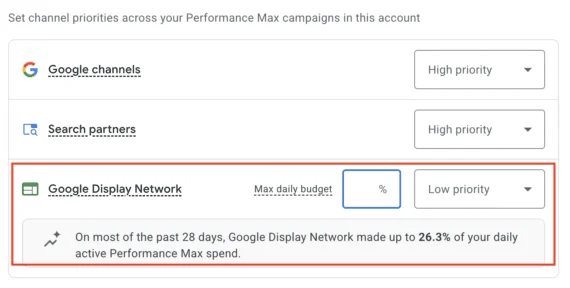
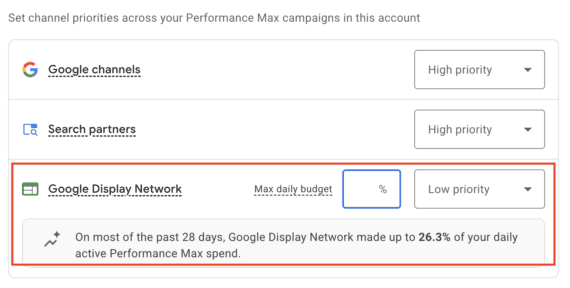
When a channel is designated as "Low" priority, the advertiser can establish a maximum daily spend percentage. This serves as a "guardrail" for the campaign’s bidding algorithm. If an advertiser identifies that the Display Network is consuming 30% of their budget but only delivering 5% of their conversions, they can flag it as a Low priority and cap its spend to a more palatable figure, such as 10%.
The implementation is flexible. Advertisers can apply these settings at the account level or, for more complex setups, at the individual campaign level. This granularity is essential for enterprise-level accounts that may manage hundreds of campaigns with disparate objectives—some designed for brand awareness (where Display might be a "High" priority) and others for direct response (where Search is the primary driver).
Analyzing Performance: Data-Driven Decision Making
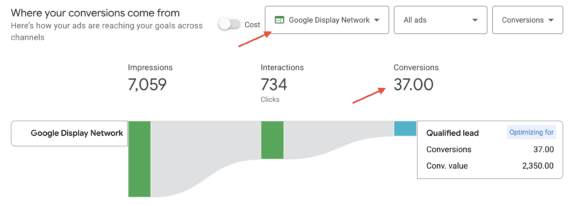
The value of this update is best illustrated through a comparative analysis of channel performance. In a typical scenario, a campaign might show a 26.3% spend allocation toward the Display Network. Without the new reporting, an advertiser might see that spend and assume the channel is performing efficiently. However, by cross-referencing this against the channel performance report, they might find that the Display Network is responsible for 48.1% of all campaign conversions.
In this specific case, the data suggests that the channel is punching above its weight. A savvy marketer would classify this as "High" priority. Conversely, if a channel accounts for 40% of the budget but only 5% of conversions, the "Low" priority setting becomes a critical tool for budget preservation. By restricting the "Low" priority channels, marketers can force the algorithm to reallocate that capital toward higher-performing channels, effectively increasing the overall Return on Ad Spend (ROAS).
Chronology of the Release and Industry Reception
The rollout of this feature follows a series of updates Google has released throughout 2026, aimed at addressing the "black box" criticism of its automated systems.
- Q1 2026: Google began expanding transparency reports for PMax, providing more granular visibility into where ads appear.
- Q3 2026: Beta testing for "Budget Guardrails" began among a select group of enterprise advertisers.
- November 2026: Official announcement of "Channel Prioritization," signaling a broader push toward "collaborative intelligence"—a strategy where humans provide the strategy and AI provides the execution.
Early reactions from the digital marketing community have been cautiously optimistic. Many search engine marketing (SEM) professionals, who have long lobbied for the ability to exclude "Search Partners" from their campaigns, view this as a partial victory. Previously, the only way to avoid the often-unqualified traffic from Search Partners was to opt out entirely. Now, advertisers can treat these channels as a secondary, low-budget test environment, mitigating risk while still allowing the algorithm to gather data.
Limitations and Structural Constraints
Despite the utility of this update, it is not without its limitations. The most significant hurdle for advanced practitioners is the "Google Channels" grouping. Google currently categorizes five distinct platforms—Search, Discover, Gmail, Maps, and YouTube—under a single bucket.
This means that an advertiser cannot, at this stage, set a "High" priority for Google Search while simultaneously setting a "Low" priority for Google Maps. They are tethered together. Critics argue that this remains a form of "all-or-nothing" restriction, as each of these five channels typically serves a different purpose in the consumer journey. For instance, a user on Google Maps is likely closer to a point-of-sale than a user browsing YouTube, yet they are treated with the same priority tier.
There is also the question of algorithmic compliance. It remains to be seen how strictly the Google Ads engine adheres to these "Low" priority caps during periods of high market volatility or during seasonal shifts, such as the holiday shopping peak. If the algorithm determines that a "Low" priority channel is the only place to achieve a conversion at the target Cost-Per-Acquisition (CPA), will it respect the spend cap, or will it prioritize the conversion goal over the spend limit? Google has yet to provide full documentation on how these priorities interact with aggressive bid strategies.
Broader Implications for Digital Strategy
The introduction of channel prioritization signals a maturation of the automated bidding ecosystem. For years, the industry narrative was "Automation vs. Human Control." This update suggests that the future is "Automation with Human Guardrails."
By empowering advertisers to set these priorities, Google is essentially acknowledging that its machine learning models are not always as efficient as a human expert who understands the specific nuances of a business. It represents a compromise that could stabilize the relationship between Google and the agency world, which has been strained by the loss of granular control.
For the average advertiser, the implication is clear: the need for data literacy is higher than ever. With these new levers comes the responsibility to audit performance constantly. Advertisers can no longer "set it and forget it." They must now act as active portfolio managers, reviewing their channel prioritization settings on a regular basis to ensure that the "High" and "Low" settings are still aligned with current market conditions and conversion trends.
As we look toward the remainder of the year, the efficacy of this feature will likely depend on the quality of the data provided in the insights dashboard. If the reporting remains robust and the platform honors the spend caps, channel prioritization could become the standard for managing complex, multi-channel campaigns. For now, it serves as a valuable tool for those looking to reclaim a measure of efficiency in an increasingly automated world.
Related posts: