Southeast Asia’s Digital Economy Set to Hit $368 Billion as Generative AI Adoption Soars Four Times Faster Than Mobile Internet


The digital landscape of Southeast Asia is experiencing a structural transformation driven by the rapid integration of artificial intelligence into the daily lives of its citizens. According to the 11th edition of the e-Conomy SEA report—a comprehensive collaborative study published by Google, Temasek, and Bain & Company titled Building the Intelligent Economy—generative AI has officially established itself as an indispensable utility. The research reveals that 243 million individuals across the region, accounting for approximately 58% of the working population, actively engage with generative AI tools daily. This unprecedented wave of adoption is scaling at a velocity four times faster than the historical rollout of the mobile internet across the region.
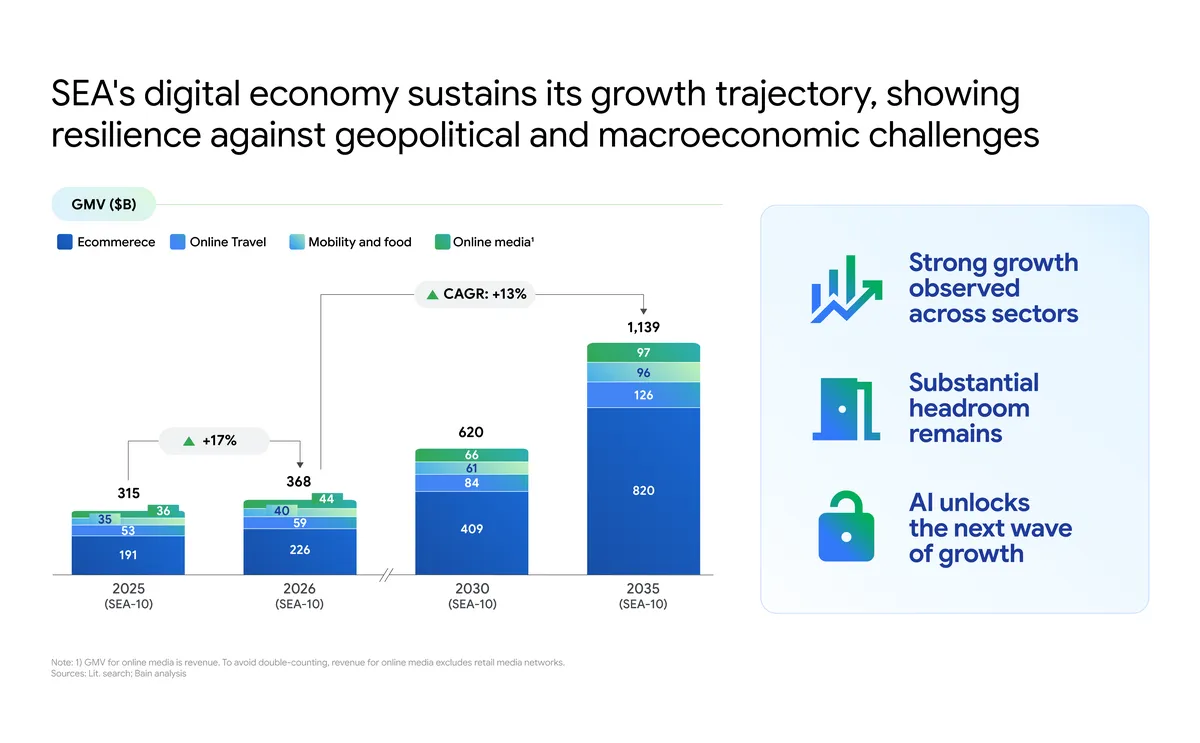
This exponential surge in technological integration is serving as the primary catalyst for the region’s economic expansion. The report projects that Southeast Asia’s digital economy will grow by 17% year-on-year in Gross Merchandise Value (GMV), reaching $368 billion. This robust trajectory places the regional digital economy firmly on course to surpass the $1 trillion threshold by 2035. As traditional macroeconomic indicators evolve, the report introduces tokens as a foundational benchmark for measuring the emerging AI economy, forecasting a staggering 60-fold increase in regional AI usage over the next five years, underpinned by growing consumer and enterprise confidence in automated agentic commerce.
A Decade of Digital Evolution: The Chronology and Background of the e-Conomy SEA Initiative
To understand the magnitude of the current $368 billion milestone, it is essential to contextualize the historical trajectory of the e-Conomy SEA report series. Launched over a decade ago by Google and Temasek, with Bain & Company joining as a core research partner, the initiative was originally conceived to measure the nascent internet economies of Indonesia, Malaysia, the Philippines, Singapore, Thailand, and Vietnam. In its inaugural years, the report focused primarily on ride-hailing, e-commerce, and digital payments, which were then emerging from fragmented local startups into scalable regional platforms.
Throughout the late 2010s, the report documented the transition of Southeast Asia into a mobile-first internet economy, propelled by a youthful, digitally literate population and widespread smartphone adoption. By 2020, the COVID-19 pandemic acted as an unexpected accelerator, permanently shifting consumer behaviors toward online delivery, digital financial services, and remote commerce. The digital economy crossed the $100 billion mark in 2019 and accelerated past $200 billion by 2022.
As the post-pandemic recovery stabilized, subsequent editions of the report began tracking profitability and sustainable growth over pure GMV expansion. The 2024 and 2025 editions highlighted the early signs of artificial intelligence integration, but the 2026 report marks a definitive turning point. For the first time, AI is no longer viewed merely as an enterprise optimization tool or an experimental feature; it has become the fundamental operating system underpinning the entire digital ecosystem. This decade-long evolution reflects a maturing market capable of absorbing complex, frontier technologies at a scale that frequently outpaces Western economies.
Sustaining Cross-Sector Growth: How AI is Reshaping Every Digital Vertical
The integration of generative AI is not isolated to a single tech sector; rather, it is broadly lifting performance metrics across all five pillars of Southeast Asia’s digital economy. E-commerce remains the undisputed anchor of the regional market, projected to hit $226 billion in GMV with an 18% year-on-year growth rate. The incorporation of multimodal discovery tools and intelligent in-app shopping assistants has fundamentally altered how consumers search for and purchase goods. Rather than scrolling through endless product listings, shoppers increasingly rely on conversational interfaces to navigate complex purchases. Empirical data from the report indicates that these personalized, AI-driven experiences organically yield a 10% increase in conversion rates, with individual merchants reporting order volume uplifts as high as 75%.
In the online travel sector, which is expected to reach $59 billion in GMV representing a 10% year-on-year increase, consumer habits are visibly shifting. While traditional search engines retain their position as the primary platform for initial travel research, generative AI has officially surpassed social media to become the second-most utilized tool for organizing complex, multi-destination itineraries. Travelers are leveraging large language models to curate hyper-personalized vacation packages, optimize flight schedules, and discover localized accommodations that align with specific budgetary and experiential parameters.
Online media is experiencing a parallel boom, generating $44 billion in revenue with a 22% year-on-year growth rate. Platforms are deploying AI to hyper-personalize content feeds, thereby improving audience retention and connecting consumers with more contextually relevant advertising. This optimization has driven a 10% to 20% increase in quality engagement metrics, directly contributing to the expansion of commerce media into a robust $4 billion market.
Mobility and food delivery services are also reaping the benefits of algorithmic efficiency, registering $40 billion in GMV with a 15% year-on-year growth rate. Consumers across major metropolitan areas such as Jakarta, Bangkok, Manila, and Singapore are saving substantial time through predictive suggestions, smarter traffic routing, and AI-powered service offerings like pooled rides and dynamic pricing models, which continue to drive healthy transactional volumes.
Finally, digital financial services have expanded to $1,650 billion in Gross Transaction Value (GTV), marking a 16% year-on-year increase. AI is playing a critical role in this sector by powering real-time fraud detection systems, broadening credit access to unbanked and underbanked populations, and delivering automated financial recommendations that complement traditional human advisory services. Notably, Singapore continues to solidify its position as the region’s premier digital wealth management hub, utilizing advanced algorithms to democratize access to sophisticated investment portfolios.
Unlocking Agentic Commerce Through Consumer Trust

One of the most profound insights highlighted in the Building the Intelligent Economy report is the rapid maturation of consumer trust, which is clearing the path for the advent of agentic commerce—a system where autonomous AI agents perform complex tasks, negotiate prices, and execute transactions on behalf of users. The foundation for this transition is already established: 72% of regional digital users regularly rely on everyday automation features such as automated price tracking and algorithmic recommendations.
This high degree of digital familiarity has translated into a willingness among 75% of surveyed users to delegate purchasing decisions and financial transactions to AI agents. This progressive attitude is rooted in deep-seated regional optimism. Consumers in Southeast Asia increasingly view artificial intelligence as a net positive for society, with 62% reporting significantly greater trust in AI tools compared to the previous year. This growing confidence is attributed by respondents to three primary factors: a proven operational track record in handling daily tasks (56%), rising personal familiarity with the technology (55%), and demonstrable improvements in output accuracy and quality (53%).
However, industry analysts and report authors emphasize that sustained consumer trust is conditional upon the establishment of transparent frameworks and protective guardrails. To feel completely comfortable embracing fully agentic commerce, users have articulated specific requirements. Prominent among these demands are robust privacy safeguards (44%), clear and unambiguous information regarding the functional limitations of AI systems (36%), and the technical ability to easily reverse or rollback agentic transactions if errors occur (30%). Technology providers and regulatory bodies must address these expectations proactively to prevent friction as autonomous commerce scales.
Strategic Imperatives: Four Critical Areas for Regional Adaptation
To support the report’s projection of a 60-fold increase in regional AI usage by 2030, Southeast Asia’s broader digital ecosystem must undergo a coordinated structural evolution. Industry leaders, policymakers, and financial institutions have identified four critical pillars that require immediate, systematic adaptation:
-
Infrastructure and Data Sovereignty: The sheer computational demand generated by 243 million active AI users necessitates a massive expansion of regional data center capacity, stable green energy grids, and localized data processing facilities. Ensuring low-latency access while adhering to diverse national data sovereignty regulations across ASEAN member states will be paramount.
-
Talent Development and Upskilling: As automation reshapes the labor market, regional educational institutions and corporate entities must collaborate to bridge the digital skills gap. Training the workforce to work alongside AI agents, rather than competing with them, will be essential to maintaining high productivity and mitigating structural unemployment risks.
-
Regulatory Harmonization and Consumer Protection: Given that Southeast Asia comprises multiple distinct legal jurisdictions, the implementation of cross-border digital policies can become fragmented. Establishing unified regulatory standards regarding AI ethics, data privacy, liability in agentic transactions, and intellectual property will foster a safer and more predictable environment for foreign and domestic investment.
-
Cybersecurity and Risk Mitigation: The exponential growth of token-based economies and autonomous financial transactions dramatically expands the attack surface for sophisticated cyber threats. Financial institutions and technology platforms must invest heavily in advanced, AI-driven cybersecurity infrastructure to protect consumer assets and maintain systemic stability.
Implications and Future Outlook
The findings of the e-Conomy SEA 2026 report signal that Southeast Asia is transitioning from a consumer of digital technologies to an active innovator and validator of advanced artificial intelligence models. With a projected Gross Merchandise Value trajectory aimed securely at $620 billion by 2030 and exceeding $1.1 trillion by 2035, the region is positioning itself as one of the most dynamic economic blocs in the global digital landscape.
The integration of generative AI into the fabric of daily life—evidenced by the 243 million active users—demonstrates a cultural and economic readiness that outpaces many developed Western markets. As agentic commerce shifts from a theoretical concept to a practical reality, the economic implications will extend far beyond the technology sector, fundamentally redefining retail, finance, logistics, and labor across the ten ASEAN nations. The success of this transition will ultimately depend on the ability of regional stakeholders to balance rapid innovation with uncompromising standards of consumer trust, data security, and inclusive economic development.