Automating Knowledge Graph Population: Extracting Entities and Triples from Unstructured Text with an LLM

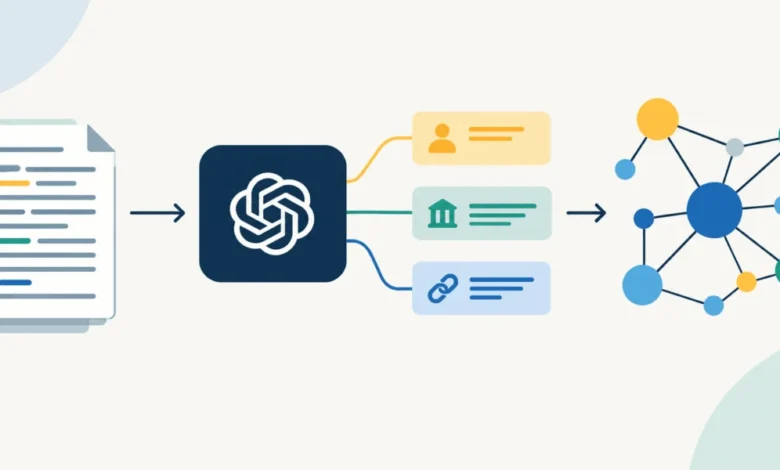
In the rapidly evolving landscape of artificial intelligence, the transition from unstructured data to actionable, structured knowledge has become a critical bottleneck for high-performance applications. Traditional Retrieval-Augmented Generation (RAG) systems have long relied on vector search to retrieve relevant information, but this method is often plagued by semantic ambiguity and the persistent issue of "hallucinations"—where a model generates plausible but factually incorrect information. To mitigate these risks, developers are increasingly turning toward deterministic, graph-based architectures. By moving beyond vector-based similarity to a structural representation of facts, organizations can anchor LLM outputs in verified, ground-truth data.
The Rise of Graph-Based RAG Architectures
The architectural shift toward graph-based RAG systems marks a move away from purely probabilistic retrieval. In a 3-tiered Graph-RAG system, data is not merely stored as high-dimensional embeddings but is mapped into a relational structure. This structure typically utilizes Knowledge Graphs (KGs) to represent entities and their relationships. A standard RDF triple—consisting of a Subject, Predicate, and Object—serves as the foundational unit of this graph. However, modern applications require a more granular approach, leading to the adoption of SPOC quads: Subject, Predicate, Object, and Context.
The addition of the "Context" dimension is a significant advancement. By tagging a fact with its source, timestamp, or reliability score, developers can resolve conflicting information across disparate datasets. For example, if two different documents offer contradictory claims about an entity, the system can use the context metadata to prioritize the most recent or authoritative source.
Automating the Knowledge Extraction Pipeline
Historically, the population of knowledge graphs was a manual, labor-intensive process requiring human domain experts to curate and input data. This manual approach is fundamentally incompatible with the volume and velocity of modern data generation. The solution lies in the automation of knowledge extraction using local Large Language Models (LLMs) via frameworks such as Ollama.
By leveraging a local model like Llama 3.2, developers can perform inference on private infrastructure, ensuring data sovereignty and reducing latency associated with cloud-based APIs. The extraction workflow involves passing raw, unstructured text—such as Wikipedia articles, internal technical documentation, or historical records—into a prompt-engineered pipeline that identifies entities and formalizes their relationships into JSON-formatted quads.
Technical Implementation and Infrastructure
The setup for an automated knowledge extraction system is straightforward but requires precise configuration to ensure high data fidelity. The primary requirement is an environment capable of running the Ollama server, which acts as the local inference engine.
- Server Initialization: The process begins by spinning up the Ollama server, typically managed via a background subprocess. This allows for persistent interaction with the model without the overhead of re-initializing the process for every query.
- Model Selection: Llama 3.2 is particularly well-suited for this task due to its lightweight nature and its ability to adhere strictly to requested output formats. For knowledge graph construction, enforcing a strict JSON output schema is mandatory; any deviation in the format would break the ingestion script into the target database.
- Data Pre-processing: Before extraction, raw data must be cleaned. In the case of Wikipedia or other web-based text, this involves filtering out navigational elements, advertisements, or non-semantic HTML tags. The objective is to provide the LLM with clean, high-signal text to minimize noise.
The Mechanics of SPOC Extraction
The core of the extraction engine is a function that acts as a bridge between natural language and structured graph entries. By defining a system prompt that specifies the desired output schema, the developer forces the model to act as a structured data generator.
For instance, processing a biography of Alan Turing yields a series of atomic facts. The extraction logic converts the sentence "Alan Turing was an English mathematician" into the triple: ("Alan Turing", "was", "English mathematician"). By appending a context tag, such as ("Wikipedia_Alan_Turing"), the resulting SPOC quad is ready for insertion into a QuadStore database.
The QuadStore is essentially a lightweight Python-based class that mimics the functionality of more complex graph databases like Neo4j or RDFLib, but with a simplified API. It stores these quads in a list and provides query methods to filter by any of the four attributes. This setup is highly effective for prototyping and small-to-medium scale deployments where a heavy-duty graph database would be overkill.
Broader Implications and Strategic Value
The implications of this automated approach are profound for enterprises managing massive internal knowledge bases. Knowledge graphs provide a deterministic layer that standard LLMs lack. When an LLM is asked a question in a RAG system, the retrieval mechanism first queries the Knowledge Graph. If the graph contains the answer, the LLM is instructed to synthesize its response based solely on that verified triple. This constraint significantly reduces the likelihood of fabrication.
Furthermore, this approach facilitates "knowledge discovery." By analyzing the graph, organizations can uncover hidden relationships between disparate entities that were never explicitly linked in the original documentation. This capability is invaluable in sectors such as pharmaceutical research, financial risk assessment, and legal discovery, where identifying secondary connections is often the difference between success and failure.
Challenges and Future Considerations
Despite the power of this automated pipeline, there are inherent challenges. The most prominent is the non-deterministic nature of LLMs. Even with a temperature setting of 0.0, a model might occasionally fail to extract a fact or misinterpret a complex sentence. Consequently, a production-grade system must include a verification layer—a secondary check to ensure the extracted triples adhere to a predefined ontology or schema.
Additionally, the scalability of local models is limited by hardware. While Llama 3.2 is efficient, processing millions of documents requires either a distributed cluster of GPUs or a sophisticated scheduling system that batches text for extraction. As local models become more efficient, the cost of maintaining a real-time knowledge graph will continue to drop, making this technology accessible to a wider range of industries.
Conclusion
The integration of local LLMs into the knowledge graph population process represents a paradigm shift in how we structure the world’s information. By automating the extraction of SPOC quads from unstructured text, developers can build systems that are not only more accurate but also more transparent and auditable. As we move further into the era of LLMs, the combination of deterministic graph-based retrieval and the generative capabilities of language models will likely become the standard architecture for high-stakes information systems. The ability to close the loop—from raw text to structured knowledge and finally to informed, reliable AI responses—is the key to unlocking the next generation of artificial intelligence applications.