Google Threat Intelligence Group Warns of Autonomous Agentic AI Frameworks and Machine-Speed Cyber Attacks

The landscape of global cybersecurity has crossed a critical threshold, shifting from manual, human-driven digital intrusions to automated, high-velocity operations propelled by agentic artificial intelligence. According to a comprehensive threat report released by the Google Threat Intelligence Group (GTIG) on November 16, 2026, malicious actors have substantially evolved their capabilities far beyond rudimentary prompt engineering. Instead of relying on manual inputs to craft malicious scripts, sophisticated threat groups are now deploying autonomous, multi-agent offensive frameworks capable of conducting complex, multi-stage cyberattacks at unprecedented operational speeds.
This technological pivot marks a fundamental paradigm shift in modern warfare and digital espionage. By chaining together diverse attack paths via machine-speed execution, adversaries can scale their operations exponentially, drastically reducing the time required to compromise enterprise networks, critical government infrastructure, and cloud environments. The findings underscore an escalating arms race wherein defenders must increasingly rely on automated, AI-driven mitigation systems simply to match the velocity of contemporary threats.
Evolution of Offensive Frameworks and Autonomous Agents
The core of this new threat wave lies in the weaponization of open-source, agentic penetration-testing and automation frameworks. Historically, penetration testing tools like Cobalt Strike or Metasploit required significant human oversight to navigate networks, pivot between hosts, and exfiltrate data. Today, cybercriminals and state-sponsored APTs (Advanced Persistent Threats) are integrating Large Language Models (LLMs) directly into autonomous harnesses to handle these discrete operational phases dynamically.
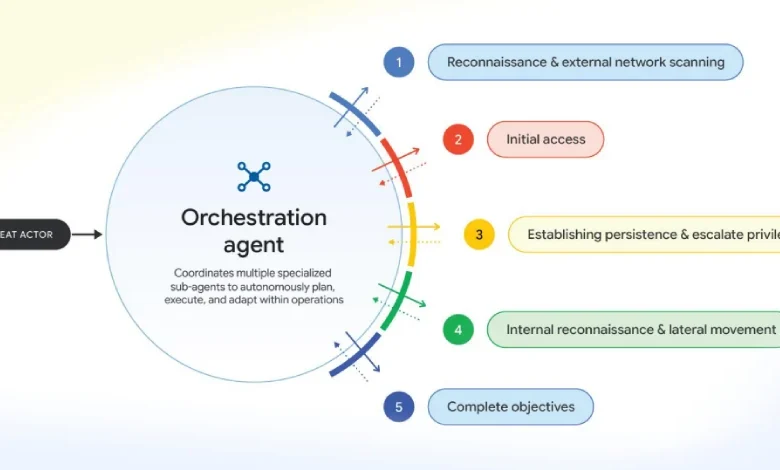
Google’s threat researchers have identified several prominent frameworks currently being leveraged in the wild to orchestrate live intrusions. These include ARTEX, CAIRN, CyberStrikeAI, and PentAGI. These frameworks operate by assigning specialized tasks to sub-agents—such as reconnaissance, vulnerability scanning, credential harvesting, and lateral movement—which communicate and adapt in real-time without requiring human intervention once the initial objective is set.
Furthermore, threat actors are incorporating specialized utility services to streamline their operations. For instance, GTIG noted the abuse of ZeroHollow, an inference service specifically tailored for exploit development and intelligent LLM routing, alongside Agent Zero, an open-source agent framework characterized by autonomous code execution and dynamic tool generation. The involvement of these tools points toward a maturing subterranean ecosystem where adversarial engineering mirrors legitimate, agile software development pipelines.
While financially motivated cybercriminal syndicates have embraced these methods for rapid extortion and ransomware deployment, suspected state-sponsored espionage groups—particularly those aligned with China—are also actively experimenting with these agentic frameworks to conduct stealthy, long-term intelligence gathering operations.
Weaponizing Patches Through Differential Analysis
One of the most alarming revelations in the Google report highlights how threat actors are compressing the window between vulnerability disclosure and active exploitation. Traditionally, security researchers and attackers alike spent days or weeks manually reverse-engineering software patches to discover the underlying root cause of a vulnerability—a process commonly referred to as n-day research.
Now, adversaries are leveraging LLM-driven pipelines to automate the reverse engineering of patches via differential analysis. By analyzing source code variations—including pre-release or preview channels, official release notes, security advisories, and preliminary proof-of-concept (PoC) code—intelligent agents can rapidly identify flaws and generate functional exploit payloads in a fraction of the usual time.
A primary real-world example of this alarming velocity occurred earlier this September during a wave of attacks targeting vulnerabilities in PaperCut NG/MF solutions. Attackers deployed hundreds of automated AI-driven routines to probe, identify, and exploit unpatched instances across global networks almost immediately after security advisories and code diffs became publicly accessible. This capability effectively neutralizes the traditional safety buffer that system administrators relied upon to apply emergency patches before widespread exploitation could occur.

Democratization of Cyber Attacks: PhaaS and Natural Language Interfaces
The lowering barrier to entry facilitated by open-source frameworks and generative AI has also transformed the cybercrime-as-a-service (CaaS) and phishing-as-a-service (PaaS) markets. Sophisticated threat groups no longer hold a monopoly on advanced attack methodologies; low-skilled affiliates and opportunistic criminals can now execute complex campaigns using natural language commands.
A prime illustration of this trend is Jieyou, a Chinese-language phishing platform that has integrated an advanced LLM chatbot assistant. Rather than manually editing backend HTML, configuring server relays, or designing bespoke credential-harvesting templates, customers of the platform can interact with the chatbot in plain text. By issuing simple natural language prompts, users can dynamically customize pretext lures, modify login portals, and configure sophisticated phishing infrastructure on the fly.
Google’s analysts noted that platforms like Jieyou represent a broader industry evolution where PhaaS providers utilize LLMs as modular force multipliers. This democratization allows actors with minimal technical proficiency to mount highly convincing, targeted phishing campaigns that bypass traditional heuristic filters through rapid, automated variation of attack artifacts.
The Rise of LLMjacking and AI Infrastructure Monetization
As organizations increasingly adopt generative AI and large language models for internal operations, threat actors have simultaneously pivoted toward targeting AI infrastructure itself. A notable trend emphasized in the report is "LLMjacking," a form of cyber intrusion where attackers compromise enterprise cloud environments specifically to steal LLM API credentials, compute resources, and proprietary model access.
Once unauthorized access to these high-value computational resources is secured, threat actors monetize their ill-gotten gains through underground proxy services and specialized marketplaces often dubbed "LLM mixers," such as APIMart and JetNight. These platforms resell stolen enterprise LLM access and discounted API routing capabilities to secondary buyers, creating a self-sustaining underground economy fueled by hijacked corporate artificial intelligence budgets.
Chronology of Recent Agentic AI Threat Developments
- September 2026: Threat actors initiate large-scale campaigns against PaperCut NG/MF vulnerabilities utilizing automated AI pipelines to rapidly weaponize n-day flaws within hours of patch release.
- November 2026: Security researchers document the targeting of government Linux servers with sophisticated, autonomous multi-stage attack frameworks.
- Mid-November 2026: Backdoored Docker images specifically designed to integrate with automated AI platforms like ArtEx are discovered circulating in public repositories.
- November 16, 2026: The Google Threat Intelligence Group (GTIG) publishes a landmark report detailing the widespread operational shift toward multi-agent offensive frameworks, LLMjacking, and AI-driven PhaaS platforms like Jieyou.
Broader Industry Implications and Defensive Imperatives
The findings presented by Google underscore a sobering reality for enterprise security teams and policymakers alike: the defense-to-offense asymmetry is widening. As cyberattacks take place at "machine speed," traditional human-led incident response procedures struggle to keep pace with threats that can mutate, pivot, and execute multi-stage intrusions in minutes.
The institutionalization of tools like Agent Zero and ZeroHollow, combined with automated patch-analysis pipelines, means that organizations can no longer rely solely on perimeter defenses or reactive patching cycles. Industry analysts emphasize that countering agentic AI threats will require a fundamental transformation in corporate defense strategies.
Organizations are increasingly urged to adopt "AI-vs-AI" defense models—deploying autonomous security agents capable of real-time behavioral analysis, automated threat hunting, and rapid isolation of compromised segments before multi-agent malware can complete its kill chain. Furthermore, stricter governance around AI infrastructure, robust credential rotation policies for LLM endpoints, and continuous monitoring of cloud compute allocations will be vital to mitigating the rising tide of LLMjacking and resource theft.
As autonomous offensive frameworks continue to mature, the cybersecurity community faces an era where resilience is defined not by how fast humans can respond, but by how intelligently enterprise networks can defend themselves at the speed of computation.