Savage X Fenty Literally Throws Shade at New York Fashion Week Competitors with Towering Aerial Installation

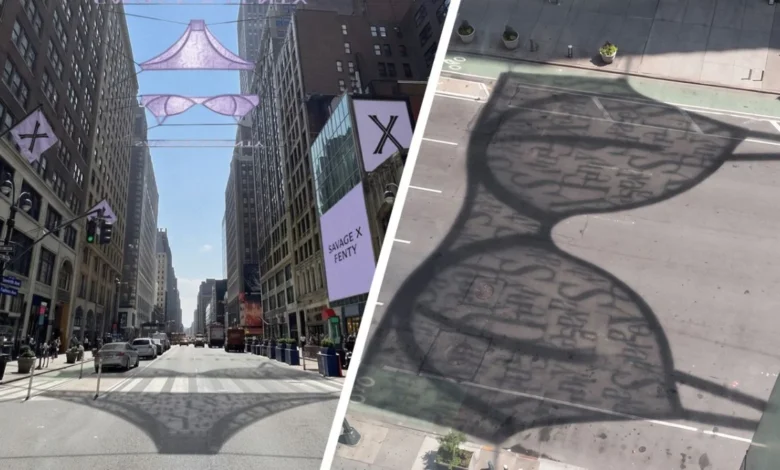
In the hyper-competitive arena of modern marketing, brands continually search for innovative ways to cut through the digital noise. During New York Fashion Week (NYFW), an event characterized by high-octane runway shows, celebrity-heavy front rows, and aggressive promotional campaigns, Rihanna’s lingerie label, Savage X Fenty, has chosen to literally cast a shadow over its rivals. Eschewing traditional static billboards and standard social media blitzes, the brand has launched an oversized, physics-defying aerial installation that dominates the Manhattan skyline, redefining the parameters of experiential design and outdoor advertising.
Suspended high above the bustling intersection of Seventh Avenue and Fashion Avenue in the heart of New York City’s historic Garment District, the installation features a massive, larger-than-life lingerie set. This colossal display does more than just capture the gaze of pedestrians; it actively interacts with the urban environment. When the autumn sun hits the structure at precise angles, the garment casts a deliberate, dramatic silhouette across the pavement below. In a display of meticulous spatial planning, the installation has been positioned so that its shadow frames a busy pedestrian crosswalk, creating an interactive, dual-layered visual experience for the thousands of daily commuters navigating the district.
Anatomy of an Aerial Spectacle: Design and Execution
The execution of the Savage X Fenty campaign marries scale with subtlety, proving that memorable marketing does not require complex digital integration. While the floating undergarments command immediate visual attention due to their sheer physical dimensions, brand identification is handled with clean, calculated precision. The floating set is cleanly bordered by the recognizable Savage X Fenty logo, while the fabric of the garments themselves features the signature Savage wordmark rendered in a sleek, contemporary serif font.
This tactile approach to advertising represents a calculated risk in an era dominated by programmatic digital ads, targeted social media feeds, and immersive augmented reality experiences. By returning to the physical world with a tangible, architectural intervention, Savage X Fenty has tapped into the power of place-based media. Industry observers note that physical installations of this magnitude force a pause in consumer habits, interrupting the monotonous scroll of smartphone screens and converting public infrastructure into a dynamic canvas.
The Evolution of Outdoor Advertising at New York Fashion Week
New York Fashion Week has long served as a testing ground for experimental marketing strategies. Historically, fashion houses relied on exclusive runway presentations to generate media buzz and drive seasonal sales. However, the democratization of fashion through social media and livestreaming has shifted the marketing paradigm. Brands no longer compete solely for the attention of print editors and elite buyers; they battle for the fleeting attention spans of global digital audiences and local foot traffic alike.
Over the past decade, outdoor advertising—often referred to as out-of-home (OOH) media—has undergone a renaissance. According to recent data from the Out of Home Advertising Association of America (OAAA), OOH advertising revenue has experienced steady post-pandemic growth, driven largely by brands seeking high-impact, physical touchpoints that cannot be blocked by ad-blocking software. Brands increasingly recognize that physical installations generate earned media, as consumers naturally photograph and share unconventional public art pieces across platforms like Instagram, TikTok, and X (formerly Twitter).
Savage X Fenty’s latest stunt fits squarely into this evolving lineage of experiential marketing. By taking to the skies above the Garment District—the historic epicenter of America’s fashion manufacturing—the brand draws a direct line between its commercial presence and the industrial heritage of New York City’s fashion ecosystem.
Industry Context and Brand Positioning
Founded by Rihanna in 2018 in partnership with TechStyle Fashion Group, Savage X Fenty has consistently disrupted the traditional intimate apparel market through inclusive sizing, diverse runway casting, and unconventional marketing strategies. From its high-profile, music-infused Amazon Prime fashion shows to pop-up retail experiences, the brand has built its market share on challenging industry norms.
The decision to execute an aerial advertising campaign during NYFW aligns with the brand’s overarching commercial ethos. While heritage lingerie brands have traditionally relied on glossy, highly stylized studio photography and traditional broadcast commercials, Savage X Fenty frequently favors disruptive, community-facing initiatives. By literally casting a shadow over Seventh Avenue—a thoroughfare flanked by the offices and storefronts of competing apparel companies—the brand executes a clever visual pun that reinforces its market ambition.
Marketing analysts point out that experiential campaigns of this scale serve a dual purpose: they capture immediate local foot traffic while simultaneously generating viral digital content. The physical presence on Seventh Avenue acts as a content generator, allowing the brand to maximize its return on investment by bridging physical urban space with digital ecosystem sharing.
Economic and Logistical Implications of Urban Installations
Executing a large-scale aerial or structural installation in a dense metropolitan environment like Manhattan is a complex logistical undertaking. It requires navigating strict municipal regulations, securing permits from city departments, coordinating structural engineering assessments to ensure public safety, and managing traffic flow during peak hours.
The financial investment required for high-impact OOH installations of this nature is substantial, yet major fashion brands increasingly view these costs as essential brand-building expenditures. Unlike digital banner ads, which suffer from high rates of consumer fatigue and ad blindness, physical urban takeovers create an unavoidable presence. Passersby cannot scroll past a building-sized shadow or a floating installation; they are forced to engage with the environment.
Furthermore, the timing of the campaign coincides with the peak influx of international journalists, buyers, influencers, and fashion enthusiasts who descend upon New York City for Fashion Week. By anchoring its visual statement in the Garment District—an area intrinsically linked to the trade shows and corporate headquarters driving the week’s events—Savage X Fenty ensures maximum visibility among key industry stakeholders.
Broader Trends in Modern Advertising
The success of the Savage X Fenty NYFW installation highlights a broader industry shift toward tactile, narrative-driven marketing. As consumers grow increasingly skeptical of traditional corporate messaging, brands are forced to adopt formats that feel more like public art installations or cultural interventions than traditional advertisements.
Recent years have seen a rise in "subvertising," guerrilla marketing, and hyper-localized brand activations designed to spark genuine curiosity and conversation. Whether through massive love-letter billboard campaigns or towering physical structures that alter urban geography, contemporary advertisers are recognizing that surprise and scale remain two of the most effective tools for commanding public attention.
As New York Fashion Week concludes, the legacy of Savage X Fenty’s aerial gambit will likely be measured not just in immediate sales conversions, but in its contribution to the ongoing dialogue about how physical spaces can be utilized for commercial storytelling. By literally rising above the competition, the brand has set a high bar for future experiential marketing efforts in the fashion capital of the world.
Related posts: