The Evolution and Implementation of Artificial Intelligence Tools in the Global E-commerce Ecosystem

Artificial intelligence has transitioned from a specialized technological niche into a fundamental pillar of modern corporate strategy, fundamentally altering how businesses interact with consumers and manage internal operations. As the diversity of its applications continues to expand, AI-driven language models and generative algorithms are demonstrating unprecedented potential in streamlining workflows. Recent industry data indicates that approximately 35% of global companies have already integrated AI into their core business processes, a figure that continues to climb as the barrier to entry for these technologies lowers. Furthermore, 90% of organizations now view AI assistance as a primary driver of competitive advantage, while 77% of modern electronic devices incorporate some form of AI functionality. To remain relevant in an increasingly automated marketplace, professionals—ranging from independent entrepreneurs to enterprise-level executives—are seeking to understand the nuances of these tools to optimize online stores, corporate blogs, and project management frameworks.
The Rapid Proliferation of AI in the Business Landscape
The current surge in AI adoption is not a sudden anomaly but the result of a decade of incremental progress in machine learning, culminating in the recent explosion of generative AI. Since the public release of advanced large language models (LLMs) in late 2022, the trajectory of business automation has accelerated. Companies that previously used AI only for basic data analysis are now employing it for complex creative tasks, customer service, and predictive logistics.
Statistics provided by research firms like AuthorityHacker and Gartner suggest that the "early adopter" phase has ended, and the "mainstream integration" phase has begun. The 35% adoption rate highlights a significant shift in resource allocation; budgets are moving away from traditional manual processes toward software-as-a-service (SaaS) platforms that offer integrated AI capabilities. This shift is particularly evident in the e-commerce sector, where the ability to scale content and personalize user experiences directly correlates with revenue growth.
A Chronological Perspective on AI Integration
To understand the current state of AI tools, it is necessary to examine the timeline of their emergence into the professional sphere:
- 2010–2018: The Era of Predictive Analytics. AI was primarily used by large corporations for "Big Data" analysis, forecasting sales trends, and basic recommendation engines (such as those used by Amazon and Netflix).
- 2018–2021: Specialized Automation. Tools began to emerge for specific tasks like automated email marketing and basic chatbots. However, these systems often lacked the nuance required for high-level creative work.
- 2022: The Generative Breakthrough. The release of models like GPT-3 and Stable Diffusion marked a turning point. For the first time, AI could generate human-like text and high-quality imagery from simple natural language prompts.
- 2023–Present: The Ecosystem Integration. AI is no longer a standalone tool but is being embedded into existing software suites like Microsoft 365, Adobe Creative Cloud, and Google Workspace. This period is defined by "multimodal" AI, which can process text, images, and video simultaneously.
Strategic Categorization of AI Tools for E-commerce
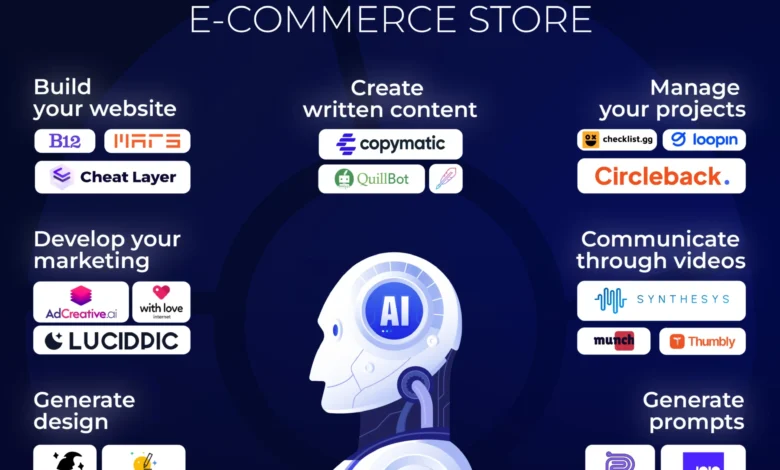
The utility of AI is best understood through its specific applications. For businesses looking to enhance their digital presence, the landscape of available tools can be categorized into several functional domains.
Web Development and Design
Building a professional website was once a task that required weeks of coding or high-level design expertise. Modern AI website builders have reduced this timeframe to minutes. Tools such as 10Web and Wix ADI utilize AI to generate site layouts based on a few user-provided details about their business. These platforms can automatically optimize images, generate initial copy, and ensure mobile responsiveness. By 2024, the focus has shifted toward "generative UI," where AI can create entire user interfaces based on descriptive prompts, allowing for rapid prototyping and deployment.
Marketing and Brand Development
In the realm of marketing, AI is being used to bridge the gap between data and creativity. Platforms like Albert.ai and Revealbot allow marketers to automate ad spend across various channels, using machine learning to determine which demographics are responding best to specific creative assets. This removes the guesswork from digital advertising. Furthermore, AI-driven SEO tools analyze search engine algorithms in real-time, providing businesses with specific keywords and structural recommendations to improve their organic visibility.
Video Communication and Production
Video content is currently the most engaging medium on social media and e-commerce platforms. However, traditional video production is expensive and time-consuming. AI tools like Synthesia and HeyGen allow companies to create professional-grade videos using AI avatars that speak multiple languages with realistic lip-syncing. This enables global brands to localize their video marketing without the need for international film crews. Additionally, tools like Runway and Pika Labs are pushing the boundaries of generative video, allowing users to create cinematic B-roll from text descriptions.
Project Management and Operational Efficiency
Efficiency is the cornerstone of a profitable online store. AI-integrated project management tools such as Monday.com and ClickUp now feature "AI sidekicks" that can summarize long comment threads, predict project bottlenecks, and automatically assign tasks based on team capacity. This reduces the administrative burden on managers, allowing them to focus on high-level strategy rather than logistical minutiae.
Content Creation and Strategy
Written content remains vital for SEO and brand authority. The rise of ChatGPT, Claude, and Jasper has revolutionized how blogs, product descriptions, and social media captions are produced. These tools are not merely "writing bots" but strategic partners that can help brainstorm content pillars, create editorial calendars, and ensure a consistent brand voice across all platforms. The integration of AI in content marketing has led to a 40% increase in content output for many digital marketing agencies, according to industry surveys.
Supporting Data: The Economic Impact of AI
The financial implications of AI adoption are substantial. According to a 2023 McKinsey Global Institute report, generative AI could add the equivalent of $2.6 trillion to $4.4 trillion annually to the global economy. In the retail and e-commerce sector specifically, this impact is estimated at $400 billion to $660 billion.
The competitive advantage mentioned in the initial statistics is reflected in productivity gains. Companies utilizing AI for coding and technical development report a 55% increase in developer speed. In customer service, AI-powered chatbots now handle up to 70% of initial inquiries without human intervention, leading to significant savings in labor costs while maintaining 24/7 availability for global customers.
Industry Perspectives and Official Responses
Leaders in the tech industry have voiced a mixture of optimism and caution regarding this rapid shift. Satya Nadella, CEO of Microsoft, has stated that "AI is the defining technology of our time," emphasizing that every software category will be reinvented by AI. Conversely, industry watchdogs and regulatory bodies in the European Union and the United States are working toward frameworks to ensure that AI development remains ethical and transparent.
For e-commerce business owners, the reaction has been largely pragmatic. "The question is no longer whether to use AI, but how to use it responsibly," says Sarah Jenkins, a digital strategy consultant. "The brands that are winning are those that use AI to augment human creativity rather than replace it entirely. Customers still crave authenticity; AI should be used to clear the path for more meaningful human-to-human interaction."
Broader Implications and Future Outlook
The long-term implications of AI in business extend beyond simple efficiency. We are witnessing a democratization of technology. Small businesses now have access to the same level of analytical and creative power that was once reserved for Fortune 500 companies. This levels the playing field in the global market.
However, this transition also presents challenges. The "digital divide" is evolving; the gap is no longer between those who have internet access and those who do not, but between those who can effectively prompt and manage AI systems and those who cannot. Professional "prompt engineering" has emerged as a vital skill set, as the quality of AI output is directly tied to the quality of the input.
Looking forward to 2025 and beyond, we can expect AI to become even more "agentic." This means AI will not just suggest actions or generate content but will be capable of executing multi-step business processes autonomously—such as managing an entire supply chain or negotiating with vendors. For the e-commerce sector, the goal will be hyper-personalization, where every visitor to an online store sees a unique version of the site tailored specifically to their preferences, browsing history, and psychological profile.
In conclusion, the integration of artificial intelligence into business processes is an irreversible trend. With 77% of devices already utilizing AI, the technology is embedded in the fabric of daily life. For companies aiming to maintain a competitive edge, the adoption of these tools is not merely an option but a strategic necessity. By understanding the landscape of available tools—from web design to complex project management—businesses can navigate this technological revolution and thrive in the new digital economy.