The Internet Lore of They’re Good Dogs Brent How a Simple Twitter Reply Became a Defining Cultural Touchstone of the Social Media Era

In the vast and often volatile ecosystem of social media, digital folklore is frequently born from the most mundane interactions. Long before platform algorithms dictated the entirety of the modern internet experience, a single, unassuming disagreement on Twitter managed to capture the collective imagination of millions. What began as a mild annoyance regarding a humorous canine review account transformed into an enduring linguistic phenomenon known simply as "They’re Good Dogs, Brent." This phrase, immortalized in September 2016, transcended its origins as a witty clapback to become a symbol of wholesome internet culture, a masterclass in community management, and a rare instance of a reluctant internet antagonist gracefully embracing accidental stardom.
Main Facts of the Viral Exchange
The focal point of this cultural artifact is the immensely popular Twitter account @dog_rates, widely known as WeRateDogs. Founded on a premise of pure, unadulterated wholesomeness, the account dedicates itself to reviewing photographs of dogs submitted by users, frequently awarding them hyperbolic and mathematically impossible scores exceeding the standard scale, such as 11/10 or 14/10. By September 2016, the account had already amassed a dedicated following of millions, relying on a tone that was inherently lighthearted, affectionate, and deeply humorous.
The friction occurred when a user named Brant—whose handle was @brant—encountered one of the account’s trademark ratings and took literal, bureaucratic offense to the methodology. Frustrated by the lack of objective scoring standards, Brant engaged with the account to voice his critique, arguing that the system was fundamentally flawed and suggesting that the page ought to rebrand to reflect its actual content more accurately.
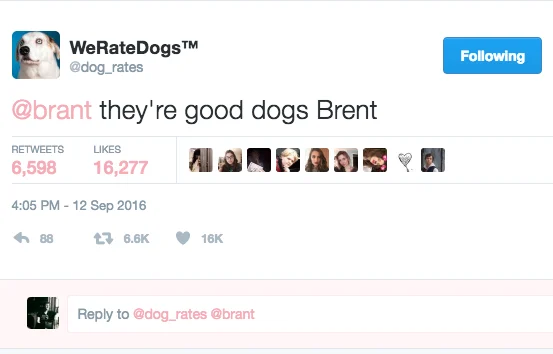
Rather than engaging in a defensive corporate-style rebuttal or ignoring the critique entirely, the operator behind @dog_rates chose a path of disarming absurdity. With a deliberate misspelling of the user’s name to subtly undermine his authority, the account replied with a phrase that would instantly enter the digital lexicon: "they’re good dogs Brent." This concise, airtight logic—implying that traditional metrics of evaluation are utterly meaningless when confronted with the inherent goodness of canines—shut down the debate permanently.
Chronology of Events: From Disagreement to Cultural Phenomenon
To understand the trajectory of "They’re Good Dogs, Brent," one must examine the rapid acceleration of the event across the digital landscape in real time.
The timeline commenced on September 12, 2016. Brant initiated the public exchange by directly tweeting at @dog_rates, stating that their rating system made no sense and aggressively suggesting a name change to "CuteDogs." The account operator fired back almost immediately, questioning his emotional state with the teasing retort, "Why are you so mad Bront." When Brant attempted to clarify his grievances by pointing out that every dog was consistently awarded inflated scores of 11 and 12, effectively rendering the numbers arbitrary, WeRateDogs delivered the definitive blow: "they’re good dogs Brent."
The velocity at which the exchange spread was immediate. Within hours, screenshots of the conversation were shared across the platform by observers who recognized the comedic perfection of the interaction. User @Braydenominator posted a screenshot that day, which ultimately accumulated over 57,000 retweets by early 2017. Major digital culture publications, including Mashable and Elite Daily, published articles detailing the exchange within 24 hours, recognizing it as a watershed moment in viral comedy.
The ripple effects extended far beyond initial news coverage. Twitter users swiftly incorporated the phrase into various existing meme formats. A particularly notable adaptation applied the phrasing to a parody of the television series The Walking Dead, replacing characters with dog-centric dialogue, while mainstream public figures, comedians, and internet personalities began casually dropping the phrase into unrelated conversations.
Supporting Data and Quantitative Impact

The quantifiable metrics surrounding the "They’re Good Dogs, Brent" phenomenon illustrate the immense economic and social power of viral moments in the mid-2010s. According to analytics and retrospective analyses conducted by major publications like The Washington Post—which later named the exchange one of the definitive memes of 2016—the @dog_rates account experienced a staggering surge in visibility. Within hours of the exchange, the account gained an estimated 50,000 new followers, cementing its status as a titan of wholesome internet content.
Capitalizing on the unexpected marketing windfall, the account operators acted swiftly to integrate the phrase into official merchandise. T-shirts and coffee mugs bearing the exact quote were produced and sold to an eager fanbase, turning a fleeting Twitter interaction into a sustainable brand asset.
For Brant himself, the quantitative impact manifested as an unexpected deluge of digital notoriety. Overnight, his personal notification feeds were flooded with mentions, memes, and lighthearted ribbing from strangers across the globe. Rather than deleting his account or retreating from the platform—reactions common among accidental meme targets—Brant chose a path of radical acceptance. He leaned into the joke, demonstrating a level of self-awareness that endeared him further to the online community. This culminated in a permanent, physical manifestation of the meme: Brant incorporated the phrase "They’re good dogs Brent" into the design of his own wedding cake, proving that digital identity and real-world life could harmoniously intersect.
The Full Circle Moment: Brant’s Dog Charlie
The narrative of "They’re Good Dogs, Brent" achieved a cinematic sense of closure nearly two years after the initial interaction. On July 23, 2018, the WeRateDogs account posted a public update revealing that they had come into direct contact with Brant once more. This time, however, the dynamic was entirely transformed.
Brant reached out to the account via direct message to submit a new subject for evaluation: his very own Havanese dog, named Charlie. Recognizing the historical significance of the submission, the account reviewed Charlie and awarded him an unprecedented "14/10," accompanied by the personalized message: "you’ve got a good dog, Brent."
The reaction from the internet was instantaneous and overwhelming. Within 24 hours of publication, the tweet garnered upwards of 92,700 likes and 16,500 retweets. Twitter promptly curated a dedicated Moments page to chronicle the emotional reactions of users who had witnessed the digital arc come to its wholesome conclusion. The public response was overwhelmingly celebratory, with users expressing profound satisfaction that the historical tension between the reviewer and the reviewed had resolved in the adoption and celebration of an actual good dog.
Broader Impact and Implications for Digital Culture
Beyond its surface-level humor, the "They’re Good Dogs, Brent" phenomenon offers a fascinating case study in modern conflict resolution and community psychology within digital spaces. In an era where online discourse is frequently characterized by polarization, outrage, and unrelenting hostility, the exchange demonstrated the disarming power of radical simplicity and humor.
Brant’s initial critique was rooted in a traditional, analytical framework—he sought consistency, logic, and standardized metrics in a domain that deliberately rejected them. The response from WeRateDogs bypassed logical debate entirely, appealing instead to an emotional consensus: the intrinsic value of dogs supersedes the need for rigorous academic scoring. By reframing the disagreement not as an intellectual debate to be won, but as a humorous misunderstanding of universal truths, the interaction neutralized potential toxicity.
Furthermore, the saga highlights the evolving nature of internet celebrity and accountability. Accidental meme subjects frequently face sustained harassment or reputational damage. Brant’s experience, by contrast, demonstrates how grace, humor, and resilience can convert a moment of public embarrassment into a badge of honor. By owning the joke—from his wedding cake to introducing his real-life dog to the very account that roasted him—Brant transformed himself from a digital punchline into a beloved fixture of internet lore.
As social media platforms continue to evolve and the lifespan of viral content grows increasingly ephemeral, "They’re Good Dogs, Brent" remains a touchstone for enduring digital culture. It serves as a reminder that behind handles, metrics, and algorithmic feeds are human beings capable of laughing at themselves, finding common ground, and agreeing on the most fundamental truth of the digital age: regardless of arbitrary rating systems, all dogs are fundamentally good.