The Rise of Didy: How Internet Slang, Algospeak, and Absurdist Humor Redefined Online Discourse Surrounding Sean Combs

The digital landscape has long served as a dynamic ecosystem where contemporary events are rapidly recontextualized through humor, irony, and evolving linguistic subcultures. In recent months, internet users across platforms such as Instagram, TikTok, and X (formerly Twitter) have witnessed the emergence of a peculiar lexical phenomenon: the widespread adoption of the term "Didy." As a deliberate misspelling of the name associated with disgraced music mogul Sean "P. Diddy" Combs, the slang term has transitioned from an obscure ironic joke into a dominant staple of modern meme culture. Beyond mere mockery, the term exemplifies broader shifts in how digital communities navigate content moderation algorithms, process high-profile legal controversies, and utilize absurdist humor to cope with real-world scandals.
Understanding the Genesis of Didy and the Mechanics of Algospeak
To comprehend the trajectory of the Didy phenomenon, one must examine the intersection of internet linguistics and algorithmic content moderation. The term functions primarily as a tongue-in-cheek reference to Sean Combs, whose legal battles and subsequent public downfall dominated global headlines following his arrest and the conclusion of high-profile legal proceedings in mid-2025. Facing serious federal charges and widespread media scrutiny, Combs became the subject of intense public fascination, leading to an inevitable wave of internet satire.
However, the creation of the moniker "Didy" is not solely rooted in comedic irreverence; it also functions as a prime example of "algospeak." As social media platforms like TikTok, Instagram Reels, and YouTube Shorts employ increasingly sophisticated automated moderation systems to suppress content referencing sensitive legal cases, violence, or controversial public figures, creators have adapted by modifying language. By deliberately altering the spelling of names and sensitive keywords—shifting from "P. Diddy" to "Didy"—users can bypass automated content flags, prevent their videos from being shadowbanned, and maintain audience engagement without triggering platform penalties.
What began as a tactical workaround quickly evolved into an independent cultural touchstone. The misspelling imbued the subject matter with an inherently goofy, unserious tone that starkly contrasted with the gravity of the actual legal allegations. This linguistic subversion allowed meme pages to discuss cultural anxieties and high-profile news stories through a lens of absurdism, transforming a grim legal narrative into a surreal digital playground.
Chronology and Viral Propagation: From Marginal Subculture to Mainstream Meme
The timeline of the Didy phenomenon traces a steady upward trajectory of virality, punctuated by key inflection points across multiple social media platforms. While sporadic, unconfirmed iterations may have appeared earlier, the earliest documented viral instances of the misspelled moniker emerged on Instagram in late July 2025, closely following the conclusion of Sean Combs’ initial legal proceedings that month.
One of the foundational moments in the meme’s history occurred on July 24th, 2025, when the Instagram page negan.feels published a variation of the popular "Mr. Incredible Becoming Uncanny" format. The post, which humorously juxtaposed eerie imagery with a reference to receiving an unexpected phone call from "Didy," struck a chord with internet audiences. Over the course of the following year, the post steadily accumulated traction, ultimately surpassing 62,100 likes and establishing a conceptual template for subsequent creators.
Throughout the remainder of 2025 and into early 2026, the slang term percolated within niche meme communities. On December 18th, 2025, the Instagram page bogorhoodfails2009 contributed to the trend with a post that garnered nearly 15,000 likes, signaling that the joke was retaining its cultural footprint rather than fading away as a transient fad. By the summer of 2026, the vocabulary surrounding the trend had expanded. On August 31st, 2026, Instagram user juggperc shared a post utilizing the phrase "When bro says didy words," which resonated deeply with users and amassed over 91,000 likes within two months, confirming that "Didy" had successfully integrated into everyday digital slang.
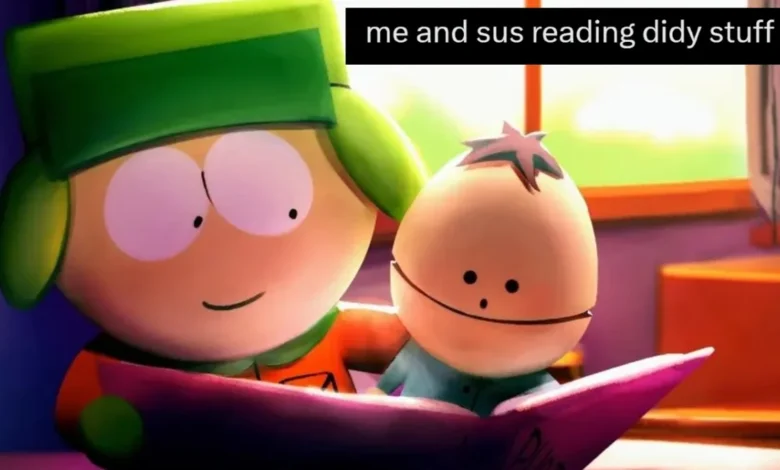
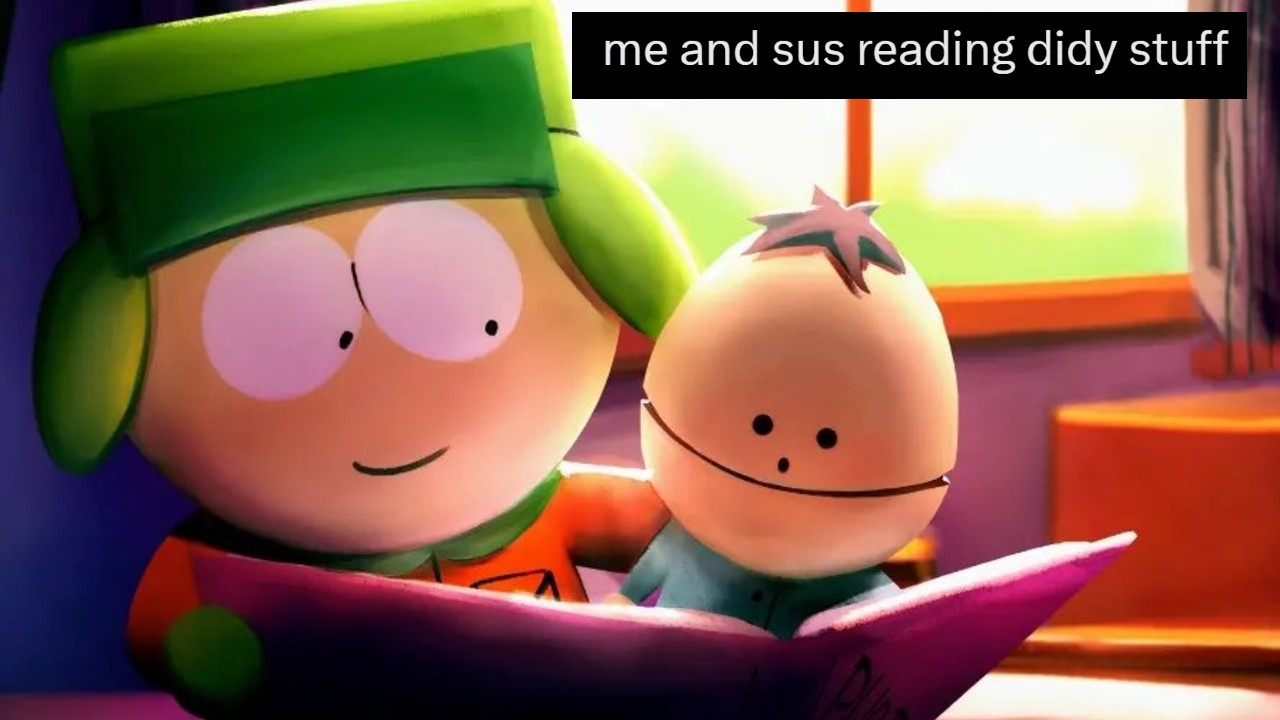
The definitive mainstream explosion of Didy memes, however, occurred in October 2026. During this period, the meme broke out of its Instagram confines and saturated TikTok and X, undergoing a significant stylistic transformation. Rather than relying solely on abstract or uncanny imagery, creators began pairing the slang term with out-of-style, low-resolution screenshots from the animated television series South Park, matched with intentionally nonsensical and hyperbolic captions.
On October 23rd, 2026, X user @jadecerealepic7 posted an image of the South Park characters Kyle and Ike, accompanied by the deadpan caption "me and sus reading didy stuff." The post quickly went viral, securing over 9,000 likes in less than four days. On the same day, another X user, @poneshion, published a South Park-themed meme referencing a fictional geopolitical conflict dubbed the "didy vs drake war," capturing over 23,000 likes. Simultaneously, short-form video platforms embraced the trend; on October 23rd, TikTok creator @rooooofus uploaded a video featuring a horse consuming a peppermint, cheekily framing the animal as a "Didy horse." The surreal video struck a chord with the algorithm, pulling in more than 850,000 views in just four days.
Sociological and Cultural Implications of Absurdist Digital Humor
The rapid ascent of the Didy meme offers valuable insight into contemporary digital media consumption and the psychological mechanisms of internet subcultures. Sociologists and digital media researchers have long noted that younger generations frequently utilize absurdist humor, irony, and surrealism as coping mechanisms when processing distressing or overwhelmingly negative news cycles.
The transition from traditional news consumption to meme-based dissemination allows users to reclaim a sense of agency over harrowing real-world events. By reducing a complex, highly publicized criminal trial and its associated figures into abstract catchphrases and vintage cartoon imagery, internet communities strip the subject matter of its intimidating gravity. In this context, "Didy" ceases to be a direct reference to a specific real-world individual involved in serious legal proceedings; instead, it becomes a malleable linguistic vessel capable of holding virtually any random, nonsensical thought.
Furthermore, the integration of classic animation, such as early seasons of South Park, introduces a layer of nostalgic juxtaposition. The stark contrast between the crude, early-2000s aesthetics of the television show and the hyper-modernity of internet slang creates a jarring comedic effect. This blending of eras is a hallmark of contemporary Gen Z and Generation Alpha humor, which often favors chaotic pastiche over traditional narrative joke structures.
Platform Responses and Algorithmic Moderation Challenges
The proliferation of terms like Didy highlights an ongoing game of cat-and-mouse between digital platform administrators and internet users. Major social media companies, facing intense regulatory pressure and public scrutiny regarding content safety, have continually refined their automated moderation tools to detect hate speech, harassment, and references to ongoing criminal investigations.
When platforms actively suppress specific keywords to maintain brand safety and comply with legal frameworks, users inevitably invent linguistic workarounds. Algospeak has thus evolved from a defensive maneuver used by marginalized communities to protect their content into a ubiquitous creative medium. By introducing intentional misspellings, internet users successfully train recommendation algorithms to distribute content that otherwise might have been flagged and removed.
While platforms continually update their natural language processing models to catch these phonetic adaptations—often recognizing that "Didy" serves as a direct proxy for "Diddy"—the sheer velocity of internet culture ensures that slang terms mutate faster than automated systems can effectively suppress them. Consequently, moderators are left grappling with a philosophical dilemma: distinguishing between genuine attempts to evade safety guidelines and harmless, albeit surreal, expressions of internet humor.
Broader Impact on Public Discourse and Celebrity Perception
The lasting impact of phenomena like the Didy meme extends far beyond temporary algorithmic trickery; it fundamentally alters how modern public figures are cemented into digital folklore. Historically, public disgrace resulted in ostracization and eventual historical obscurity. In the modern era, however, high-profile falls from grace are frequently met with hyper-accelerated memeification, transforming the subject into an absurdist digital caricature.
Sean Combs joins a growing pantheon of contemporary figures who have been abstracted into internet memes, severing their real-world identities from their digital personas. For millions of younger internet users who consume news primarily through TikTok, Instagram Reels, and X, the true gravity of the legal proceedings surrounding Combs is filtered through layers of detachment, irony, and surrealist cartoons.
Whether the Didy meme will maintain its cultural relevance or eventually fade as algorithms adapt and new news cycles emerge remains to be seen. Nevertheless, the phenomenon stands as a testament to the internet’s remarkable capacity to ingest, digest, and entirely transform contemporary reality into an unrecognizably humorous digital dialect. As long as algorithmic restrictions persist and creators seek novel ways to express themselves within constrained digital environments, the evolution of algospeak and absurdist meme culture will continue to shape the boundaries of modern public discourse.