The Ultimate Guide to Integrating AI Tools into Your Online Store and Business Processes

Artificial intelligence has officially transitioned from a theoretical concept of computer science laboratories to an indispensable operational engine for modern commerce. Across industries, enterprises of all scales are racing to integrate machine learning models, natural language processing frameworks, and generative software into their daily workflows. Recent industry data underscores this rapid paradigm shift: approximately 35% of global companies have already formally adopted artificial intelligence into their core processes, according to recent figures compiled by AuthorityHacker. Furthermore, an overwhelming 90% of business leaders now view AI assistance as a definitive competitive advantage in an increasingly digitized global marketplace. This sentiment is mirrored by consumer markets as well, where roughly 77% of modern electronic devices now incorporate some form of artificial intelligence directly into their native functionalities. As these technologies continue to diversify and mature, understanding both the practical applications and the underlying mechanics of AI has become a fundamental requirement for professionals seeking to maintain market relevance.
The rapid democratization of artificial intelligence did not happen overnight; it represents the culmination of decades of algorithmic refinement, exponential growth in computing power, and the accumulation of massive digital datasets. The genesis of modern commercial AI can be traced back to the early 2010s, marked by breakthroughs in deep learning and neural networks. However, the true inflection point for mainstream business adoption occurred in late 2022 with the public deployment of advanced generative large language models. These milestones lowered the technical barrier to entry, allowing non-technical entrepreneurs, small business owners, and corporate executives to leverage sophisticated automation without needing a background in software engineering. Throughout 2023 and into 2024, the tech sector witnessed a proliferation of specialized SaaS (Software-as-a-Service) platforms designed to embed AI directly into website builders, customer relationship management systems, and content management pipelines.
To evaluate the true impact of this technological wave, industry analysts and market researchers have closely monitored enterprise integration patterns. According to consensus reports from leading tech intelligence firms, the primary drivers for AI adoption are cost reduction, operational efficiency, and scalability. Companies utilizing AI-driven automation report significant time savings in repetitive administrative tasks, allowing human capital to be redirected toward strategic growth, creative problem-solving, and high-level decision-making. Business executives have increasingly voiced support for these integrations. In statements released at major technology summits throughout the year, industry leaders emphasized that artificial intelligence should not be viewed merely as a tool for cost-cutting, but as an expansive collaborative partner capable of supercharging human creativity and operational output. Representatives from prominent enterprise software firms note that organizations failing to incorporate AI into their digital infrastructure risk falling behind agile competitors who can execute marketing campaigns, website deployment, and customer service operations at unprecedented speeds.
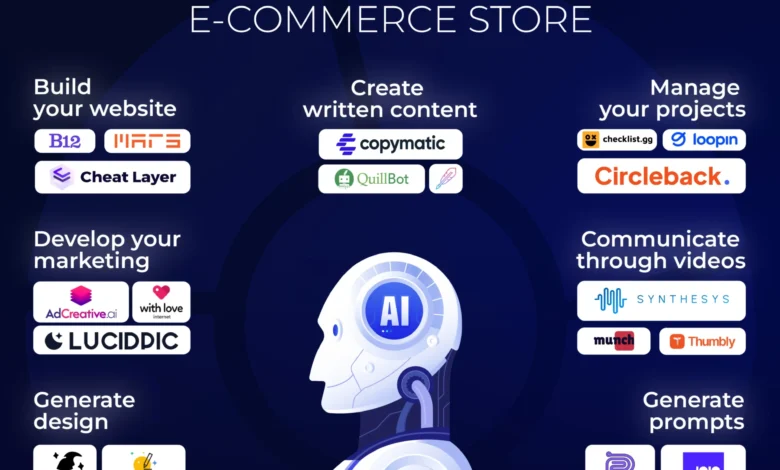
The practical implications of this technological revolution span every corner of modern business operations, particularly for e-commerce ventures, digital storefronts, and content creators. Building and maintaining a digital presence no longer requires months of coding and expensive web development teams. Today, sophisticated website-building platforms utilize artificial intelligence to generate fully responsive, aesthetically polished online storefronts in a matter of minutes based on simple user prompts. These systems automatically optimize layout designs, suggest user-experience improvements, and tailor navigation paths to match consumer behavior patterns, drastically reducing bounce rates and boosting conversion metrics.
In the realm of digital marketing, AI has completely revolutionized how brands approach consumer outreach, audience segmentation, and campaign execution. Marketing teams now rely on predictive algorithms to analyze vast datasets, identifying consumer trends and purchasing intent long before traditional analytics methods could catch up. These tools enable hyper-personalized email campaigns, dynamic pricing models, and automated social media management that adapt in real time to shifting market conditions. By harnessing machine learning, brands can maximize their return on ad spend, targeting specific demographic micro-segments with precision messaging crafted entirely by automated systems.
Video communication and marketing have also undergone a radical transformation. Video content remains one of the most powerful mediums for consumer engagement, yet traditional production is notoriously resource-intensive and expensive. Modern AI-powered video tools allow businesses to generate professional-grade promotional videos, product demonstrations, and localized marketing clips without the need for high-end studio equipment, actors, or complex editing suites. Automated avatar generation, text-to-video synthesis, and intelligent subtitle translation enable small e-commerce merchants to scale their video marketing globally, reaching international audiences in multiple languages with minimal overhead.
Effective project management is the backbone of any successful enterprise, and artificial intelligence is increasingly stepping in to streamline workflow coordination. Project management platforms now feature integrated AI assistants capable of automatically scheduling tasks, predicting project bottlenecks, tracking team workloads, and generating comprehensive progress reports. By automating these logistical oversight duties, project managers can focus on team leadership and strategic alignment, ensuring that complex product launches or website overhauls are delivered on time and within budget.
At the heart of every generative AI application lies the prompt—the specific instruction given to the model to produce the desired output. Recognizing that the quality of an AI’s output is directly tied to the clarity of the input, a specialized category of tools has emerged dedicated exclusively to prompt engineering and generation. These prompt-generation systems help users refine their queries, providing structural frameworks, contextual parameters, and tone guidelines that ensure the artificial intelligence delivers precise, highly relevant results. For e-commerce operators, mastering prompt generation translates into superior product descriptions, more accurate coding assistance, and sharper strategic insights.
Content marketing remains a cornerstone of digital visibility, search engine optimization, and brand authority. Generating high-volume, engaging written content has traditionally posed a major bottleneck for businesses operating blogs and online stores. Today, advanced writing assistants and content strategy platforms help marketers brainstorm topics, outline articles, draft SEO-optimized product descriptions, and maintain a consistent brand voice across all digital channels. While human oversight remains essential to ensure brand authenticity and factual accuracy, these tools enable content teams to scale their publishing output exponentially.
Visual aesthetics play a critical role in consumer trust and brand perception. Generating high-quality graphic designs, marketing banners, social media graphics, and product mockups no longer strictly requires a dedicated graphic design department. AI-powered design generators allow users to create stunning, unique visual assets instantaneously through descriptive text prompts. Whether an online store needs striking hero images for its homepage or custom graphics for an upcoming promotional campaign, design algorithms offer infinite creative variations while maintaining professional artistic standards.
Ultimately, the widespread integration of artificial intelligence into online retail and business management represents a permanent structural evolution rather than a temporary trend. As machine learning models continue to evolve, the distinction between traditional software and intelligent automation will continue to blur. Businesses that successfully embrace these diverse AI tools—spanning web development, marketing, video production, project management, and content creation—will be uniquely positioned to thrive in a hyper-competitive digital economy. By balancing technological efficiency with human strategic vision, modern enterprises can unlock unprecedented levels of innovation, productivity, and customer satisfaction.