White House Network Compromised by Residential Proxy Services Linked to Russian Cyber Operations

The integrity of the Executive Office of the President’s (EOP) digital infrastructure has come under intense scrutiny following the discovery that multiple devices within the White House network are acting as residential proxy nodes. Security researchers from Layer3 Intel and Synthient have identified that staffers have inadvertently or unknowingly installed software that redirects internet traffic through their devices, effectively turning sensitive government assets into conduits for global data routing. Among the services identified is Infatica, a proxy provider founded by Vladimir Fomenko, a figure previously linked to the 2016 election interference operations that targeted databases in Arizona and Illinois.
The Mechanism of the Breach
Residential proxy services operate by transforming consumer and professional internet connections into "exit nodes." When a user installs an application—often a free utility, browser extension, or mobile app—that contains a residential proxy Software Development Kit (SDK), their IP address is added to a pool of addresses that customers can rent. For the end-user, this often happens in the background without explicit knowledge of the security implications. For the proxy service provider, it creates a lucrative business model, selling access to high-reputation IP addresses—such as those belonging to the U.S. government—to clients who wish to mask their identity or geographic location.
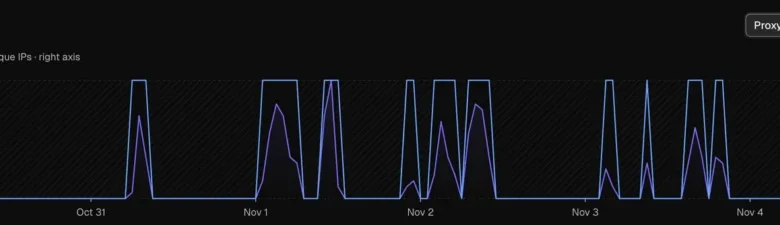
Data captured by Layer3 Intel indicates that between October 5 and November 3, the White House network (AS2650) served as an exit node for external traffic on 236 separate occasions. The beaconing activity was consistent, occurring across 26 of the 30 days analyzed, with a heavy concentration of traffic taking place during off-hours, specifically between 5:00 p.m. and midnight. Researchers noted that the presence of these nodes effectively creates a "public access" point within one of the most secure networks in the world.
A History of Malicious Ties
The involvement of Infatica raises significant national security concerns due to the background of its founder, Vladimir Fomenko. In 2016, Fomenko’s hosting company, King Servers, was identified by intelligence agencies and private cybersecurity firms as the infrastructure provider for several servers used by state-sponsored actors to breach election systems. While the current proxy activity does not inherently prove that the Russian state is utilizing these specific White House nodes, the provenance of the service provider creates a severe risk profile.
Ben Brundage, founder of the proxy tracking firm Synthient, noted that the activity detected from the White House network was explicitly linked to Windows 11 installations of Infatica. The implications of this are twofold: first, the potential for sensitive data exfiltration from within the network; and second, the risk of "network lateral movement." Because these proxy nodes are located inside a trusted network, they can be used to bypass traditional perimeter defenses, effectively granting external actors a foothold inside the firewall.
Timeline of Detected Activity
The discovery follows a pattern of increasing exploitation of residential proxy infrastructure throughout 2025 and 2026.
- 2016: King Servers, founded by Vladimir Fomenko, is identified as a hub for cyberattacks against U.S. election infrastructure.
- Late 2025: Security researchers uncover widespread vulnerabilities in residential proxy services that allow attackers to probe local networks for vulnerable systems.
- January 2026: Synthient exposes the "Kimwolf" botnet, where criminals abused residential proxy services to seize control of devices within private local networks.
- October 5 – November 3, 2026: Layer3 Intel detects consistent proxy beaconing from the Executive Office of the President’s (AS2650) network.
- November 2026: The security community formally alerts stakeholders to the presence of 28 distinct residential proxy services operating through the White House network.
Broad Implications for Government Security
The White House is not an isolated case. Investigations by the security firm Spur and other industry analysts suggest that residential proxies have become a pervasive threat to critical infrastructure. In early 2026, data revealed that residential proxy nodes were present in nearly 300 government-operated networks, 318 utility companies, and 166 healthcare organizations.
The financial incentive for this activity is remarkably low, which only exacerbates the threat. With some bandwidth resellers charging as little as 60 cents per gigabyte, an adversary can gain access to a highly trusted network for less than the cost of a cup of coffee. Furthermore, the lack of rigorous "Know Your Customer" (KYC) protocols within the proxy reseller ecosystem allows criminal actors to remain anonymous while operating from within the digital perimeter of a target organization.
Technical Analysis: The "Free" Software Trap
The primary vector for these compromises is the inclusion of third-party SDKs in seemingly innocuous applications. Developers often monetize "free" software by bundling these SDKs, which then silently enable the device’s proxy capabilities. Employees at high-security agencies or the White House who install such applications on government-issued or personal devices used for work may be inadvertently compromising their entire organizational environment.
Once an application with a proxy SDK is installed, it beacons out to the service provider’s command-and-control server. The device then awaits instructions to relay traffic from a client located anywhere in the world. Because the traffic appears to originate from a legitimate White House IP address, it is rarely flagged by standard threat detection systems, which are designed to block known malicious IP ranges rather than trusted government infrastructure.
Official Response and Remediation
As of the time of publication, the White House has not issued a formal response regarding the security lapse. However, cybersecurity experts emphasize that the remediation process for such a breach is complex. Simply blocking the proxy services at the firewall level is insufficient, as the nodes are embedded at the endpoint level.
Effective mitigation requires a multi-pronged approach:
- Endpoint Auditing: Organizations must conduct comprehensive scans of all devices on their network to identify installed software that may contain proxy SDKs.
- Strict Egress Filtering: Restricting the types of outbound traffic allowed from sensitive subnets can prevent devices from establishing unauthorized connections to proxy command-and-control servers.
- Policy Enforcement: Tightening mobile device management (MDM) policies to restrict the installation of unauthorized third-party applications is essential.
- Network Monitoring: Implementing advanced behavioral analysis to detect anomalous, low-volume, off-hours traffic patterns characteristic of residential proxy beaconing.
The incident highlights a growing tension between the convenience of the modern, hyper-connected digital workplace and the rigorous security requirements of government administration. As residential proxy services continue to proliferate, the ability of organizations to police their internal network environment becomes increasingly difficult. For the White House, the discovery serves as a stark reminder that the smallest, seemingly trivial software installations can introduce significant systemic risks to the highest levels of government.
The fact that 28 different residential proxy services were found to be using the White House network as an exit point suggests that the issue is not limited to a single malicious actor, but rather reflects a systemic failure in endpoint security and network hygiene. Without immediate and decisive action to purge these nodes from the EOP network, the White House remains vulnerable to a wide array of cyber-espionage and data-scraping activities that capitalize on its trusted, high-reputation network status.