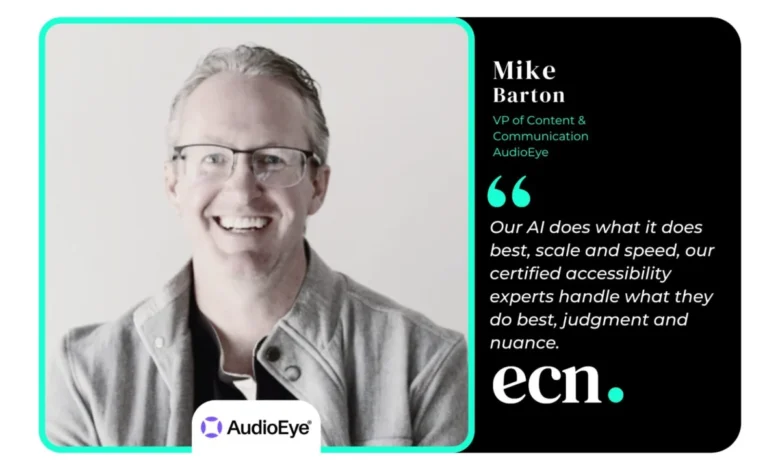
The digital landscape has undergone a dramatic transformation over the past two decades, shifting from a niche technical concern into a critical business imperative. At the forefront of this evolution is AudioEye, a leading digital accessibility platform trusted by more than 127,000 organizations globally. In a comprehensive overview of the current state of digital inclusion, Mike Barton, Vice President of Content Marketing and Communications at AudioEye, detailed the company’s strategic integration of artificial intelligence and human expertise to address the needs of the 1.3 billion individuals worldwide living with disabilities.
The push for universal web access intersects directly with escalating legal risks, multi-billion-dollar market opportunities, and rapidly shifting international regulations. As businesses navigate stricter frameworks such as the European Accessibility Act and a doubling of U.S. accessibility lawsuits since 2020, the demand for scalable, robust compliance solutions has reached unprecedented levels.
The Modern Imperative: Bridging the Digital Divide
Digital accessibility refers to the intentional design and engineering of websites, mobile applications, and digital documents to ensure that individuals with disabilities can navigate and interact with them seamlessly. This includes populations relying on assistive technologies, such as screen readers, voice navigation, and specialized input devices.
According to industry data, the stakes for enterprises failing to adopt these standards extend far beyond legal exposure. Consumers with disabilities represent an estimated $18 trillion in global spending power. Furthermore, research indicates that approximately seven out of ten users will abandon a digital platform immediately if it lacks basic accessibility features, often shifting their business permanently to competitors.
For commercial enterprises, particularly within the e-commerce sector, accessibility functions as a vital conversion metric. Industry metrics show that 83 percent of shoppers with disabilities restrict their online purchasing to platforms they know are fully compatible with their assistive tools. Consequently, treating accessibility merely as a peripheral compliance checkbox creates severe revenue vulnerabilities.
A Hybrid Methodology: Balancing AI Scalability with Human Judgment
As the volume of digital content expands exponentially, organizations face the challenge of auditing and repairing thousands of web pages simultaneously. AudioEye has addressed this operational bottleneck through a hybrid architecture that pairs high-speed automated machine learning with rigorous manual oversight by certified accessibility specialists.
In practical terms, the AudioEye platform integrates into a client’s digital infrastructure via a single line of JavaScript, deploying in a manner similar to standard cookie consent banners or customer support chat widgets. Once embedded, the platform’s AI continuously monitors rendered pages against the Web Content Accessibility Guidelines (WCAG). Independent analyses indicate that such automated detection systems identify significantly higher volumes of code-level anomalies—such as missing alternative text, broken form labels, and improper heading hierarchies—than traditional legacy scanning tools.
However, industry experts emphasize that automation alone remains insufficient for comprehensive compliance. Complex interactive elements, contextual design choices, and user experience nuances often elude algorithmic detection. To bridge this gap, AudioEye pairs its software infrastructure with manual audits conducted by certified professionals, including individuals with lived experience using assistive technologies. This dual approach ensures that approximately 97 percent of compliance issues are intercepted and resolved before internal development teams are required to intervene.
Escalating Legal Pressures and Regulatory Horizons
The regulatory landscape governing digital spaces has tightened significantly. In the United States, litigation under the Americans with Disabilities Act (ADA) has maintained a sharp upward trajectory over the past half-decade. Concurrently, the implementation of the European Accessibility Act (EAA) has expanded compliance mandates across international borders, holding any enterprise operating within or serving customers in the European Union legally accountable for digital inclusion standards.
The financial and operational consequences of non-compliance can be severe. Businesses frequently face demand letters, regulatory penalties, and costly litigation. To mitigate these risks, modern accessibility solutions must offer verifiable protection frameworks. Industry analysts note that robust compliance mechanisms require a combination of real-time automated monitoring, certified expert validation, and documented legal defense support to withstand judicial scrutiny.
The Intersection of Accessibility and Emerging Technologies
Looking toward the future, the integration of artificial intelligence is reshaping digital accessibility from two distinct directions. On one hand, generative AI tools and automated coding assistants frequently accelerate the production of inaccessible web code, as they are often trained on historical datasets that lacked inclusive design standards. This dynamic threatens to widen the existing digital divide unless counterbalanced by automated remediation platforms.
On the other hand, the rise of autonomous AI agents—systems designed to browse the web, retrieve information, and execute transactions on behalf of users—relies heavily on structured web accessibility trees. Platforms that maintain clean, accessible code structures ensure optimal visibility not only for human users relying on assistive tech, but also for the next generation of AI-driven discovery channels. As a result, digital accessibility and artificial intelligence optimization are rapidly converging into a single strategic conversation for enterprise technology leaders.
Future Outlook for Global Web Inclusion
As regulatory frameworks continue to expand globally and digital touchpoints multiply across healthcare, finance, travel, and public sectors, the standard for organizational accountability will only rise. Enterprises that integrate accessibility early in their development lifecycles stand to capture previously untapped consumer markets while insulating themselves from legal liabilities. The ongoing evolution of hybrid platforms signals a permanent shift away from reactive, one-time audits toward continuous, automated, and human-verified digital governance.