Verifying the OpenVLA LoRA Fine-Tuning Pipeline Through Reproducible Google Colab Experiments

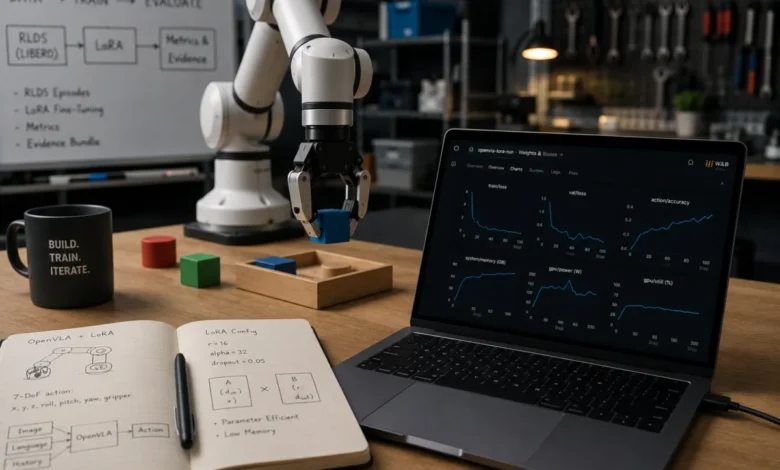
The emergence of large-scale Vision-Language-Action (VLA) models has fundamentally altered the landscape of robotic control, yet the barrier to entry remains high due to the perceived complexity and computational costs of fine-tuning these systems. OpenVLA, a 7-billion-parameter open-source model, represents a significant milestone in this field, having been trained on nearly one million real-world robot demonstrations. To address the accessibility of this technology, a new technical framework has been established to demonstrate that OpenVLA fine-tuning is not only approachable but can be verified through a small, reproducible path using consumer-grade cloud infrastructure like Google Colab.

This experimental workflow focuses on Low-Rank Adaptation (LoRA), a parameter-efficient fine-tuning technique that allows researchers to update a fraction of a model’s weights. By targeting a specific subset of the OpenVLA-7B checkpoint and utilizing the Robot Learning Dataset Standard (RLDS), this methodology provides a blueprint for validating training pipelines before committing to large-scale robotic deployments. The primary objective is to prove that the dataset loads correctly, the GPU performs meaningful computation, and the resulting metrics provide a clear audit trail for peer inspection.
The Evolution of Vision-Language-Action Models
To understand the significance of this fine-tuning experiment, one must look at the broader context of robotic AI. Traditionally, robot policies were trained for specific, narrow tasks. The introduction of VLAs like OpenVLA—detailed in research by Kim et al. (2024)—shifted the paradigm toward general-purpose models. These models take a camera image and a natural-language instruction, such as "pick up the green block," and predict the discrete tokens required for robot movement.

OpenVLA is built upon the Prismatic VLM architecture and is trained on the Open X-Embodiment dataset, which comprises 970,000 demonstrations across diverse robotic platforms. Despite its power, a "base" model often struggles with "embodiment shift"—the discrepancy between the training data and a specific robot’s camera angle, gripper type, or physical environment. Fine-tuning is the bridge that allows a general model to adapt to these specific nuances.
Technical Chronology: From Setup to Verification
The execution of a verifiable OpenVLA fine-tuning run follows a strict chronological sequence designed to ensure stability and reproducibility.

- Environment Configuration: The process begins by establishing a dual-environment setup in Google Colab. Due to the specific dependency requirements of OpenVLA, the workflow utilizes one virtual environment for training and a separate environment for syncing data to Weights & Biases (W&B). This prevents version conflicts between the older ML libraries required by the model and the modern clients used for experiment tracking.
- Hardware Allocation: The experiment is designed for an NVIDIA A100 High-RAM runtime. This hardware choice is critical, as the 7-billion-parameter model, even when quantized or using LoRA, requires substantial VRAM to handle the vision-language embeddings and the gradient updates.
- Dataset Ingestion: The system utilizes the
libero_spatial_no_noopsdataset, a subset of the LIBERO benchmark. This dataset is formatted in RLDS, which stores robot episodes as sequences of observations, instructions, and actions. The "no_noops" variant is specifically chosen to ensure the model learns from active movements rather than static frames where the robot is idle. - Execution of the LoRA Loop: The training command is initiated using
torchrun, targeting a 100-step "smoke test." This phase is not intended to create a production-ready policy but to verify that the gradient descent process is functioning and that the model is successfully minimizing loss against the LIBERO demonstrations. - Data Export and Audit: Upon completion, the notebook generates a structured evidence folder containing environment logs, command histories, and a verified link to the W&B dashboard.
Decoding the Mechanics of LoRA and 7-DoF Actions
The choice of Low-Rank Adaptation (LoRA) is a strategic response to the computational demands of the 7B-parameter architecture. Full fine-tuning would require updating every single parameter in the model, a process that is both memory-intensive and prone to "catastrophic forgetting," where the model loses its general reasoning capabilities. LoRA instead freezes the majority of the pretrained weights and inserts small, trainable matrices into the transformer layers. In this specific run, only 1.4 percent of the parameters are updated, significantly reducing the GPU footprint while maintaining competitive performance levels.
The output of this process is a set of discrete action tokens. OpenVLA represents robot control as a normalized seven-degree-of-freedom (7-DoF) command. These seven values correspond to:

- Translation: Movement along the X, Y, and Z axes.
- Rotation: Changes in Roll, Pitch, and Yaw.
- Gripper State: The binary or continuous value determining if the end effector is open or closed.
A successful fine-tuning run ensures that the model learns to map the visual input of a specific workspace—such as a kitchen counter in the LIBERO dataset—to the precise 7-DoF tokens demonstrated by human operators.
Supporting Data: Analyzing the Training Signal
The validity of the fine-tuning run is confirmed through three primary metrics captured during the 100-step window. While the duration is short, the delta in these numbers provides the necessary "learning signal" to prove the pipeline is active.

Training and L1 Loss
The train_loss serves as the primary indicator of supervised learning error. In the documented experiment, the loss dropped sharply within the first ten steps, stabilizing between 3.2 and 3.6. Simultaneously, the l1_loss, which measures the absolute difference between predicted and demonstrated actions, showed a downward trend from 0.46 to 0.22. This indicates that the model’s continuous action predictions were gravitating toward the ground-truth demonstrations.
Action-Token Accuracy
Action-token accuracy measures the frequency with which the model’s predicted tokens perfectly match the demonstration tokens. In this run, accuracy rose from a baseline of approximately 9% to a peak of 35% near the 90th step. While 35% accuracy is insufficient for autonomous operation, its tripling over 100 steps confirms that the LoRA adapter is successfully absorbing the task-specific patterns of the LIBERO dataset.

System Telemetry
Beyond ML metrics, system telemetry provides the "physical" proof of the run. Monitoring via W&B showed that the Colab A100 GPU maintained a power draw between 165 and 195 watts, with utilization hovering around 40%. This data confirms that the notebook was not merely idling or running a simulated loop, but was performing the heavy matrix multiplications required for transformer training.
Official Responses and Project Objectives
The OpenVLA project, spearheaded by researchers at Stanford, UC Berkeley, and other institutions, was released with the explicit goal of democratizing high-performance robotics. By providing the official vla-scripts/finetune.py entry point, the developers intended for third-party researchers to adapt the 7B model to local laboratory settings.

Analysts in the field of AI-robotics note that the "reproducibility crisis" has long plagued the industry, with many papers presenting results that are difficult to replicate without proprietary hardware or private datasets. The use of open benchmarks like LIBERO and transparent experiment trackers like W&B is a direct response to this challenge. This specific Colab implementation aligns with the "Open Science" movement, providing a low-cost entry point for students and independent researchers to participate in VLA research.
Broader Impact and Implications for Robotics
The ability to run a verifiable fine-tuning session on a cloud-based GPU has several long-term implications for the robotics industry.

1. Lowering the Embodiment Barrier:
Small labs that cannot afford massive compute clusters can now perform the "embodiment shift" necessary to get a 7B-parameter model running on their specific hardware. This accelerates the deployment of AI in niche manufacturing and domestic service robots.
2. Standardizing the Audit Trail:
The transition from "notebooks that don’t crash" to "verifiable evidence folders" marks a shift toward more rigorous engineering standards in AI tutorials. By requiring logs of GPU power, L1 loss, and dataset metadata, the community can better distinguish between genuine progress and superficial demonstrations.

3. The Role of RLDS:
The success of this run reinforces the importance of the Robot Learning Dataset Standard. As more datasets are converted to RLDS, the same fine-tuning script used in this experiment can be applied to a vast array of robotic tasks, from surgical precision to industrial sorting.
In conclusion, while a 100-step run is a modest beginning, it serves as a vital "smoke test" for the future of open-source robotics. It proves that the sophisticated architecture of OpenVLA can be tamed and adapted within a standard cloud environment. For the researcher, the lesson is clear: before pursuing complex task performance, one must first ensure that the training foundation is real, measurable, and entirely reproducible.