Building Agentic Workflows in Python with LangGraph: A Comprehensive Guide to Persistent AI Agents

The evolution of artificial intelligence has transitioned rapidly from simple text generation to the development of sophisticated autonomous agents capable of reasoning, using tools, and maintaining long-term memory. As developers move beyond basic Retrieval-Augmented Generation (RAG) and single-turn model calls, the need for robust frameworks to manage complex logic has become paramount. LangGraph, an extension of the LangChain ecosystem, has emerged as a critical tool for building these "agentic" workflows. By representing an agent as a state machine—or more specifically, a directed graph—LangGraph provides the structural integrity required for industrial-grade AI applications. This guide explores the technical foundations of LangGraph, the implementation of tool-using agents, and the strategic implications of persistent conversation memory in the current AI landscape.
The Architecture of Agentic Workflows: State, Nodes, and Edges
To understand the utility of LangGraph, one must first recognize the limitations of traditional linear chains. In a standard LLM chain, information flows in one direction. However, real-world problem-solving is rarely linear; it involves loops, corrections, and external lookups. LangGraph addresses this by utilizing three core primitives: State, Nodes, and Edges.
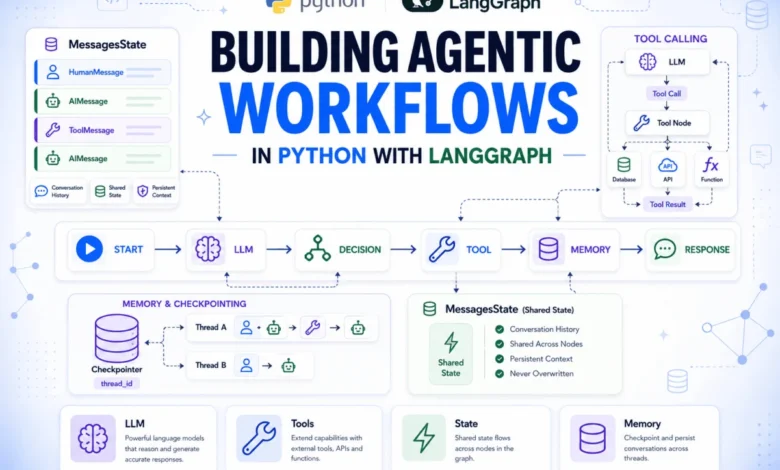
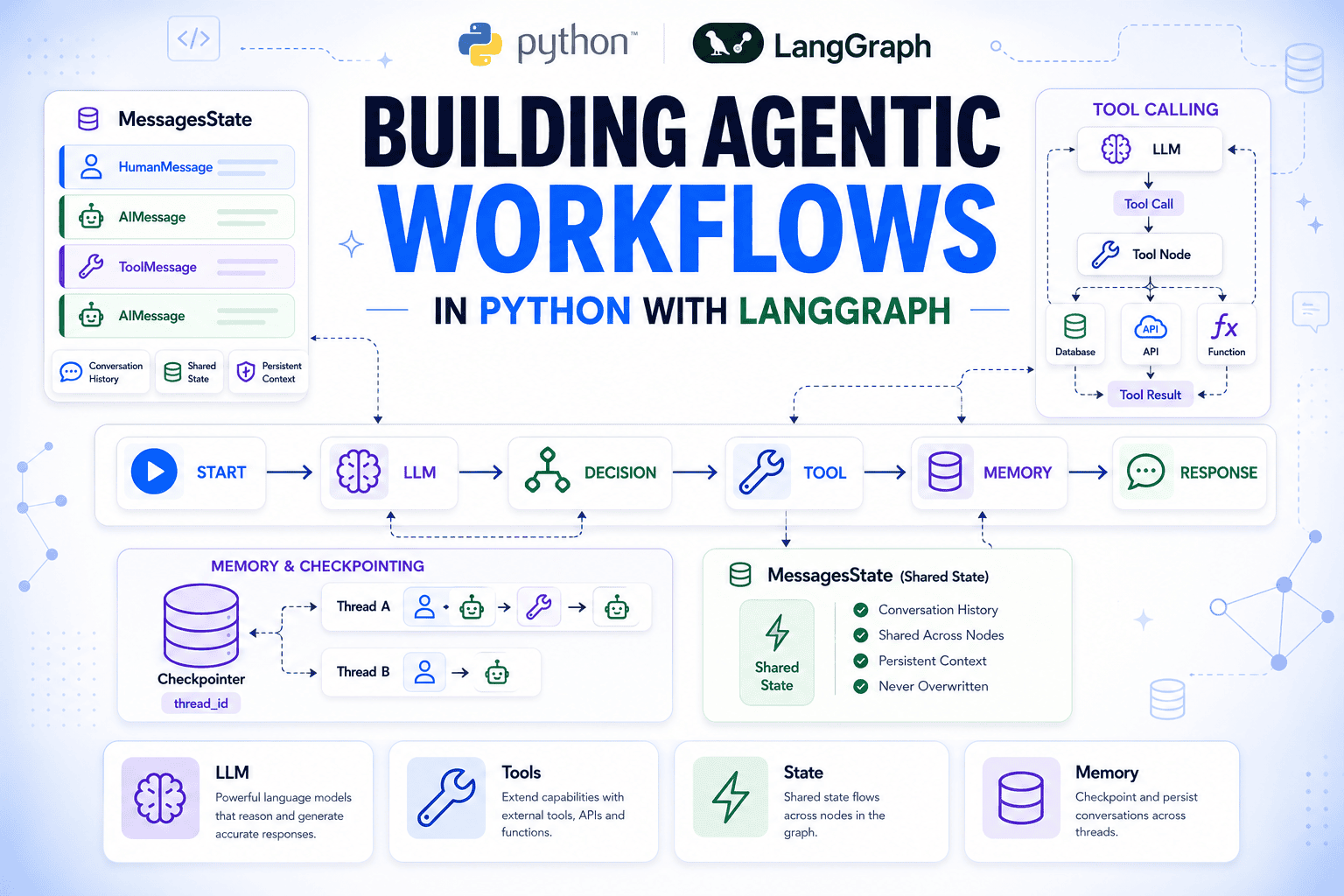
The State serves as the shared memory of the graph. Implemented as a Python TypedDict, the state is the single source of truth for the agent. Every node reads the current state, performs a task, and returns an update. This architecture ensures that no information is passed between nodes through hidden side channels, making the entire execution flow transparent and reproducible.
Nodes are the operational units of the graph. In a LangGraph implementation, nodes are standard Python functions. By registering a function as a node, developers can encapsulate specific logic—such as calling a language model or querying a database—without the overhead of complex class hierarchies. This modularity allows for granular testing and debugging of specific agent behaviors.
Edges define the control flow. While standard edges dictate a fixed sequence (Node A always follows Node B), conditional edges allow the agent to make "decisions" based on the current state. For example, a routing function might check if a model’s response contains a request to use a tool; if so, the edge directs the flow to a tool-execution node; otherwise, it directs the flow to the end of the process.
Chronology of Development: From Chains to Graphs
The journey toward LangGraph represents a significant shift in the AI development timeline. In late 2022 and early 2023, the primary focus for developers was on "prompt engineering" and simple chains. As Large Language Models (LLMs) like GPT-4 demonstrated higher reasoning capabilities, the community attempted to build agents using the "AgentExecutor" class in LangChain.
However, by late 2023, developers reported that the "black box" nature of AgentExecutor made it difficult to customize complex multi-agent behaviors or handle edge cases in production. This feedback led to the release of LangGraph in early 2024. The framework was designed to give developers "low-level" control over the "high-level" agentic reasoning, effectively moving from a pre-packaged agent model to a custom-built state machine approach.
Technical Implementation: Setting Up the Agentic Environment
Building a functional agent begins with a structured environment. Modern Python development for AI requires specific libraries to handle model interactions and environment variables. The primary dependencies include langgraph for the orchestration, langchain-openai for model access, and python-dotenv for secure API key management.
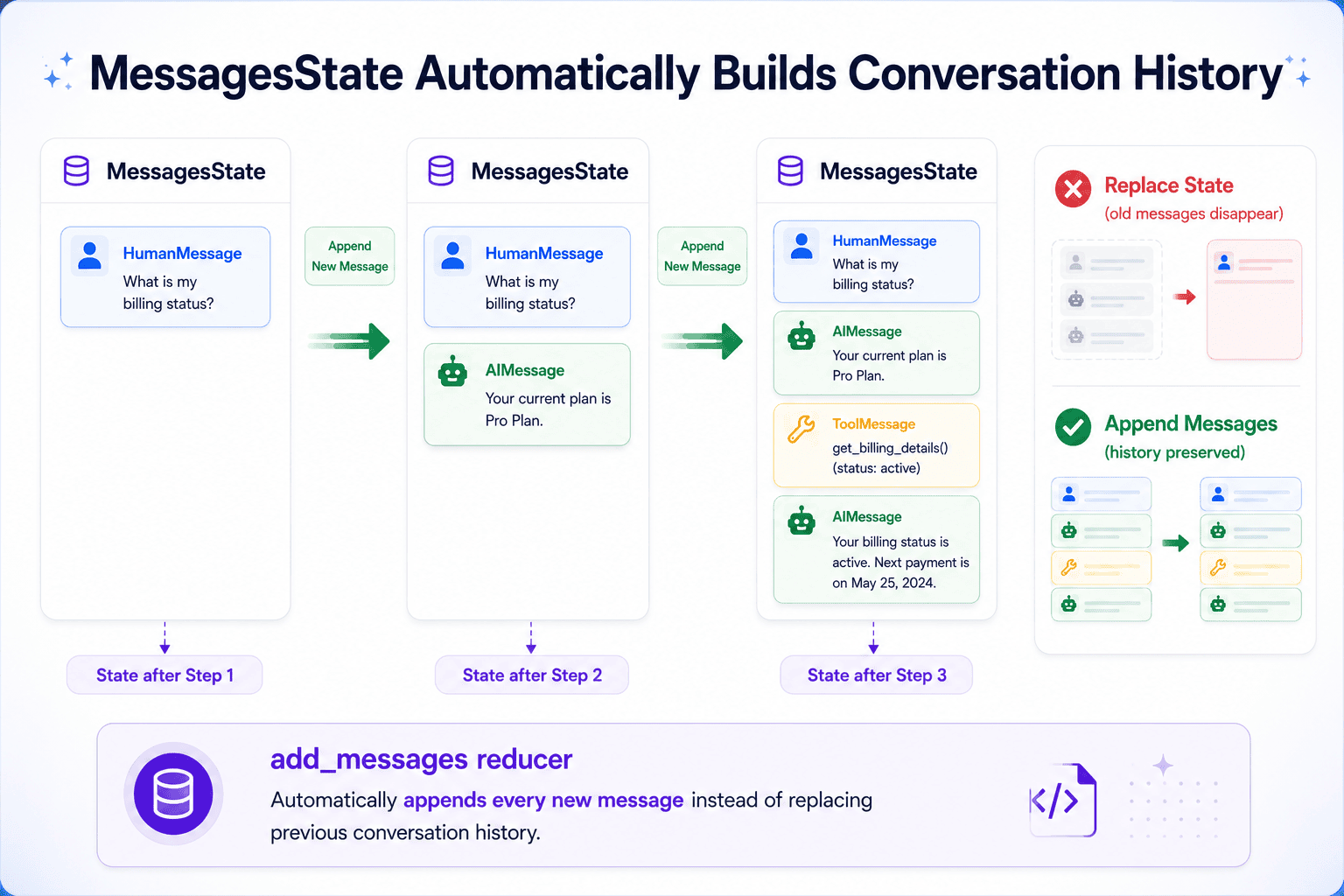
Once the environment is configured, the developer defines the MessagesState. This specialized state type is crucial for conversational agents because it handles the accumulation of message history. Unlike a standard list that might be overwritten, MessagesState uses a "reducer" function (specifically add_messages) to append new user inputs, AI responses, and tool outputs to the existing history. This ensures that the model maintains context across multiple turns of a conversation, a requirement for any effective support or assistant agent.
The ReAct Pattern: Integrating Tools and Reasoning Loops
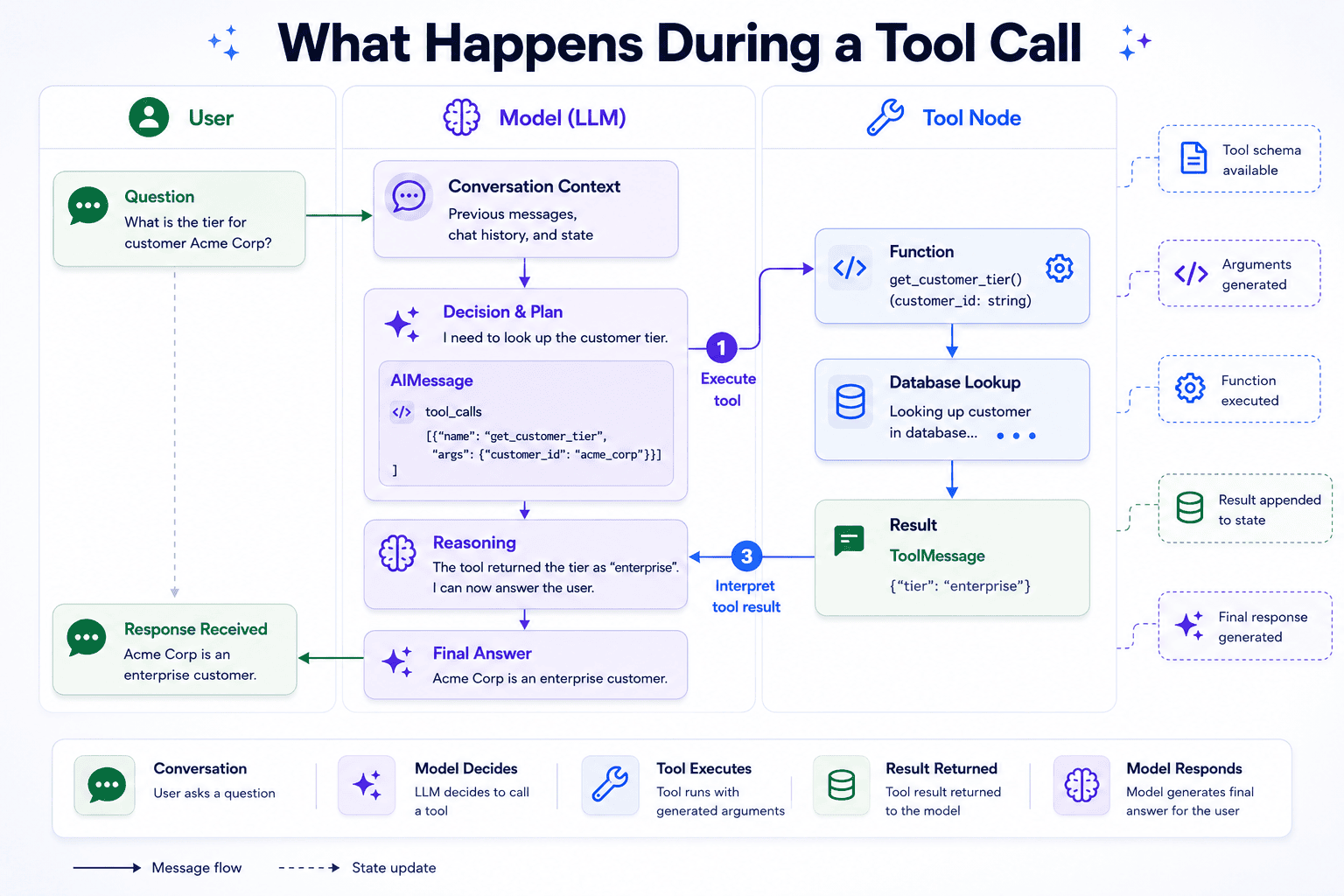
One of the most powerful features of an agent is its ability to interact with the real world through tool calling. This is typically implemented via the ReAct (Reason + Act) pattern. In this workflow, the model does not just provide an answer; it first "reasons" whether it needs more information and then "acts" by calling a tool.
For instance, in a SaaS support context, a model might be given a tool to check a customer’s subscription tier. When a user asks, "What is my current plan?", the model recognizes it lacks this specific data. It generates a "tool call" instead of a text response. The LangGraph orchestration detects this tool call via a conditional edge and routes the execution to a ToolNode.
Data indicates that while this loop increases the robustness of the agent, it also introduces additional latency and cost. Every tool use requires at least two model calls: one to initiate the tool call and another to interpret the tool’s output and provide the final answer to the user. Developers must balance this increased "intelligence" with the operational costs of running multiple LLM inferences per user query.
Persistence and the Role of Checkpointers
In a production environment, an AI agent must be able to remember users across different sessions or handle interruptions in connectivity. This is where "Persistence" and "Checkpointers" become vital. Without persistence, every call to an agent’s invoke() method starts from a blank slate.
LangGraph implements persistence through checkpointers like InMemorySaver. A checkpointer takes a "snapshot" of the graph’s state after every node execution. By associating these snapshots with a thread_id, the system can resume a conversation exactly where it left off. If a user returns to a chat after an hour, providing the same thread_id allows the checkpointer to reload the entire message history and state into the graph before the next execution begins.
For enterprise-scale applications, developers typically move beyond InMemorySaver to persistent databases like PostgreSQL or Redis. This ensures that even if the application server restarts, the "memory" of the AI agents remains intact.
Industry Impact and Expert Analysis
The shift toward graph-based agentic workflows has had a profound impact on the AI industry. Software engineers are no longer just "prompting" models; they are architecting systems. Analysis of current market trends suggests that the most successful AI implementations are those that move away from "one-shot" responses toward multi-step reasoning.
Industry experts note that LangGraph’s approach minimizes the "hallucination" risks associated with LLMs. By forcing the model to operate within the constraints of a graph, developers can implement guardrails. For example, a node can be programmed to validate a tool’s output before it is ever shown to the user, or a conditional edge can prevent the model from performing certain actions if the user’s subscription tier is insufficient.
Furthermore, the introduction of "Human-in-the-loop" patterns—where a graph pauses for human approval before executing a sensitive tool call—has made AI agents more palatable for regulated industries such as finance and healthcare. LangGraph’s ability to "breakpoint" a state, wait for external input, and then resume, is a direct response to the need for human oversight in autonomous systems.
Future Implications: Toward Multi-Agent Systems
As developers master the single-agent graph, the next frontier is the multi-agent system (MAS). In this configuration, a "supervisor" node in the graph routes tasks to various "specialist" agents, each with its own specific graph and tools. This hierarchical structure allows for the decomposition of complex problems that would overwhelm a single LLM context window.
The implications of this technology are vast. We are moving toward a reality where "agentic swarms" can handle entire workflows—from software development and testing to automated customer success and market research. The primitives of LangGraph—state, nodes, and edges—remain the foundational building blocks for these future systems.
In conclusion, LangGraph provides the necessary scaffolding for the next generation of AI applications. By treating agent logic as a structured graph rather than a linear script, developers gain the visibility, persistence, and control required to deploy reliable AI agents in the real world. As the ecosystem continues to mature, the ability to build and manage these agentic workflows will become a core competency for software developers across all sectors of the economy.