Meta Officially Launches Meta One Subscription Tiers Bringing Advanced AI and Creator Tools to Billions of Users

Meta has officially rolled out its comprehensive suite of subscription tiers, branded as Meta One, marking a significant strategic shift in how the tech giant monetizes its vast ecosystem of applications. Following initial announcements and preliminary testing phases earlier in the year, the official launch introduces targeted plans tailored for individual casual users, artificial intelligence power users, digital content creators, and commercial enterprises. By integrating advanced artificial intelligence capabilities and professional management tools directly into applications like Facebook, Instagram, and WhatsApp, Meta aims to redefine user engagement and digital expression across its multi-billion-user platform.
Background Context and Chronology of the Meta One Rollout
The groundwork for the Meta One ecosystem was laid several months prior, beginning with preliminary announcements in May that signaled Meta’s intent to diversify its revenue streams away from traditional advertising models. During those initial disclosures, leadership outlined plans to experiment with standalone application enhancements, informally referenced as Facebook Plus, Instagram Plus, and WhatsApp Plus. Naomi Gleit, Meta’s Head of Product, originally detailed these foundational concepts, emphasizing that the forthcoming tiers would provide users with elevated avenues for digital connection and self-expression.

Throughout the spring and summer, the company conducted localized trials to gauge consumer appetite for paid enhancements. These tests included minor aesthetic upgrades, such as vibrant animations for Instagram Stories—exemplified by the "Super Heart" feature—and weekly visibility boosts known as "spotlights." Building upon those foundational trials, the September launch consolidates these disparate features into a unified architecture. The Meta One framework systematically categorizes services into distinct tiers: Core, Premium, Max, and Expert. This structural evolution demonstrates Meta’s calculated progression from basic cosmetic upgrades to deeply integrated utility services driven by machine learning and professional business tools.
Breakdown of Individual and AI Power User Tiers
For individual consumers and AI enthusiasts, Meta One introduces the Core and Premium subscription tiers. These packages are specifically engineered to deliver compute-intensive artificial intelligence capabilities that exceed the standard offerings available to free-tier users. As generative artificial intelligence continues to reshape consumer software, Meta is positioning its paid subscriptions as gateways to enhanced creative freedom.
Subscribers to the Core and Premium levels gain access to advanced media generation tools powered by Meta AI. These features allow users to dynamically create complex visual assets, execute deep modifications within applications, and utilize specialized in-app tools such as Instagram’s "Restyle" feature. The inclusion of these resource-heavy processing capabilities reflects the substantial computational costs associated with modern generative models, justifying the tiered pricing model for heavy consumers of AI services. While casual users may question the value proposition of paying nominal monthly fees—such as the reported $3.99 to $4.00 entry points for basic enhancements—power users stand to benefit significantly from uninterrupted access to high-capacity creative workflows.

Empowering Creators and Small Businesses
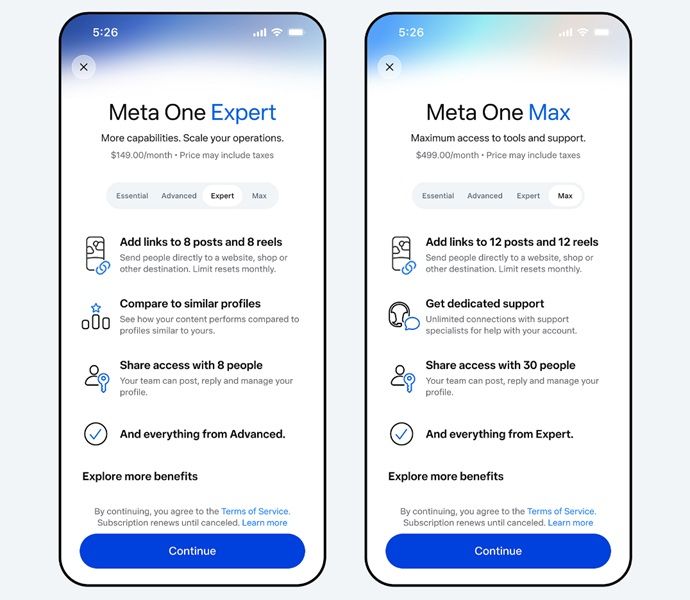
A cornerstone of the Meta One deployment is its targeted suite for creators and commercial enterprises, with pricing starting at $14.99 per month. Recognizing that small businesses and independent content producers frequently struggle with the administrative overhead of managing multiple digital touchpoints, Meta has embedded professional-grade infrastructure directly into its primary social networks.
The creator and business tiers eliminate the historical friction of managing separate professional dashboards by unifying advanced account tools within existing profiles. Subscribers receive verified badges, enhanced verification channels on WhatsApp, and comprehensive impersonation protection—critical security features for growing digital brands. Furthermore, Meta One introduces an "enhanced profile" layout designed to prioritize vital commercial information, such as official websites and physical store locations.
Engagement mechanics have also been upgraded. The system automatically dispatches follow invitations to users who actively interact with a creator’s content and incorporates prominent follow buttons directly into Reels interfaces. Perhaps the most technologically significant addition for businesses is integration with the Meta Business Agent. Available around the clock via WhatsApp, this conversational agent provides automated customer service and operational support, enabling small enterprises to maintain 24/7 responsiveness without expanding their human resource overhead.
Strategic Implications and Industry Analysis
Meta’s transition toward a subscription-inclusive business model carries profound implications for the broader digital landscape. For over a decade, the dominant economic engine of social media relied entirely on ad-supported models, where user data served as the primary currency. By introducing tiered subscriptions that offer tangible utilities—ranging from advanced AI computation to automated business management—Meta is diversifying its financial foundation.
Industry analysts note that this strategy mirrors trends observed across the software-as-a-service (SaaS) sector, where basic utility remains free while specialized productivity and creative tools are monetized. However, challenges remain. Consumer resistance to paying for social media features that were previously accessible at no cost could slow mass adoption among non-commercial users. Conversely, the high-value propositions offered in the business and creator tiers—particularly automated agents and verified security—are expected to attract strong uptake among micro-entrepreneurs seeking enterprise-level tools at accessible price points.
As Meta One continues its global deployment, its success will likely depend on the company’s ability to clearly differentiate the value of its paid tiers from the robust free services that billions of people already rely on daily. Whether these enhancements become standard expectations for digital participation or remain niche tools for power users and professionals will shape the next chapter of social media economics.