Cutting AI Costs Through Intelligent Data Formatting: How Markdown is Revolutionizing Token Efficiency for LLM Agents

The rapid proliferation of autonomous AI agents has brought to the forefront a persistent and expensive challenge: the voracious appetite these systems have for tokens. As developers increasingly rely on Large Language Models (LLMs) to perform complex research, file retrieval, and data synthesis, the cost of processing search results and logs has become a significant barrier to scalability. When an AI agent initiates a search, it often triggers a recursive loop of document retrieval, pulling in massive payloads of JSON data, metadata, and tracking parameters that are essential for software interfaces but largely redundant for a model’s reasoning process. This "token bloat" represents a hidden tax on AI infrastructure, prompting a shift toward more lightweight, model-centric data formats like Markdown.
The Anatomy of Token Bloat in AI Agents
To understand the financial implications, one must first consider how LLMs consume data. Every character, including the structural syntax of JavaScript Object Notation (JSON)—brackets, keys, quotation marks, and indentation—is converted into tokens. In a standard web search, a single query might return hundreds of data points. For instance, a search for "coffee shops" might yield nested objects containing precise coordinate metadata, tracking URLs, and server-side logging information.
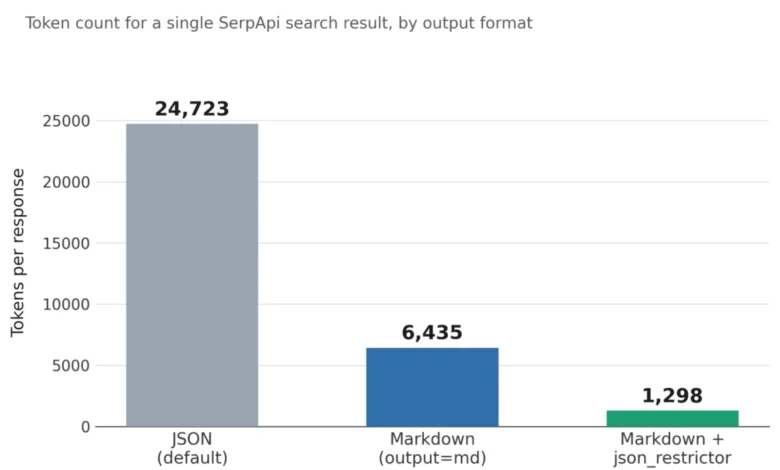
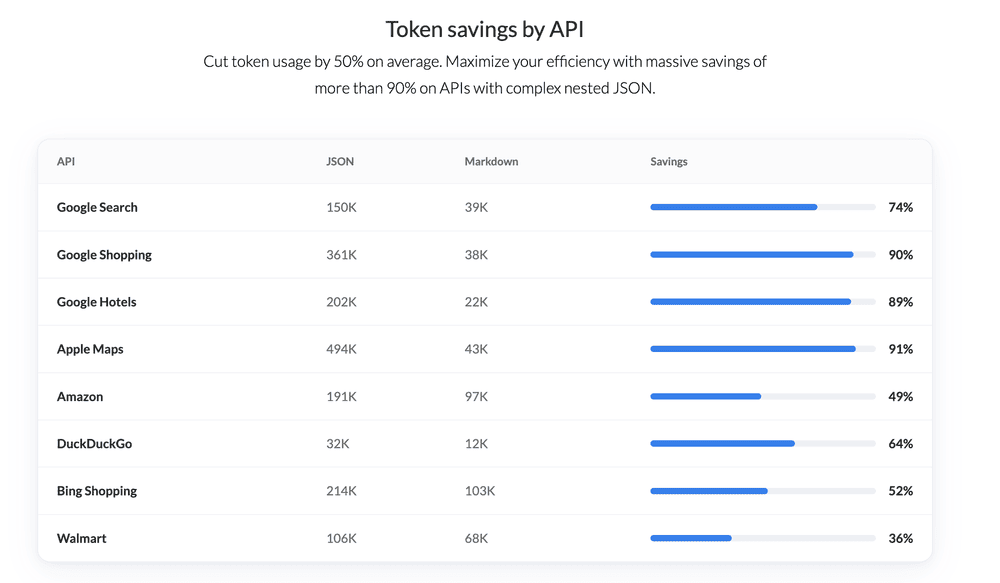
While this structure is ideal for a web browser or a mobile application, it is often extraneous for an AI agent tasked simply with identifying the top three rated coffee shops in a specific district. The model must process every token, consuming precious context window space and driving up the cost per query. Recent benchmarks from SerpApi have demonstrated the severity of this issue: a standard JSON-based search response for "coffee" can consume upwards of 24,000 tokens. By transitioning to a Markdown format—which preserves the core informational value while stripping away the structural noise—that same query can be reduced to roughly 6,000 tokens, a 74 percent reduction in computational overhead.
A Chronology of Token Efficiency Efforts
The history of LLM optimization has moved through several distinct phases. Initially, the industry focused on model architecture—reducing the parameter count of models to speed up inference. However, as the focus shifted toward "agentic workflows," the bottleneck moved from the model itself to the data pipeline.
- The Early Era (2022–2023): Developers utilized raw JSON responses directly from search APIs. The prevailing philosophy was "data completeness," where every available field was passed to the LLM to ensure the model had full context.
- The Era of Prompt Engineering (2023): As costs spiked, developers began using complex system prompts to instruct models to ignore certain fields or to summarize data before passing it to subsequent steps. This added latency and increased complexity in prompt management.
- The Data-Shape Revolution (2024–Present): The current focus has shifted to pre-processing and server-side formatting. By shifting the responsibility of "token trimming" to the API provider, developers are now able to ingest only the information required for the model’s specific task, effectively moving the filtering process from the LLM’s context window to the data source.
Comparative Analysis: JSON vs. Markdown
The debate between JSON and Markdown is not merely aesthetic; it is functional. JSON is a data-interchange format designed for machines to communicate with other machines. Its rigidity is its strength, ensuring that numeric values (like prices or geographic coordinates) are parsed with mathematical precision. However, when the consumer is an LLM—a probabilistic engine designed for natural language reasoning—the rigid structure of JSON often acts as "semantic noise."
Markdown, by contrast, is a lightweight markup language that prioritizes readability. By converting API responses into tables, headings, and lists, the structure becomes intuitive for LLMs. The model recognizes a table row as a discrete entity much faster than it parses a deeply nested JSON object.
According to data provided by SerpApi, the transition to Markdown is particularly effective for summarization tasks. While JSON requires the model to navigate complex hierarchies, Markdown allows the model to scan the data linearly. This leads to faster inference times, as the model spends fewer cycles "decoding" the structure of the payload and more cycles "reasoning" about the content.
Implications for Enterprise AI Infrastructure
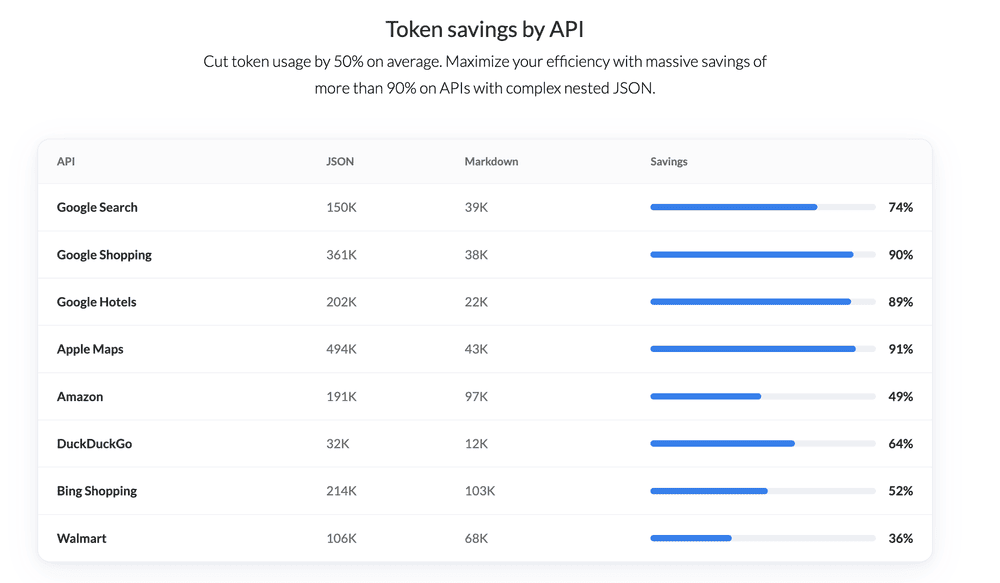
The move toward Markdown-formatted data has profound implications for enterprise-grade AI systems. For a company running millions of agentic queries per month, a 74 percent reduction in token usage is not merely a marginal improvement; it represents a significant shift in the unit economics of AI deployment.
There are, however, limitations to this approach. Industry experts emphasize that Markdown is not a universal replacement for JSON. In workflows involving high-stakes financial data, real-time stock monitoring, or applications where precise data typing is required for database insertion, JSON remains the industry standard. The current best practice involves a hybrid approach: utilizing Markdown for the research-and-summarization layers of an agentic workflow, while reserving structured JSON for the transactional and data-persistence layers.
Technical Implementation and Strategy
For organizations looking to integrate these efficiencies, the barrier to entry has lowered significantly. Providers like SerpApi have introduced "output parameters" that allow developers to toggle between JSON and Markdown at the request level.
Beyond simply switching formats, the use of "field restrictors" represents the next frontier in cost management. By defining a schema of required fields at the API level—using tools like json_restrictor or command-line filtering—developers can ensure that the payload entering the context window is surgically trimmed to include only the necessary attributes. This dual-layer approach—choosing the right format (Markdown) and the right fields (restricted subsets)—effectively minimizes the "payload bloat" that has historically plagued autonomous agents.
The Road Ahead: Measuring the Delta
As the industry matures, the ability to measure "token ROI" will become a standard requirement for MLOps engineers. Organizations are now encouraged to run side-by-side benchmarks on their own specific query sets. By measuring the "delta" between a standard API call and an optimized Markdown response, companies can forecast cost savings and model performance improvements with high accuracy.
The broader implication is a shift in the philosophy of data delivery. For years, APIs were designed to provide "everything, everywhere, all at once." As we move into an era of agent-first computing, the primary goal of data delivery must shift to "exactly what is needed, in the format that is most easily understood." Markdown is not a panacea for all AI cost issues, but it represents a critical step forward in the quest to build more efficient, scalable, and cost-effective autonomous systems.
As developers continue to experiment with these formats, the focus will likely shift to even more compact data representation methods, potentially including custom binary formats or compressed schemas. However, for the immediate future, the conversion of search-driven data into optimized Markdown stands as one of the most effective strategies for mitigating the rising costs of the AI revolution. By treating the "shape" of the data as a first-class citizen in the development process, engineers can ensure that their agents remain both highly capable and fiscally sustainable.