The rapid proliferation of Large Language Model (LLM) applications across enterprise environments has created a critical engineering bottleneck: the transition from prototype to reliable, production-grade software. Unlike traditional deterministic programming, where unit tests provide a binary pass or fail, LLM applications are probabilistic. An application that functions flawlessly on Tuesday may produce hallucinations or non-compliant outputs on Wednesday due to subtle changes in model provider weights, prompt engineering adjustments, or shifting user inputs. Systematic evaluation has emerged as the definitive solution for managing this volatility, transforming the "guesswork" of spot-checking into a rigorous, data-driven regression-testing loop.
The Failure of Traditional Testing in the LLM Era
For decades, software development relied on unit tests that asserted absolute equality—if a function received input X, it must return string Y. However, generative AI defies this paradigm. If a customer asks, "Can I return these shoes?" the model might respond with "You may return them within 30 days" or "Returns are accepted for a month after delivery." Both are factually correct and semantically equivalent, yet a traditional string-comparison test would flag the second as a failure.
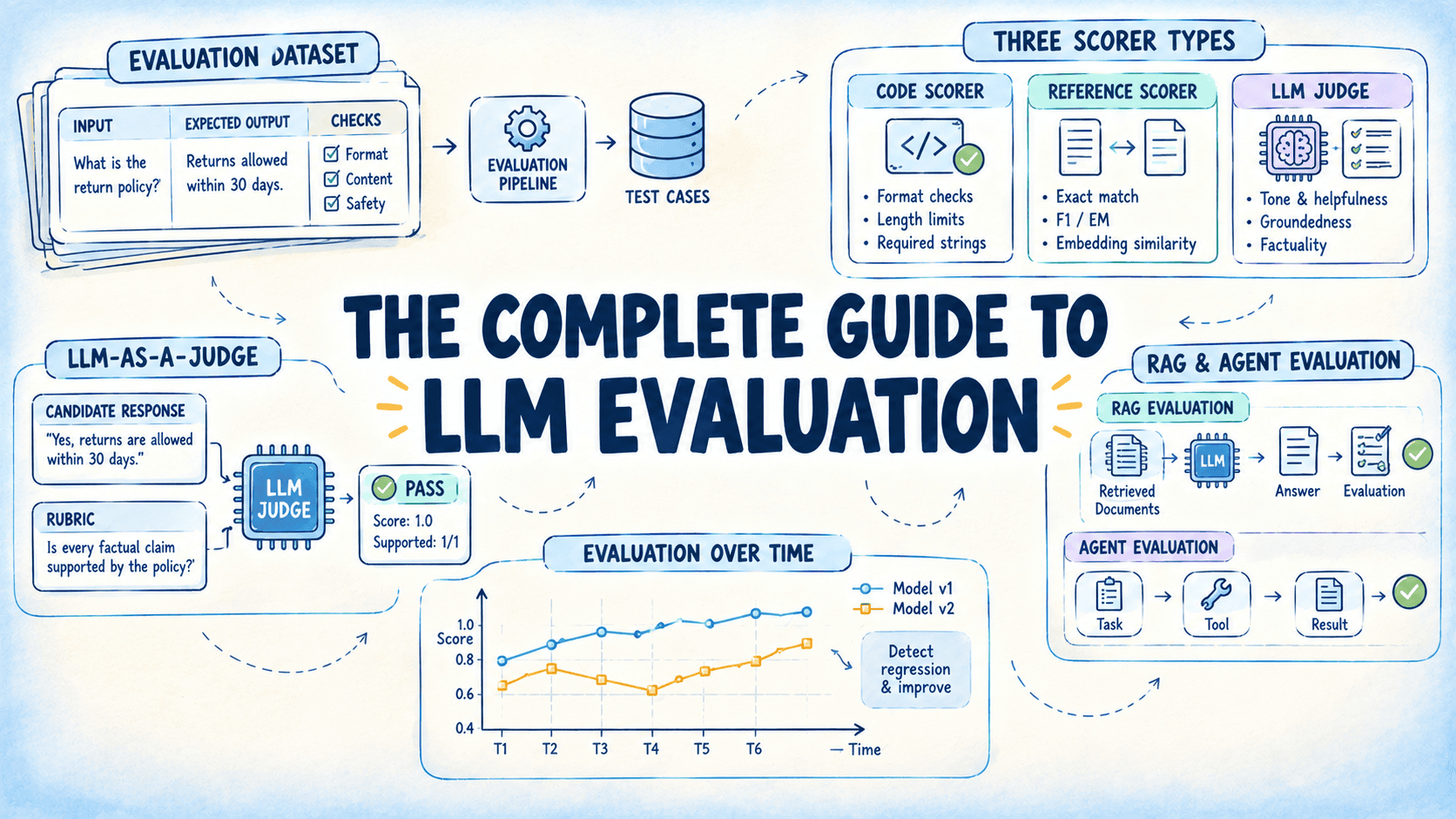
This lack of semantic awareness in legacy testing suites has led to the development of the "LLM-as-a-Judge" architecture. By treating the evaluation process as an automated pipeline, developers can now build test cases, apply specific grading rubrics, and maintain a historical record of performance. This shift mirrors the transition from manual QA to continuous integration/continuous deployment (CI/CD) pipelines, effectively insulating production environments from the inherent instability of generative outputs.
The Anatomy of an Evaluation Framework
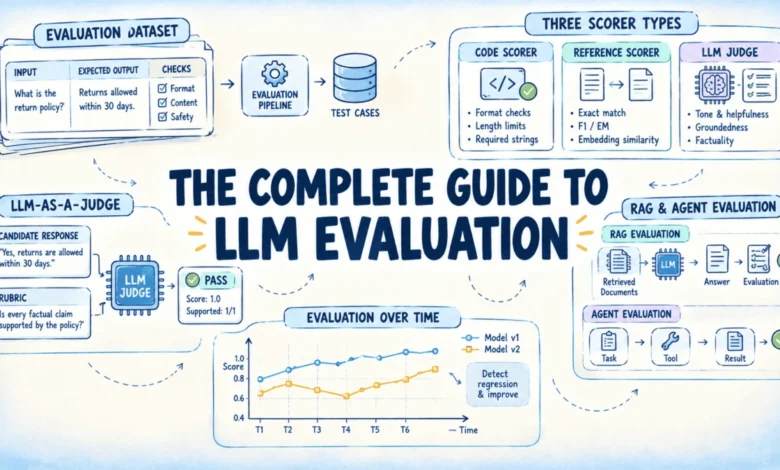
To implement a robust evaluation framework, developers must categorize their scorers into three distinct layers. This layered approach ensures cost-efficiency and maximum accuracy:
- Code-Based Scorers: The most fundamental layer uses deterministic logic. These are used to verify non-negotiable constraints, such as JSON structure, response length, or the presence of specific keywords. Because these are computationally inexpensive and return the same result every time, they should be the first line of defense.
- Reference-Based Scorers: These compare model output against a "gold standard" or ground-truth answer. Metrics such as Exact Match, F1 scores, or BERTScore (which utilizes cosine similarity between token embeddings) fall into this category. While useful for structured tasks, they often struggle with nuance, tone, and complex reasoning.
- LLM-as-a-Judge: This is the most sophisticated layer. A high-performance model is specifically prompted to grade the output of a target model based on a defined rubric. This approach is essential for evaluating subjective qualities like helpfulness, tone, and groundedness.
Architecting the "Judge" for Maximum Reliability
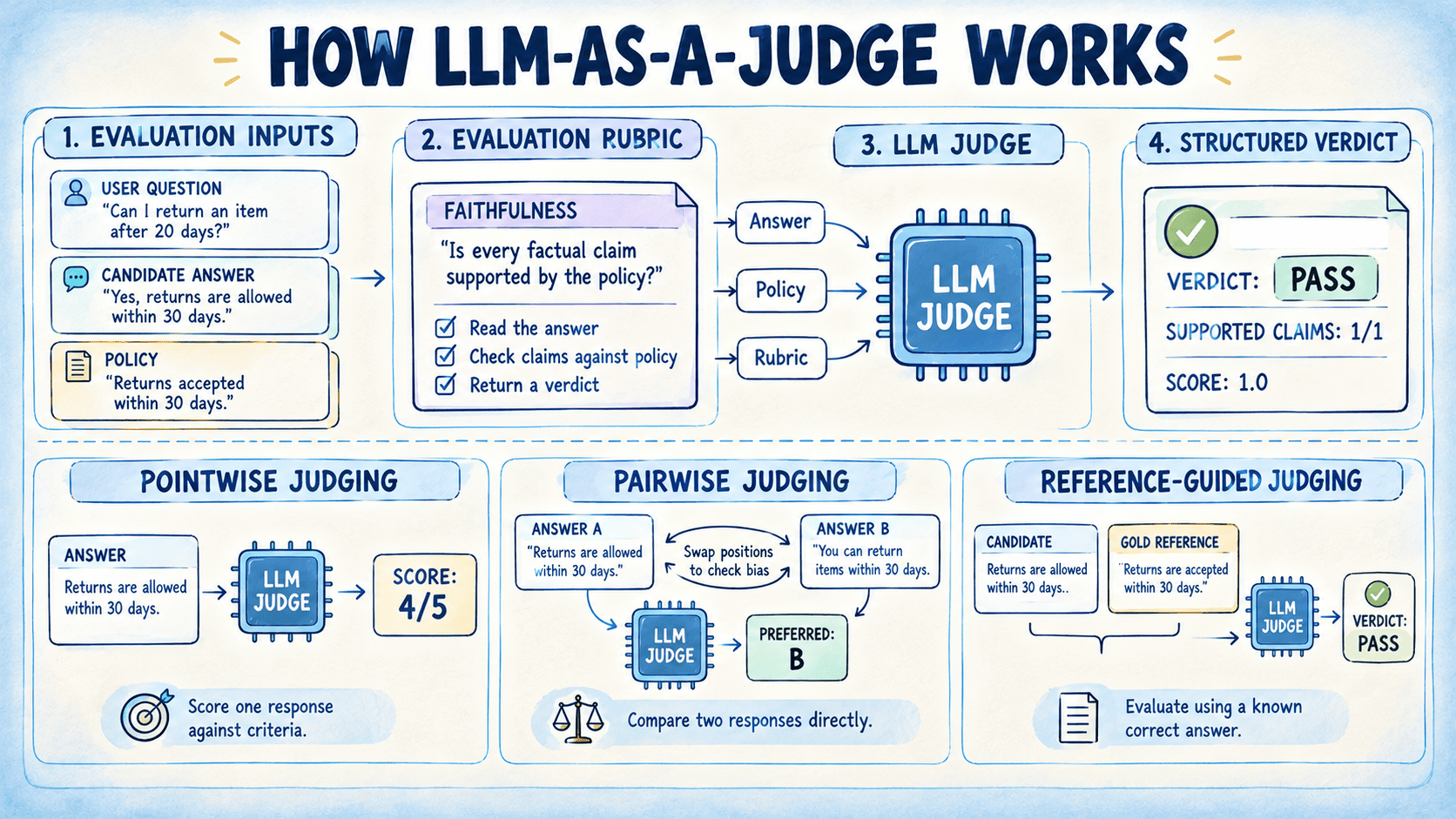
The effectiveness of an LLM-as-a-judge is entirely dependent on the quality of its rubric prompt. A vague instruction such as "is the answer good?" invariably produces noisy, unreliable scores. Industry best practices suggest a structured, four-part prompt format: a definition of the criterion, a definition of the input constraints, a clear procedural guide, and a strict requirement for structured output—preferably JSON.
To mitigate bias, developers are increasingly adopting three primary techniques:
- Question-Answer Generation (QAG): This technique decomposes a response into individual factual claims. The judge is asked a binary "yes/no" question for each claim—specifically, whether it is supported by the provided source context. By calculating the ratio of supported claims to the total, developers obtain a mathematically sound, reproducible faithfulness score.
- G-Eval: Designed for subjective tasks like coherence, G-Eval uses Chain-of-Thought (CoT) prompting to decompose evaluation criteria into granular steps. By analyzing the log-probabilities of output tokens, it calculates an expected value, providing a high-resolution score between 1 and 5. This minimizes the common tendency of models to "collapse" toward a favorite digit.
- Pairwise Comparisons: When absolute scales are insufficient, developers present the judge with two outputs (A and B) and ask for a preference. To account for position bias—where models often prefer the first option—the test must be run twice with the positions swapped. Only consistent results are recorded, while disagreements are categorized as ties.
Mitigating Bias and Calibrating Performance
Research into LLM-as-a-judge models indicates persistent biases, most notably a preference for longer, more confident-sounding, or verbose answers. To counter this, engineers must calibrate their judges against human-labeled datasets. A sample of 30 to 50 outputs, graded by a human expert and then by the LLM judge, serves as the baseline.
Statistical tools such as Cohen’s Kappa are essential for measuring the level of agreement between human and machine. A Kappa score exceeding 0.6 indicates substantial agreement; if the score is lower, the rubric requires refinement. By treating the labeled set as a regression test for the judge itself, organizations can ensure that their evaluation system remains consistent even as the underlying models evolve.
Evaluating RAG and Agentic Workflows
Retrieval-Augmented Generation (RAG) presents a unique challenge because it involves two distinct failure points: the retriever (which fetches context) and the generator (which synthesizes the answer). Evaluating these independently is mandatory for debugging. High faithfulness with low recall indicates that the generator is working, but the retriever is failing to surface the necessary information. Conversely, high precision with low faithfulness suggests the retriever is finding the right documents, but the generator is hallucinating claims not present in those documents.
For AI agents—systems that utilize tools and multi-step planning—the focus shifts to "task completion." An agent that provides a polite, fluent response but fails to actually execute the requested tool call is a failure. Diagnostic scoring of agentic trajectories—tracking tool correctness, argument validity, and final goal achievement—allows developers to pinpoint exactly where an agentic loop deviated from the desired path.
The Release Cycle: Offline and Online Evals
Effective evaluation must be an ongoing process throughout the entire software lifecycle. Offline evaluation occurs before deployment. By curating a "golden set" of 25 to 50 representative queries—covering standard operations, edge cases, and adversarial "jailbreak" attempts—teams can ensure that every pull request undergoes rigorous scrutiny. This provides a clear, quantitative "pass/fail" gate before code reaches production.
Online evaluation acts as the final safety net, sampling live traffic to monitor for quality drift. This is critical for catching scenarios that were not covered in the initial development phase. As production failures are identified, they should be converted into new test cases for the golden set, creating a virtuous cycle of improvement.
Implications and Future Outlook
The industry is moving toward a standard where LLM application quality is measured by observable metrics rather than anecdotal "vibe checks." This shift has significant implications for enterprise adoption; companies are no longer willing to deploy AI features that they cannot audit.
As we look toward the future, the integration of automated evaluation into CI/CD pipelines will become as standard as security scanning or dependency management. The challenge for developers will not be building the application, but building the testing harness that provides the confidence to ship. By embracing structured rubrics, rigorous calibration, and persistent monitoring, developers can effectively mitigate the risks associated with generative AI, ensuring that their applications remain faithful, accurate, and useful in a production environment.
The maturation of these evaluation frameworks represents the next logical step in the lifecycle of AI software. As organizations move from proof-of-concept to global-scale deployment, those who prioritize robust, reproducible evaluation will be the ones to define the future of reliable AI.