The rapid proliferation of large language models (LLMs) has transitioned the primary challenge for enterprise engineering teams from model training to efficient, scalable inference. While achieving functional accuracy in models like Llama 3 or GPT-4 is now commonplace, the operational burden of serving these models—maintaining low latency while controlling escalating GPU costs—remains a significant hurdle. As production demand grows, organizations frequently encounter bottlenecks where request queues balloon, latency targets are missed, and infrastructure costs scale disproportionately to traffic. Inference optimization, a specialized discipline focused on maximizing hardware utilization without modifying the underlying model weights, has emerged as the essential bridge between research prototypes and high-performance production systems.
The Physics of Inference: Prefill and Decode
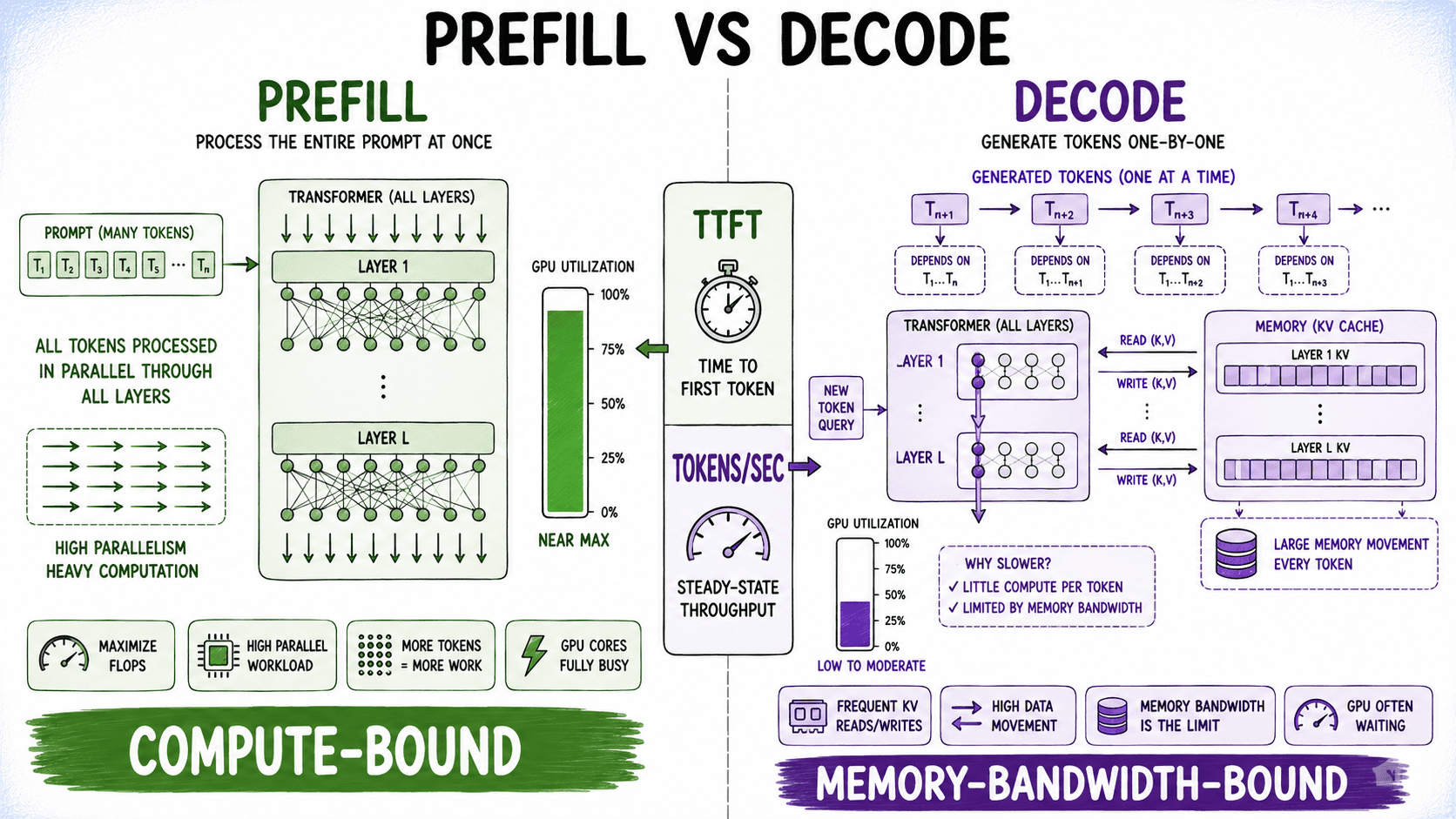
To optimize an LLM, one must first recognize that the inference process is not monolithic; it is a two-phase operation with distinct computational profiles. The "prefill" phase occurs when a model processes an entire input prompt. Because the input tokens are known simultaneously, the GPU can execute these calculations in parallel, saturating the hardware’s compute units. This phase is fundamentally compute-bound, and its efficiency is the primary determinant of Time-to-First-Token (TTFT).
Conversely, the "decode" phase follows an autoregressive pattern. The model generates one token at a time, with each new token dependent on the entire history of preceding tokens. This sequential dependency renders parallel computation impossible within a single request. Consequently, the bottleneck shifts from compute power to memory bandwidth. The GPU must constantly shuffle massive weight matrices and KV (Key-Value) cache data from VRAM to the processor, making memory throughput the binding constraint for tokens-per-second (TPS). Understanding this dichotomy is critical; an optimization that accelerates prefill may have zero impact on decode speed, and vice versa.
Memory Management and the Evolution of the KV Cache
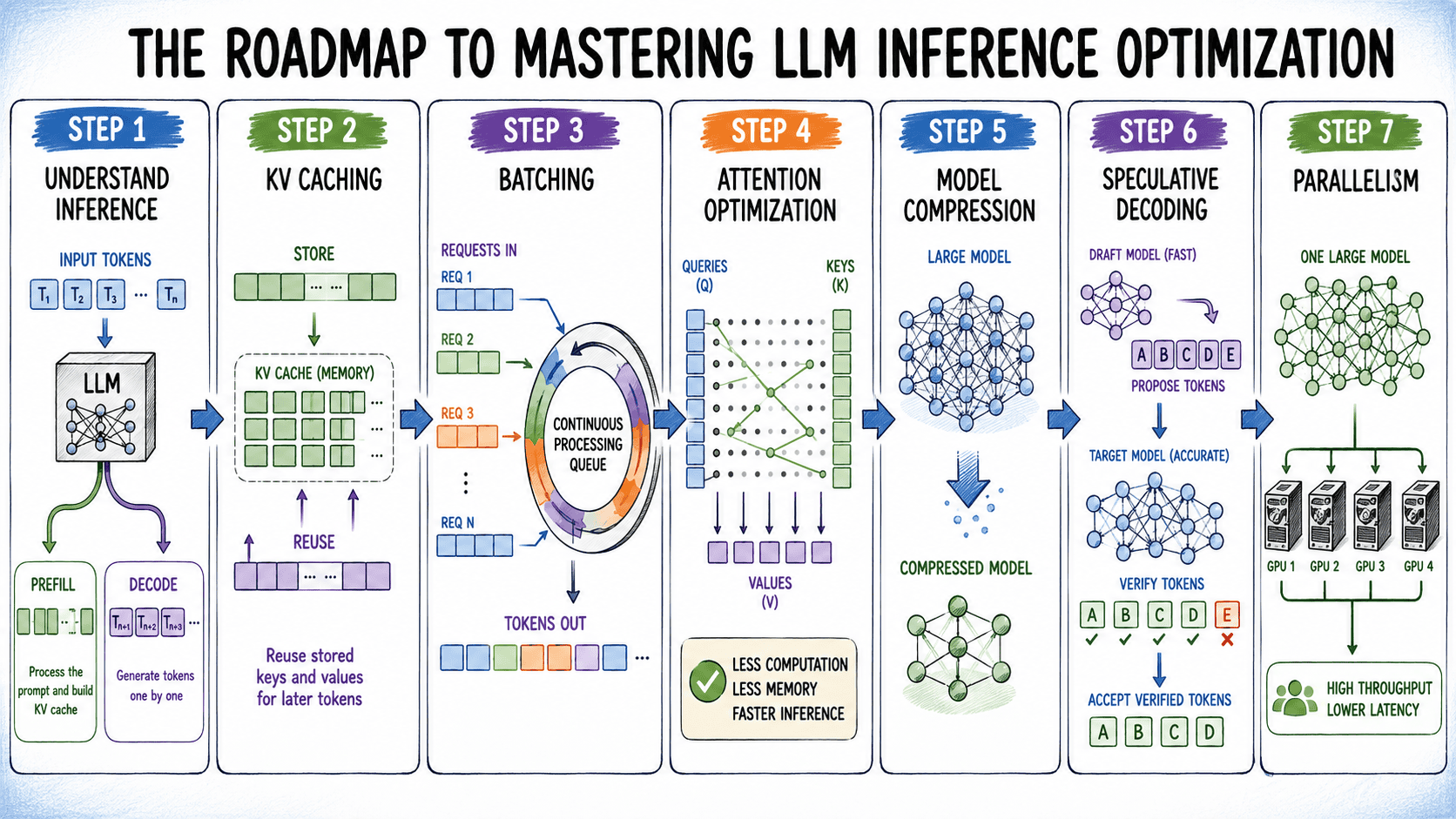
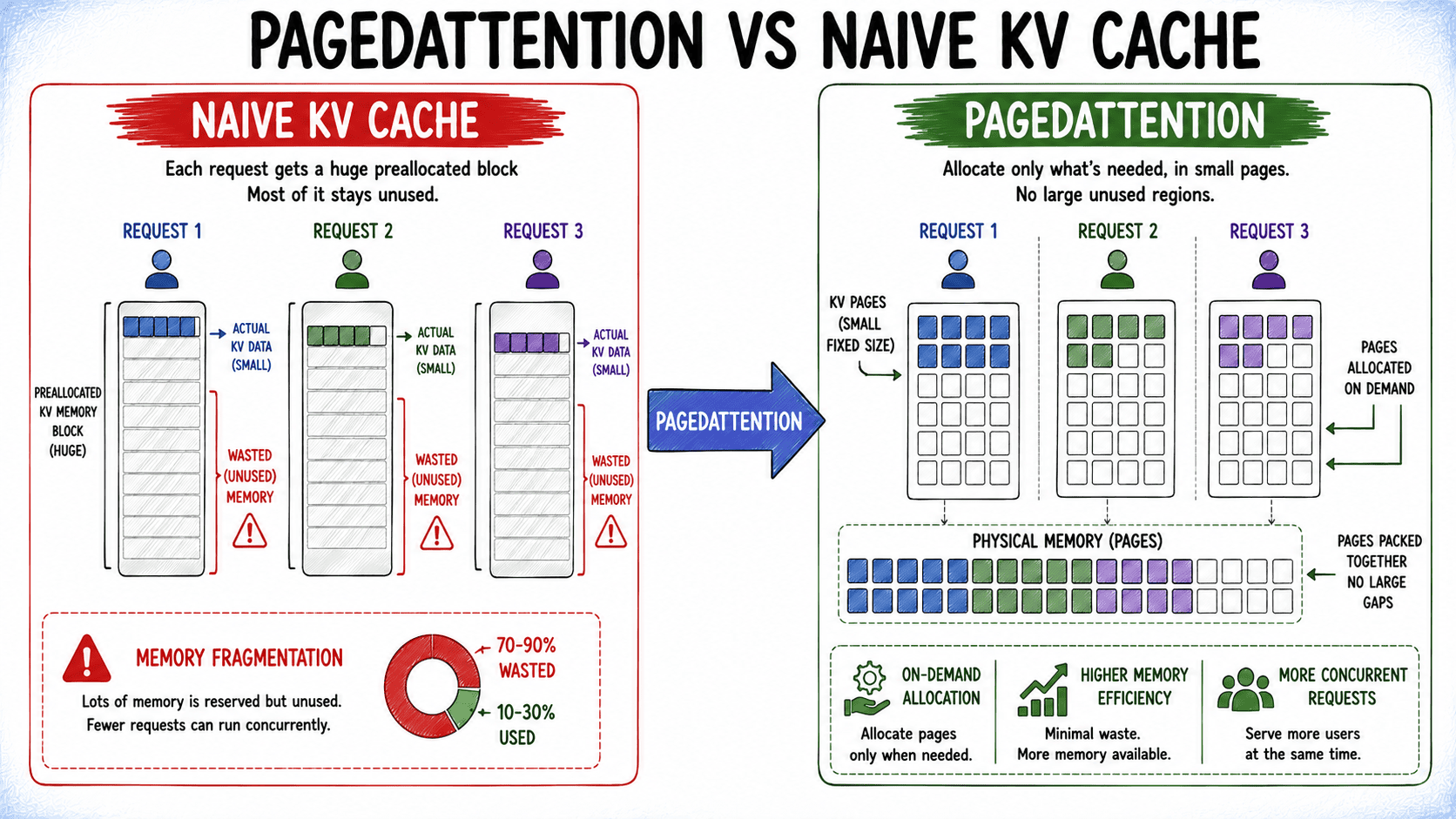
The most significant memory consumer in modern LLM serving is the KV cache—a mechanism that stores intermediate attention states to avoid redundant recomputation of tokens. In a standard setup, naive memory allocation for these caches can lead to severe fragmentation. If a system reserves memory for a maximum sequence length of 32,000 tokens for every request, but the average request only uses 512 tokens, the vast majority of GPU memory sits idle and inaccessible.
The introduction of PagedAttention, pioneered by the vLLM project, revolutionized this landscape by applying the principles of virtual memory from operating systems. By partitioning the KV cache into fixed-size blocks, PagedAttention allows for non-contiguous memory allocation. This approach effectively eliminates internal fragmentation, enabling significantly higher batch sizes on the same hardware. Furthermore, "prefix caching"—a method where the KV cache for static prompts (such as system instructions or long-form reference documents) is computed once and reused across thousands of subsequent requests—has emerged as a vital technique for reducing redundant operations in Retrieval-Augmented Generation (RAG) pipelines.
The Shift Toward Continuous Batching
Effective GPU utilization relies on high-density batching. Historically, static batching required all requests in a batch to be processed synchronously, meaning a single long-generation request would stall the entire pipeline until completion. This "head-of-line blocking" led to severe under-utilization of hardware resources.
Continuous batching (or in-flight batching) addresses this by treating the batch as a fluid entity. As soon as a single request completes, the scheduler immediately inserts a new request into the vacant slot, rather than waiting for the entire batch to finish. This ensures that the GPU is constantly performing useful work. Industry-standard inference engines, such as TensorRT-LLM and vLLM, have adopted continuous batching as the default, as it typically provides a 5x to 10x throughput improvement over traditional static scheduling in production environments.
Architectural Innovations: Attention and Compression
The attention mechanism remains the most computationally expensive component of the Transformer architecture. Recent years have seen a transition from standard Multi-Head Attention (MHA) toward more efficient variants like Multi-Query Attention (MQA) and Grouped-Query Attention (GQA). These architectures share key and value heads across multiple query heads, significantly reducing the memory bandwidth required during the decode phase.
Complementing these architectural shifts is the maturation of model compression techniques. Quantization, the process of reducing the precision of model weights from 16-bit floating point (FP16) to 8-bit or 4-bit integers, has become a cornerstone of cost-effective deployment. Techniques such as GPTQ (Generalized Post-Training Quantization) and AWQ (Activation-aware Weight Quantization) allow models to run on consumer-grade or lower-tier enterprise GPUs with negligible impact on output quality. Additionally, hardware-level support for structured sparsity in modern NVIDIA architectures—where specific portions of weight matrices are pruned to zero—allows for hardware-accelerated speedups that were previously unavailable.
Speculative Decoding and Parallelism
For latency-sensitive applications like real-time chatbots, speculative decoding has become a critical tool. This technique utilizes a "draft" model—a much smaller, faster architecture—to predict the next several tokens. The "verifier" model (the primary, high-parameter model) then evaluates these tokens in parallel. If the verifier agrees with the draft, multiple tokens are generated in a single pass. This process is mathematically exact, meaning it produces the same output as the original model but at a fraction of the latency.
When a single GPU is insufficient, engineering teams must leverage parallelism. Tensor parallelism distributes the layers of a model across multiple GPUs, allowing for the serving of models that would otherwise exceed a single device’s VRAM. Pipeline parallelism, which splits the model vertically, is increasingly used in conjunction with prefill-decode disaggregation. This advanced pattern decouples the hardware pools, routing compute-heavy prefill requests to high-throughput compute nodes and memory-heavy decode requests to memory-optimized nodes.
Broader Implications and Future Outlook
The shift toward optimized inference is not merely a technical preference; it is an economic necessity. As organizations integrate LLMs into core business workflows, the cost-per-token becomes the primary metric for sustainability. Recent data suggests that aggressive optimization can reduce inference costs by up to 90% compared to unoptimized, off-the-shelf deployments.
However, the rapid pace of development in this field presents a challenge: the "optimization stack" is moving fast. Techniques that were considered state-of-the-art eighteen months ago are now standard features in open-source runtimes. For developers, the mandate is clear: effective LLM deployment requires a rigorous approach to profiling. By measuring TTFT and TPS, identifying the specific bottleneck—whether compute-bound or memory-bound—and applying the corresponding optimization layer, teams can transform prohibitively expensive models into highly responsive, cost-efficient production assets. As the industry moves toward specialized hardware and increasingly efficient attention mechanisms, the gap between "experimental model" and "production-grade intelligence" will continue to close, fueled by the relentless refinement of the inference engine.