Google’s latest Android Bench update reveals Gemini 4 Argon struggles to compete with top-tier AI models for mobile development tasks

The landscape of artificial intelligence-driven software development has shifted significantly following the October 26, 2026, update to Google’s Android Bench. This standardized assessment tool, designed to evaluate how effectively Large Language Models (LLMs) handle the nuances of Android-specific coding, has provided a sobering reality check for Google’s own internal development efforts. As developers increasingly look toward AI to streamline the creation of mobile applications, the latest data suggests that Google’s flagship model, Gemini 4 Argon, is currently failing to maintain parity with its competitors from OpenAI and Anthropic.
Understanding the Android Bench Framework
Introduced earlier in 2026, the Android Bench was established by Google to address a critical gap in the developer ecosystem. While general-purpose coding benchmarks abound, they often fail to account for the unique requirements of the Android platform, such as Jetpack Compose implementation, Kotlin-specific idioms, and the complex lifecycle management inherent in mobile operating systems. By creating a dedicated benchmark, Google aimed to provide developers with a transparent, data-driven way to select the best AI model for their specific workflows.
The benchmark evaluates models across two primary axes: the "pass rate," which measures the model’s ability to produce functional, bug-free code on the first attempt, and the "completion rate," which reflects the model’s ability to finalize tasks efficiently. With the latest October update, Google introduced a third, highly requested metric: the "reasoning level." This parameter attempts to quantify the logical depth an AI employs when navigating complex architectural requirements, providing developers with a clearer picture of whether a model is simply predicting patterns or actively solving software engineering problems.
The Current Leaderboard: A Shift in Power
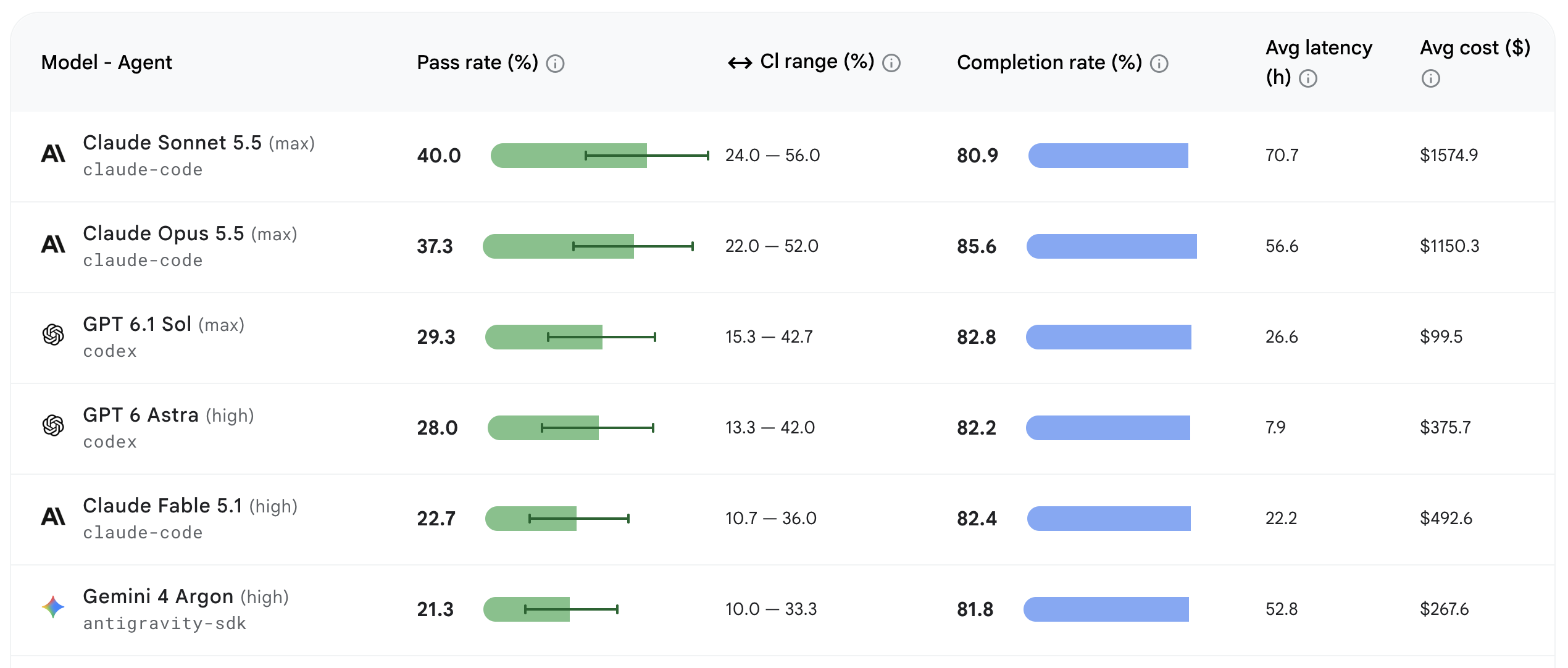
The October 2026 results paint a clear picture of a market currently dominated by Anthropic’s latest offerings. Claude Sonnet 5.5 has officially taken the top spot on the leaderboard, boasting a 40% pass rate and an 80.9% completion rate. This performance milestone marks a significant leap forward for Anthropic, cementing its reputation among senior developers who require high reliability in production-grade code generation.
Following closely in second place is Claude Opus 5.5, which has maintained consistent performance since its introduction earlier in the month. However, the most disruptive entry in the recent update is arguably OpenAI’s GPT-6.1 Sol. While its 29.3% pass rate sits below the top-tier Claude models, its 82.8% completion rate—the highest on the chart—suggests that it is exceptionally adept at handling the heavy lifting of routine coding tasks.
Perhaps the most compelling argument for the adoption of GPT-6.1 Sol is its economic viability. According to the data provided by the Android Bench, GPT-6.1 Sol requires an average expenditure of just $99.50 per set of standard tasks. In contrast, the market-leading Claude Sonnet 5.5 carries an estimated cost of $1,574.90 for the same volume of work. This discrepancy highlights a growing trend in the industry: developers are increasingly forced to weigh raw accuracy against the prohibitive costs of high-reasoning inference, a trade-off that is becoming central to enterprise-level software procurement.
The Underwhelming Debut of Gemini 4 Argon
Perhaps the most scrutinized result in the October update is the performance of Google’s own Gemini 4 Argon. Positioned as a direct competitor to the industry’s frontier models, Gemini 4 Argon’s debut has been described by industry analysts as "underwhelming." With a pass rate of 21.3% and a completion rate of 81.8%, the model currently sits in fifth place, trailing not only the newest Claude and GPT iterations but also the older Claude Fable 5.1.
The disparity in performance has reignited concerns regarding Google’s internal AI development trajectory. Shortly after the public release of Gemini 4 Argon in late September 2026, internal reports surfaced suggesting that the model faced significant friction when tasked with multi-stage Android coding workflows. At the time, Google management officially defended the model, citing its versatility across non-coding domains. However, the hard data from the Android Bench provides a stark, objective contrast to that sentiment, illustrating that when measured against the specific constraints of Android development, the model is currently underperforming relative to its peers.
Chronology of AI Integration in Android Development
To understand the current state of the Android Bench, one must look back at the rapid evolution of developer tools over the past twelve months:
- Q1 2026: Google introduces the Android Bench to standardize AI performance metrics, aiming to move away from subjective "vibes-based" testing and toward reproducible code-generation metrics.
- Summer 2026: Rapid iterations of Claude and GPT models force a monthly update cycle for the benchmark, as the baseline for "high performance" shifts almost every thirty days.
- September 30, 2026: Google officially launches Gemini 4 Argon, marketing it as the ultimate companion for modern mobile developers.
- October 1, 2026: Reports emerge detailing internal struggles with Gemini 4, specifically regarding its performance in handling complex dependency injection and legacy code refactoring.
- October 26, 2026: The updated Android Bench is released, incorporating reasoning levels and the latest frontier models, which ultimately exposes the performance gap of Gemini 4 Argon.
Implications for the Developer Ecosystem
The findings from the latest Android Bench update have broader implications for both Google and the global developer community. For developers, the message is one of necessary diversification. The data indicates that "brand loyalty" to a specific AI vendor is increasingly suboptimal; rather, developers should adopt a multi-model strategy. By using high-reasoning models for architectural planning and more cost-effective, high-completion models for routine boilerplate generation, teams can significantly optimize both their quality and their operational budgets.
For Google, the situation presents a strategic challenge. The Android platform is one of the most critical environments for Google’s ecosystem, and the perceived inferiority of its flagship AI model in this domain could influence developer sentiment toward competing platforms. If developers feel that they must rely on Anthropic or OpenAI to effectively build for Android, the competitive advantage that Google once held by controlling the entire stack—from the OS to the development environment—could begin to erode.

Future Outlook and Official Stance
While the current data places Google in a defensive position, the history of AI development suggests that these rankings are transient. The rapid deployment cycle of these models means that a "version 6.2" or a future "Gemini 5" could theoretically invert these results in a matter of weeks. Google has signaled that it will continue to update the Android Bench regularly, providing a level of transparency that is rare in the closed-source world of large language models.
In recent industry discussions, stakeholders have emphasized that the "pass rate" metric is the most critical hurdle for the next generation of AI. As LLMs move from generating simple functions to managing entire application modules, the cost of debugging AI-generated code will likely surpass the cost of the API calls themselves. Therefore, a model with a 90% pass rate at a higher price point will almost always be more valuable to a commercial enterprise than a cheaper model that introduces subtle, hard-to-detect bugs.
As the industry looks toward the end of 2026, all eyes remain on the leaderboard. The October update has proven that the race to dominate the developer’s desktop is far from settled. Whether Google can recalibrate its Gemini architecture to meet the high bar set by Anthropic’s latest models, or if the market will permanently shift toward a diverse ecosystem of specialized AI tools, remains one of the most consequential questions in modern software engineering. For now, the Android Bench stands as the ultimate arbiter, holding even the largest technology companies accountable to the cold, hard reality of code execution.