The Rising Dominance of Social Media in American News Consumption Sparks Fresh Debate Over Content Moderation and Free Speech

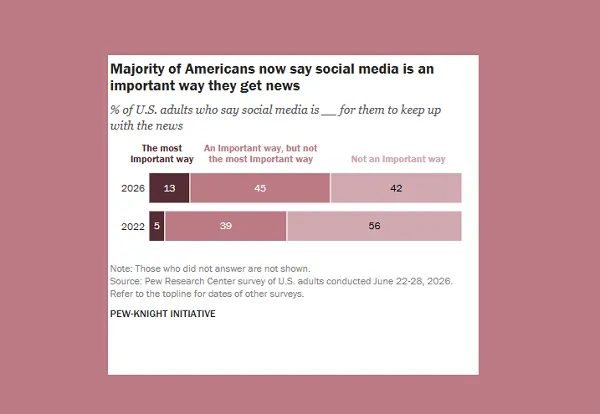
Social media has firmly entrenched itself as a primary pillar of the American media landscape, fundamentally altering how citizens discover, consume, and react to breaking news and current events. According to a comprehensive report published by Pew Research Center, more than half of all American adults now look to social media platforms as vital conduits for news and information. This milestone reflects a dramatic acceleration in digital news habits over a remarkably short timeframe, underscoring the immense power that technology companies wield in shaping public awareness and civic discourse.
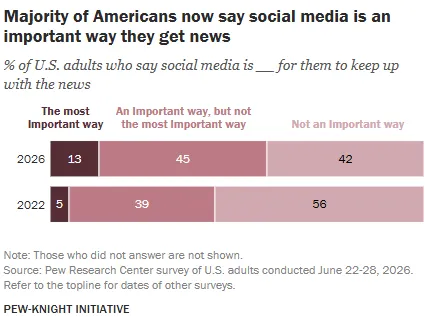
The findings, derived from a nationally representative survey of over 3,500 U.S. adults conducted in June, reveal that 58% of the American populace considers social media to be an important connector to current events. Within that demographic, 13% identify social applications as their single most indispensable source of news. Given that the total U.S. adult population stands at approximately 270 million, according to data from the Annie E. Casey Foundation, these percentages translate to roughly 35 million individuals who rely primarily on social networks to stay informed, and nearly 157 million who depend on them regularly.
This upward trajectory marks a significant shift from previous polling. When Pew Research administered a comparable study in 2022, only 43% of U.S. adults acknowledged social media as an important news vehicle, and a mere 5% designated it as their primary resource. This rapid expansion in user reliance highlights a structural transformation in the media ecosystem, wherein traditional print and broadcast outlets continue to cede ground to decentralized, algorithm-driven digital platforms.
The Chronology of Digital Moderation and Political Friction
The debate surrounding how social media platforms curate information is far from new, but it has evolved through distinct phases over the past several years, intersecting heavily with issues of democratic integrity, free expression, and government oversight.
In the wake of the 2020 U.S. elections and the height of the COVID-19 pandemic, major technology firms faced intense pressure from public health officials, civil rights organizations, and political figures to aggressively police misinformation, hate speech, and foreign interference. Platforms responded by expanding trust and safety teams, implementing third-party fact-checking programs, and labeling or removing content deemed harmful or misleading.
However, these measures quickly triggered a fierce backlash from conservative politicians and free-speech advocates, who argued that content moderation had morphed into partisan censorship. This tension reached a boiling point in late 2022 when billionaire entrepreneur Elon Musk acquired Twitter—subsequently rebranding the platform as X—explicitly citing concerns that previous management teams had engaged in ideological manipulation and democratic interference by suppressing specific viewpoints.
As political scrutiny intensified, critics popularized the term "censorship-industrial complex" to describe a purported network of government agencies, academic institutions, and non-governmental organizations allegedly working in tandem to pressure tech companies into silencing dissenting opinions.
The political stakes rose significantly in December, when U.S. Secretary of State Marco Rubio formally announced targeted State Department actions aimed at combating what the administration labeled the global censorship-industrial complex. In his public announcement, Rubio asserted that the federal government would take punitive measures against individuals and entities leading organized campaigns to coerce American digital platforms into censoring, demonetizing, and suppressing viewpoints that conflicted with institutional narratives.
The Algorithmic Dilemma: Engagement Versus Polarization
As government officials push to ensure digital platforms remain open to all perspectives, platform architects face a competing operational challenge: the inherent design of engagement-driven algorithms. Social media networks rely on recommendation systems optimized to maximize user attention. Because sensational, provocative, and controversial content consistently generates higher levels of user engagement—measured in clicks, shares, and comments—algorithms naturally tend to elevate borderline or polarizing material.
This fundamental dynamic was famously highlighted by Meta founder Mark Zuckerberg in a 2021 public memo addressing the weaponization of misinformation. At the time, Zuckerberg wrote candidly about the structural vulnerabilities of digital networks: "One of the biggest issues social networks face is that, when left unchecked, people will engage disproportionately with more sensationalist and provocative content. This is not a new phenomenon. It is widespread on cable news today and has been a staple of tabloids for more than a century. At scale it can undermine the quality of public discourse and lead to polarization."
For several years, Meta aligned its corporate strategy with this perspective, investing heavily in content moderation, reducing the visibility of political content in user feeds, and partnering with independent fact-checkers to counter the proliferation of misleading claims.
A Pivot in Policy: Meta’s Strategic Reversal
That strategic posture underwent a stark transformation in January 2025, when Meta announced a sweeping departure from its traditional fact-checking and content-restriction models. In an official corporate communication detailing the shift toward "more speech, fewer mistakes," Zuckerberg articulated a revised philosophy. He argued that technology conglomerates bear a fundamental obligation to facilitate broader public discussion, even on contentious and sensitive topics.
Following this announcement, Meta moved rapidly to relax various rules that had previously restricted discussions surrounding polarizing societal debates, including immigration policy, elections, and gender identity. By stepping back from proactive curation and allowing community-driven discourse to dictate platform boundaries, Meta signaled a philosophical return to an earlier era of the internet—one prioritizing maximum openness over managed safety.
This reversal has ignited intense debate among media analysts, sociologists, and political scientists. Critics point out an inherent contradiction: Zuckerberg’s own prior analyses explicitly warned that unchecked engagement with provocative content inevitably fosters societal polarization and institutional erosion. By deliberately dismantling the guardrails designed to mitigate these exact outcomes, platforms may inadvertently accelerate the spread of unverified claims and deepen ideological divides.
Implications for the Future of Public Discourse
The convergence of rising social media news consumption and relaxed content moderation standards presents profound implications for democratic societies. As millions of citizens increasingly bypass traditional journalistic gatekeepers in favor of algorithmic feeds, the responsibility for evaluating the veracity of information shifts heavily onto individual users—many of whom may lack the time or tools to verify complex claims.
At the same time, ongoing government interventions, such as those initiated by the State Department, highlight a growing regulatory appetite to prevent digital platforms from acting as arbiters of speech. Yet, as platforms retreat from heavy-handed moderation to appease critics of censorship, they run the risk of amplifying misinformation that can distort public policy debates and undermine trust in public institutions.
Ultimately, the evolving relationship between social media networks, their users, and regulatory bodies remains one of the defining challenges of the modern information age. As platforms navigate this delicate balancing act between open expression and content integrity, the society that consumes their content must grapple with the enduring consequences of a digital ecosystem driven by engagement.
Related posts: