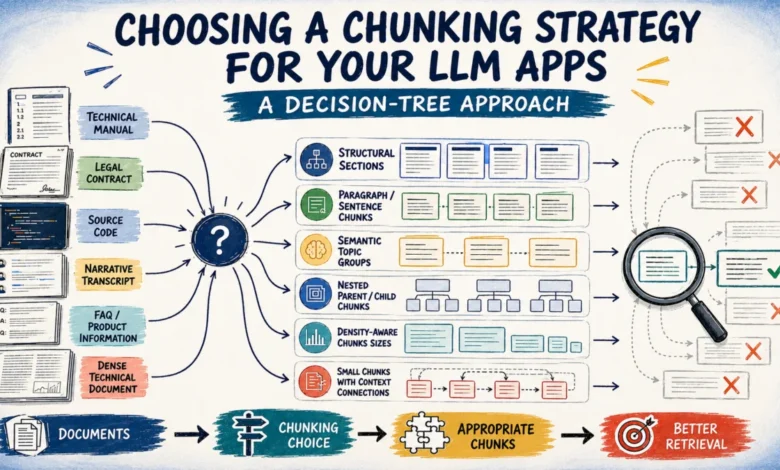
The Evolution of RAG and the Chunking Problem
In the early days of generative AI implementation, developers relied on naive, fixed-size chunking. This method, which arbitrarily slices text every 500 or 1,000 tokens, was sufficient for basic testing but often led to "context fragmentation." In technical, legal, or medical domains, such arbitrary cuts frequently sever the relationship between a header and its body, or a definition and its subsequent application.
The industry has since moved toward more nuanced strategies. Data scientists now recognize that a document’s internal structure—whether it is a dense legal contract, a highly modularized software documentation set, or a narrative-driven financial report—requires a tailored approach to segmentation. The objective is to ensure that each chunk is semantically coherent enough to be correctly embedded into a vector space, yet concise enough to fit within the restrictive context windows of current retrieval models.
A Structured Decision Framework
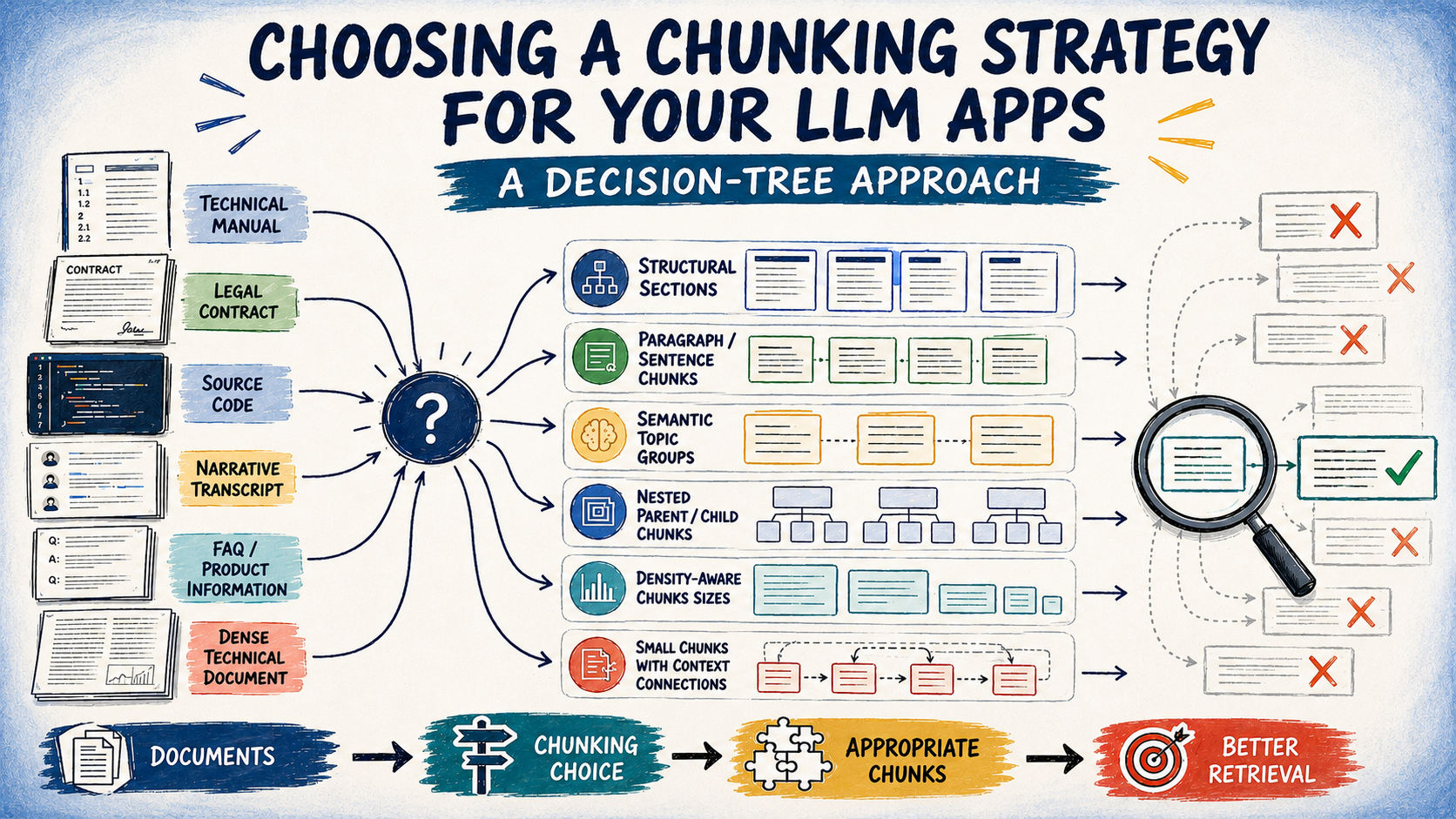
To address the variability in document types, engineering teams are increasingly adopting a standardized decision-tree approach. This methodology shifts the process from trial-and-error to a logic-based selection flow, prioritizing retrieval accuracy while managing computational overhead.
Phase 1: Structural Assessment
The process begins with an audit of the source material. If a document is inherently compact—such as a FAQ entry or a single-page product specification—the most efficient strategy is often to forgo chunking entirely. Embedding the entire document as a single unit preserves the total contextual integrity, preventing the system from "hallucinating" because it only saw half of the relevant information.
If the document exceeds the context window, the next step is to evaluate its internal hierarchy. Documents that utilize Markdown, HTML, or specific indentation patterns (such as code classes or functions) should utilize document-based chunking. By aligning the system’s split points with the author’s original formatting, developers ensure that the logical units of the information remain intact.
Phase 2: Contextual Dependency and Semantic Density
For complex datasets, such as technical manuals where a term defined on page one is critical to understanding page fifty, standard splitting techniques fail. In these instances, late chunking is increasingly favored. This advanced technique involves embedding the entire long-form document first and then deriving chunk-level embeddings from that high-fidelity foundation. This ensures that even small snippets carry the latent meaning of the broader document.
Furthermore, developers must consider information density. In a document that contains both sparse headers and dense, multi-layered data tables, adaptive chunking is required. This strategy uses different logic for different sections, dynamically adjusting the size of the chunks based on the "information density" of the specific paragraph or section being processed.
Phase 3: Cost-Benefit Optimization
As the complexity of the strategy increases, so does the cost. LLM-based chunking, which utilizes a model to "read" and parse the document into logical units, offers the highest accuracy but consumes significant compute resources. Conversely, semantic chunking—which uses embedding distance to detect topic shifts—provides a middle-ground, balancing quality with cost-effectiveness.
Chronology of RAG Development
- 2022: The Naive Era. Initial implementations focused on fixed-size sliding windows. Retrieval results were often poor, leading to the "garbage in, garbage out" phenomenon in RAG outputs.
- 2023: The Structural Shift. Developers began implementing document-specific parsers (PDF-to-text, HTML-to-Markdown) to identify natural breaks, marking the rise of document-based chunking.
- 2024: The Semantic and Agentic Pivot. The industry shifted toward "meaning-aware" techniques. The introduction of agentic chunking allowed for automated inspection of documents, where an AI agent classifies the document type before choosing the optimal split method.
- 2025-Present: The Era of Optimization. Current focus is on balancing retrieval latency with semantic precision, moving toward hybrid systems that combine hierarchical and late-chunking strategies for large-scale enterprise deployments.
Quantitative Impacts and Performance Indicators
Data from recent performance benchmarking indicates that migrating from fixed-size chunking to structure-aware or semantic chunking can improve Retrieval-Augmented Generation accuracy by an average of 15% to 30% in high-complexity datasets. However, this gain comes with a performance tax. LLM-based chunking, while the gold standard for accuracy, can increase document ingestion time by 400% compared to traditional character-based splitting.
For large-scale, heterogeneous collections, the consensus among machine learning engineers is to implement a "multi-modal" ingestion pipeline. This involves using an agent to categorize incoming files and routing them to the appropriate chunking logic—a move that saves significantly on compute costs while maintaining high recall rates.
Addressing Preprocessing Pitfalls
Even with a well-designed strategy, technical hurdles persist. A common symptom of improper chunking is the "mid-sentence cut," which typically indicates a mismatch between the document structure and the parsing logic. When developers observe that their system returns fragments that lack the necessary context to answer a query, the immediate fix is often to implement a recursive approach. Unlike fixed-size methods, recursive chunking attempts to split text at the largest possible unit (paragraph) before moving down to smaller units (sentences or words), thereby preserving the natural flow of the prose.
Furthermore, in systems where hierarchical or adaptive chunking fails to yield improvements, it is often a sign of "over-engineering." In smaller, uniform corpora, the added latency of these advanced methods provides diminishing returns. In such cases, reverting to a robust, recursive, or document-based approach is often the most pragmatic solution.
Broader Implications for Enterprise AI
The importance of this decision-making process cannot be overstated as organizations move to integrate proprietary knowledge bases into AI agents. The chunking strategy acts as the "data pipeline" for the model. If the pipeline is flawed, no amount of prompt engineering or fine-tuning can salvage the performance of the system.
As the field matures, the standard for RAG excellence will be defined by the granularity of the "retrieval unit." Companies that master the art of semantic segmentation—aligning the mechanical act of splitting data with the human intent behind the document—will achieve significantly higher levels of precision, reliability, and utility in their generative AI applications. The shift from "brute force" chunking to intelligent, context-aware partitioning represents the next evolution in the lifecycle of enterprise-scale AI deployment.