Apple’s iPhone Duo Set to Capture Nearly 30 Percent of Global Foldable Smartphone Market by 2027 Following Strong Debut

The global mobile technology landscape is undergoing a significant structural shift as foldable devices transition from a niche luxury category into the mainstream consumer consciousness. Following the highly anticipated commercial launch of Apple’s inaugural foldable device, market intelligence firm TrendForce has released an updated forecast indicating that the Cupertino-based tech giant is poised to capture nearly 30 percent of the worldwide foldable smartphone market by 2027. This rapid ascent underscores the profound influence of Apple’s ecosystem integration, hardware-software synergy, and developer engagement on a sector that has otherwise faced declining momentum among competing Android manufacturers.
The trajectory of the foldable smartphone market has experienced notable volatility over recent years. While brands such as Samsung and Huawei pioneered the form factor, consumer adoption was frequently hindered by high price points, software fragmentation, durability concerns, and a lack of compelling productivity use cases that justified the hardware compromise. However, the introduction of the iPhone Duo has altered industry dynamics almost overnight, validating the form factor for a massive global consumer base and prompting analysts to revise long-term shipment projections upward.
Chronology of Market Projections and the iPhone Duo Launch
The events leading to TrendForce’s latest market assessment unfolded rapidly over a matter of weeks, highlighting the immediate disruption caused by Apple’s entry into the foldable space.
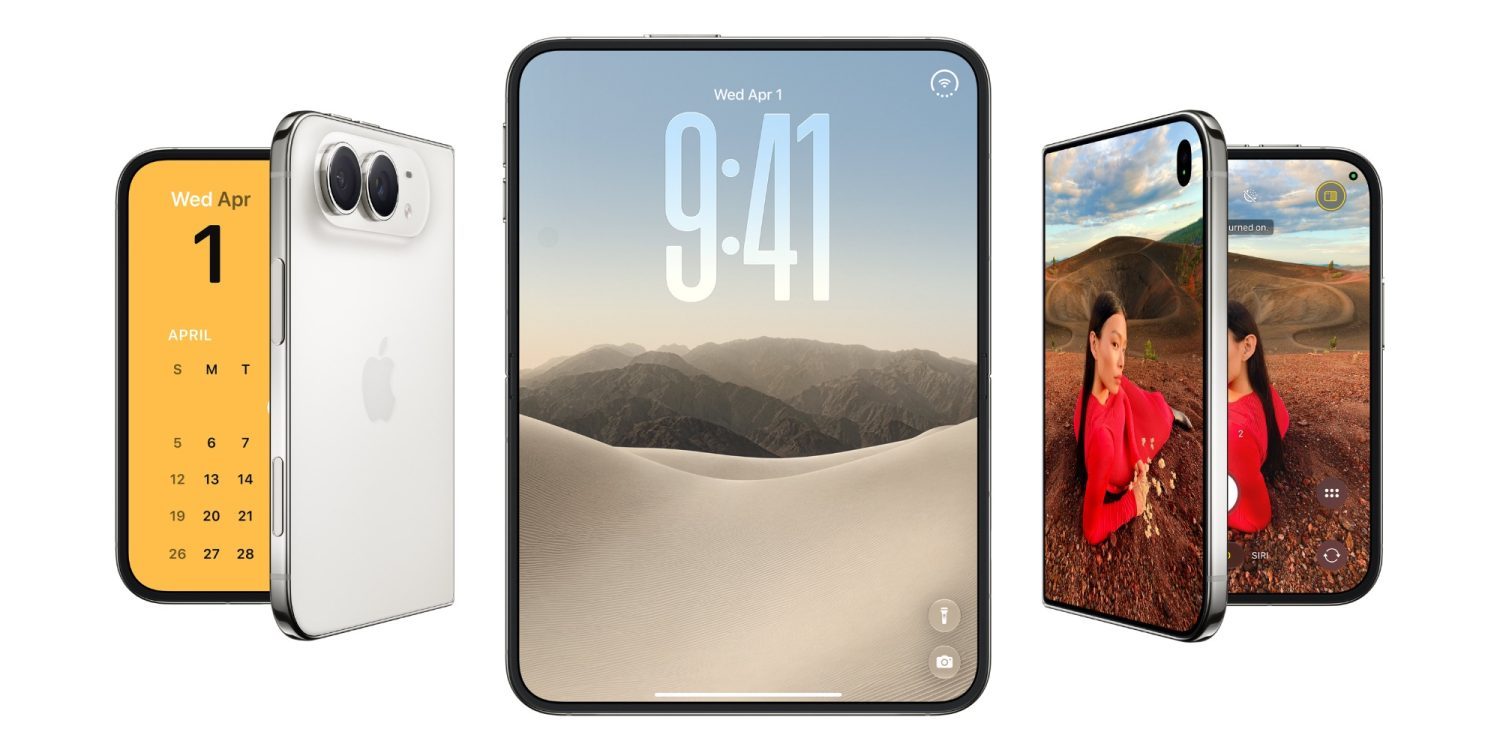
The timeline of market developments surrounding the iPhone Duo includes:
- Early September 2026: Apple officially announces the iPhone Duo, introducing its first-ever foldable smartphone featuring a dual-screen configuration with both folded and unfolded operating modes.
- Day After Announcement (September 2026): TrendForce publishes its initial preliminary report, predicting that Apple would ship 5 million units of the iPhone Duo by the end of 2026, capturing a substantial 24.8 percent market share in its debut year.
- Late October 2026: Following nearly a week of commercial shipments and initial retail performance data, TrendForce issues an updated, comprehensive market report. The firm reiterates its prior outlook and raises its 2027 forecast, estimating that Apple will secure 29.8 percent of the global foldable market by the close of the following year.
This swift revision reflects stronger-than-anticipated initial demand and retail absorption out of the gate, confounding skeptics who questioned whether consumers were ready to embrace Apple’s implementation of foldable technology.
Detailed Market Data and Shifting Competitive Dynamics
According to TrendForce’s updated metrics, the broader foldable smartphone market is entering a phase of renewed expansion, though the growth is unevenly distributed among manufacturers. Prior to Apple’s market entry, the overall foldable segment was projected to stagnate, with 2026 growth forecasted at a meager 0.5 percent. Concurrently, shipments from established Android brands were tracking toward a year-over-year decline exceeding 20 percent, as consumer interest plateaued and hardware iterations offered diminishing returns.
Looking toward 2027, the market landscape is expected to rebound significantly, reaching an anticipated 23.5 million total shipments—representing a robust 16.3 percent increase over the previous year. Apple’s entrance is widely credited as the primary catalyst for this renewed momentum, driving supply chain advancements, engineering refinements, and heightened consumer awareness.
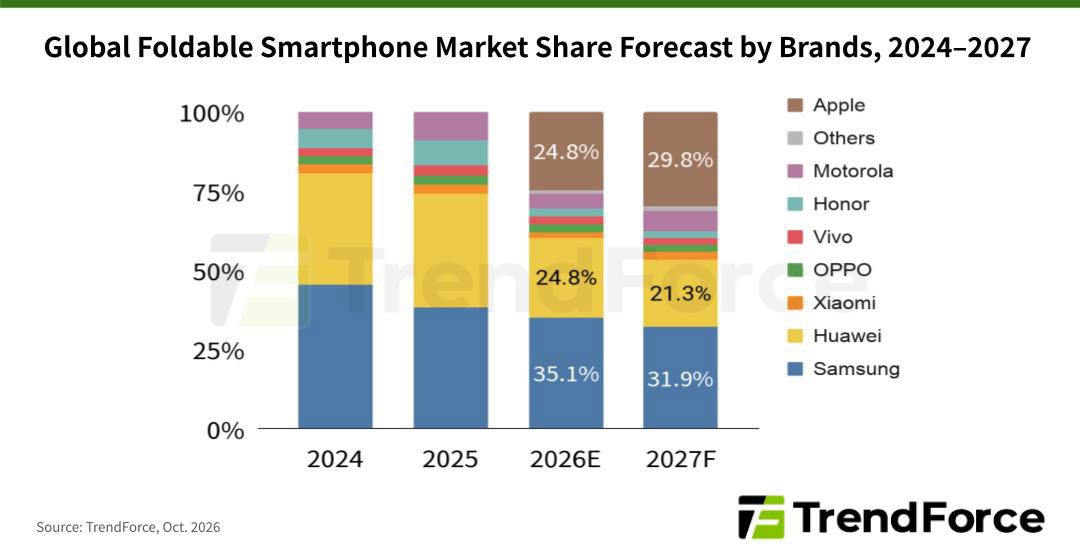
Despite the influx of Apple devices into the ecosystem, incumbent market leaders are bracing for shifts in their respective market shares:
- Samsung: Long recognized as the dominant force in foldables, Samsung is projected to see its market share decline from 35.1 percent in 2026 to 31.9 percent in 2027 as competitive pressure intensifies.
- Apple: Positioned firmly in second place, Apple is forecasted to capture 29.8 percent of the market by 2027, rapidly closing the gap with the long-standing category leader.
- Huawei: Facing mounting competition from both domestic rivals and Apple’s global footprint, Huawei’s market share is projected to contract from 24.8 percent in 2026 down to 21.3 percent in 2027.
Strategic Advantages: Ecosystem Integration and Multitasking Efficiency
Industry analysts and research reports point to a distinct structural advantage that separates Apple from its competitors in the foldable space. TrendForce highlighted in its analysis that Apple’s primary strength lies in its vertical integration—specifically its unified control over custom silicon design, operating system architecture, and a highly engaged developer ecosystem.
Historically, foldable devices on the Android platform suffered from inconsistent application scaling and third-party software adaptation, as developers had to account for a fragmented array of screen sizes, aspect ratios, and hinge mechanisms across multiple manufacturers. In contrast, Apple’s rigorous design guidelines and developer tools—demonstrated heavily by software engineering leadership during recent platform introductions—encourage seamless transitions between folded and unfolded states.
Furthermore, TrendForce notes that Apple’s arrival shifts the competitive paradigm of the foldable market away from mere novelty form-factor innovations toward practical, everyday utility. By emphasizing multitasking efficiency, advanced artificial intelligence use cases, and robust hardware reliability, the iPhone Duo redefines what consumers and enterprise users expect from a dual-screen mobile device. As app compatibility matures, the practical value of foldable displays increases exponentially, lowering the barrier to entry for mainstream consumers who previously viewed foldables as fragile or impractical gadgets.

Broader Economic and Industrial Implications
The rapid market penetration of the iPhone Duo carries profound implications for the global consumer electronics supply chain. Panel manufacturers, hinge fabricators, and advanced packaging specialists are currently scaling production lines to meet Apple’s stringent quality and volume demands. This capital expenditure is expected to accelerate research and development across the entire component sector, yielding thinner ultra-thin glass (UTG), more durable hinge mechanics, and more energy-efficient display drivers that will ultimately benefit the entire mobile industry.
Moreover, the integration of advanced artificial intelligence use cases alongside foldable hardware represents a crucial convergence point for modern smartphones. As AI models become more deeply embedded in mobile operating systems, split-screen and expanded canvas form factors provide the ideal physical workspace for generative AI assistants, multi-window productivity tasks, and immersive media consumption. Apple’s ability to synchronize its proprietary silicon capabilities with the unique physical properties of the iPhone Duo positions the company to capture not only hardware sales, but long-term software and service engagement within the high-end smartphone tier.
As commercial availability widens and subsequent software updates refine the user experience of the iPhone Duo, market observers will closely monitor whether Android competitors can counter Apple’s momentum with accelerated innovation of their own. For now, TrendForce’s projections make it clear that the foldable smartphone market has officially entered a new era—one defined by mainstream validation, ecosystem maturity, and intensified global competition.