The Rise of Social-First AI: How Real-Time Data and Platform-Native Workflows Are Transforming Digital Marketing


In the rapidly evolving landscape of digital marketing, artificial intelligence has shifted from a futuristic novelty to an everyday corporate utility. However, a significant disconnect has emerged between the expectations of senior leadership and the daily realities faced by social media managers on the front lines. While general-purpose artificial intelligence tools have dominated enterprise technology stacks over the last several years, recent industry data indicates that these broad models are failing to meet the fast-paced, high-nuance demands of modern social media marketing. This growing friction has catalyzed a new technological paradigm: social-first artificial intelligence.

Unlike general-purpose large language models that draw from static web crawls and historical training data with strict knowledge cutoffs, social-first AI is architected explicitly around live social media signals, platform-specific formats, and real-time human interactions. As marketing budgets increasingly pivot toward automated intelligence, industry analysts and practitioners are re-evaluating what it means for an AI tool to genuinely deliver return on investment.
The Core Divide: General-Purpose AI Versus Social-First Systems
To understand why traditional AI models struggle in social media environments, experts point to the fundamental difference in data grounding. General-purpose models are optimized for long-form content, encyclopedic queries, and structured data analysis. They excel at processing static text but falter when confronted with the hyper-accelerated cadence of social media, where a viral trend can emerge, peak, and fade within a 48-hour window.

Furthermore, platform culture shifts continuously. Tone varies wildly between platforms like TikTok, LinkedIn, and Instagram, and can even change week-to-week based on trending audio, memes, and subcultural lexicon. When marketers rely on general-purpose chatbots to generate social content, the resulting copy frequently feels sanitized, formal, or slightly out of date.
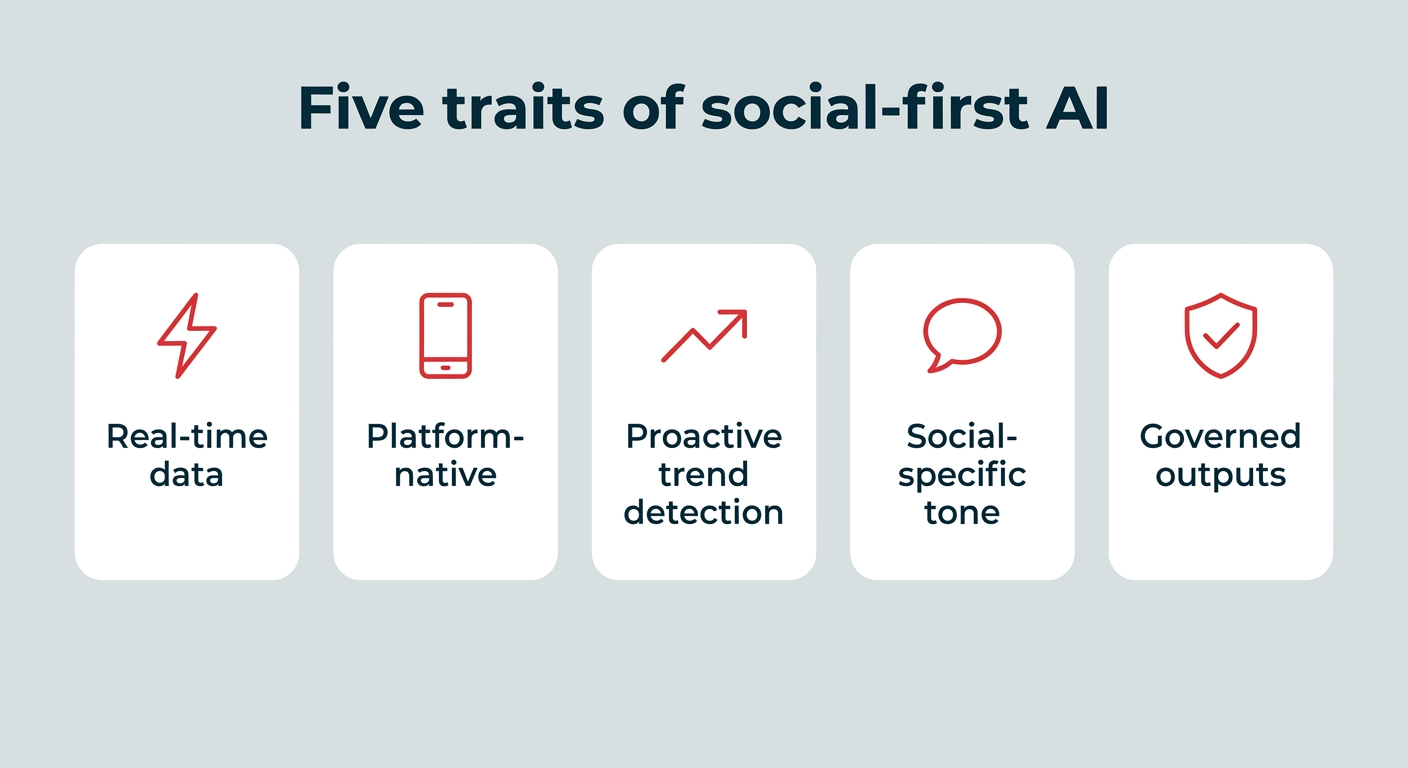
In contrast, social-first AI systems operate on live data streams. They feature proactive trend detection, platform-native formatting capabilities, and built-in governance workflows. Rather than treating social media as an afterthought bolted onto a generalized corporate marketing suite, social-first AI treats social platforms as the primary source of truth and the primary operational workflow.
The Growing Frustration: Expectations Versus Frontline Reality
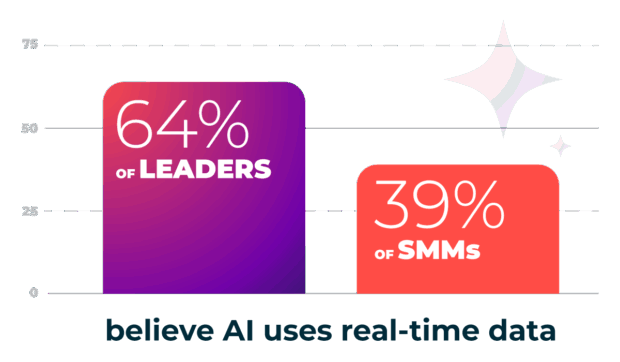
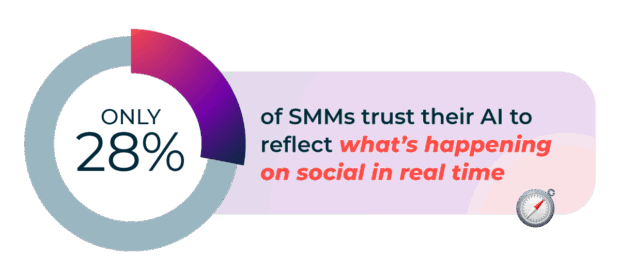
Data from recent marketing surveys highlights a stark perceptual divide between executive suites and the practitioners executing daily campaigns. According to recent findings, roughly 64 percent of senior marketing leaders believe their current AI toolkits utilize real-time data. However, only 39 percent of social media managers working directly with those tools share that confidence.
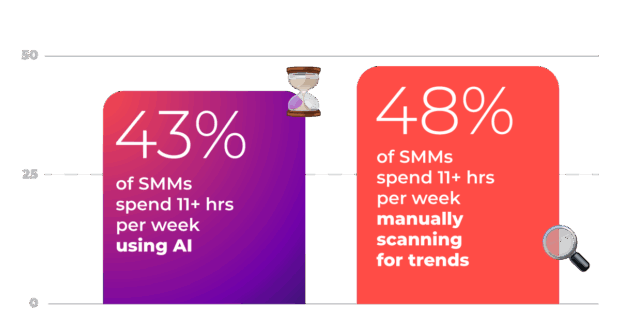
This confidence gap is mirrored in productivity metrics. AI tools were originally pitched as time-saving mechanisms designed to eliminate repetitive administrative tasks and accelerate content production. Yet, over 43 percent of social media managers now report spending more than 11 hours per week navigating and troubleshooting AI tools. Rather than freeing up marketing professionals for strategic brainstorming and community management, poorly adapted AI has frequently created an additional layer of oversight, forcing teams to painstakingly rewrite robotic copy or reverse-engineer flawed outputs.
The financial implications of this mismatch are substantial. Approximately 40 percent of senior marketing leaders acknowledge that they have wasted upwards of 10 percent of their total AI budgets on underperforming software that failed to deliver measurable results. In an economic climate where corporate finance departments scrutinize every line item, these misallocations risk eroding executive trust in the potential of marketing technology as a whole.
Chronology of Adoption and the Cost of Delayed Reactions
The timeline of artificial intelligence adoption in marketing reveals a clear trajectory from simple content generation to complex workflow automation.
In the initial phase of generative AI adoption, brands primarily utilized large language models for rudimentary drafting tasks, such as summarizing long reports or writing basic image captions. These early applications required heavy manual oversight but were viewed as low-risk experiments.
As budgets expanded—with nearly half of senior marketers now allocating over 10 percent of their total budgets to AI, and one in five dedicating more than 20 percent—expectations shifted toward end-to-end campaign automation. Organizations anticipated that intelligent software could autonomously spot cultural moments, draft platform-appropriate content, and publish updates in real time.
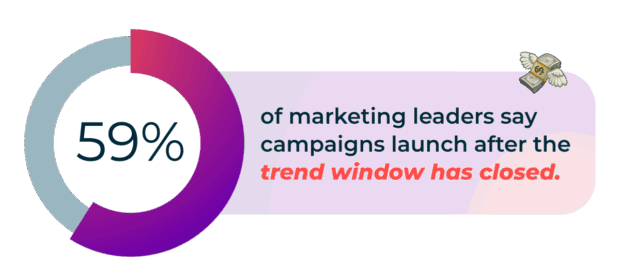
However, the technology lagged behind these ambitions. Nearly 60 percent of senior marketers report that their campaigns frequently go live after the relevant trend window has closed. When intelligence layers fail to process emerging signals rapidly, the resulting delays render cultural marketing efforts obsolete before they ever reach an audience. Consequently, brands are finding that speed without contextual grounding is functionally useless.
Industry Implications and the Shift Toward Specialized Operating Systems
As the limitations of generalized chatbots become increasingly apparent, enterprise organizations are demanding specialized solutions. Industry experts suggest that future technology investments will depend on six critical criteria: real-time data access, platform-specific content understanding, rapid trend detection speed, seamless workflow integration, built-in governance controls, and transparent, citable sources.
Platforms that fail to meet these stringent operational benchmarks are increasingly being sidelined by modern marketing teams. The modern enterprise requires unified operating systems where listening, content creation, customer care, and compliance governance coexist within a single data architecture. By integrating conversational AI orchestration with live intelligence streams covering millions of global sources across dozens of languages, organizations can transition from reactive reporting to proactive execution.
Ultimately, the maturation of social-first AI represents a pivotal inflection point for the digital marketing industry. By grounding artificial intelligence in live, platform-native data rather than static web archives, technology providers are attempting to bridge the gap between executive ambition and frontline reality. For marketing teams navigating an increasingly noisy digital landscape, the success of future campaigns will depend less on the sheer volume of AI deployment and more on the precision, speed, and contextual intelligence of the tools they choose to trust.
Related posts: