Southeast Asia’s Digital Economy to Hit $368 Billion as Generative AI Adoption Scales at Record Speeds


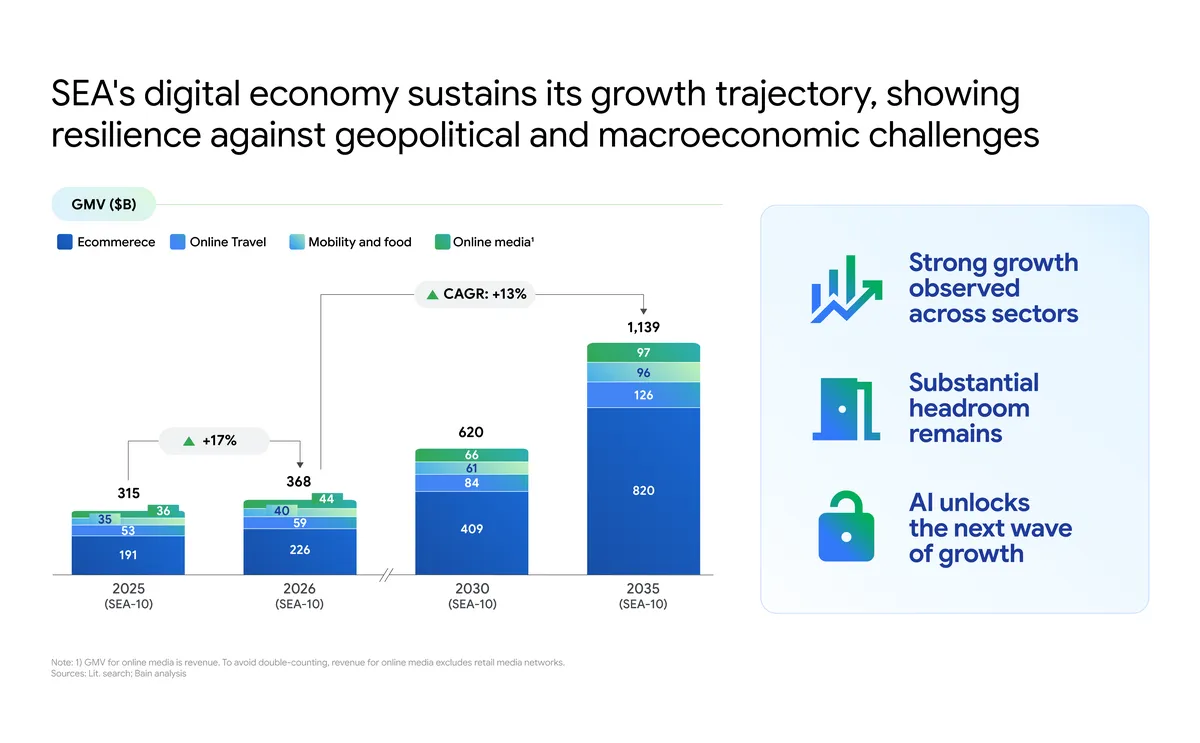
The digital economy across Southeast Asia is on a rapid trajectory toward monumental expansion, projected to reach a Gross Merchandise Value (GMV) of $368 billion in 2026. This represents a robust 17% year-on-year growth rate driven primarily by the unprecedented, mainstream integration of generative artificial intelligence. According to the 11th edition of the annual e-Conomy SEA report—titled Building the Intelligent Economy and co-authored by Google, Temasek, and Bain & Company—generative AI has transitioned from a novelty to an indispensable infrastructure component for everyday commerce and digital interaction across the region.
With approximately 243 million active users—representing 58% of the region’s working population—engaging with generative AI tools daily, the technology is scaling at a pace four times faster than the historic rollout of mobile internet. This staggering acceleration places Southeast Asia firmly on course to shatter the $1 trillion threshold in digital economy GMV by 2035. As regional market dynamics shift toward token-based benchmarking for computing consumption, institutional analysts anticipate that consumer readiness for agentic commerce will spur a 60-fold expansion in regional AI utilization over the coming half-decade.
Context and Historical Evolution of the e-Conomy SEA Report
To understand the magnitude of the 2026 milestone, one must examine the broader historical context of Southeast Asia’s digital transformation. Initiated over a decade ago, the e-Conomy SEA report series has served as the definitive barometer for the region’s internet economy, tracking the maturation of internet usage across Indonesia, Malaysia, the Philippines, Singapore, Thailand, and Vietnam.
In its earliest iterations during the mid-2010s, the report focused heavily on foundational infrastructure challenges: low smartphone penetration, unbanked populations, fragmented logistics networks, and nascent digital payment systems. Over successive years, the region graduated from solving basic connectivity hurdles to witnessing the meteoric rise of regional super-apps, widespread adoption of QR-code-based digital payments, and the acceleration of e-commerce during the global economic shifts of the early 2020s.
By 2023 and 2024, post-pandemic adjustments forced a sharper corporate focus on profitability over pure growth, tempering valuation spikes but stabilizing the ecosystem. The 2026 report marks a structural turning point—the transition from the mobile-first era into the intelligence-first era. Generative AI is no longer viewed merely as an enterprise optimization tool; it has permeated the consumer fabric, altering how millions of Southeast Asians discover products, plan logistics, manage finances, and consume digital media.
Sector-by-Sector Analysis: AI as a Catalyst for Sustained Growth
The 17% year-on-year expansion is not isolated to a single vertical; rather, it is a synchronized upward movement across all major pillars of the digital economy. Artificial intelligence is actively rewriting the operational playbooks of e-commerce, online travel, digital media, transport, food delivery, and financial services.
E-Commerce Continues to Anchor Regional Dominance
E-commerce remains the undisputed anchor of Southeast Asia’s digital economy, commanding $226 billion in GMV and growing at 18% year-on-year. The sector’s expansion is heavily underpinned by multimodal discovery tools and sophisticated in-app conversational assistants. Consumers are increasingly utilizing AI to navigate complex purchasing decisions, bypassing traditional keyword searches in favor of contextual, conversational queries. Data from the report indicates that these personalized experiences organically drive a 10% increase in conversion rates, with individual merchant order volume uplifts reaching as high as 75%.
Online Travel and Tourism rebound with Intelligence
The online travel sector has reached $59 billion in GMV, reflecting a 10% year-on-year increase. While traditional search engines remain the primary starting point for travel research, generative AI has officially surpassed social media platforms to become the second most utilized tool for planning complex itineraries. Travelers leverage AI agents to synthesize flight schedules, accommodation reviews, and localized activity recommendations into cohesive, customized travel plans within seconds.
Digital Media and the Rise of Commerce Media
Online media revenue has climbed to $44 billion, marking a 22% year-on-year growth rate. Media platforms are deploying AI algorithms to dynamically personalize content feeds and match audiences with hyper-relevant advertisements. This precision targeting has yielded a 10% to 20% improvement in quality engagement metrics, simultaneously accelerating the rise of commerce media into a formidable $4 billion market segment.
Mobility, Food Delivery, and Digital Financial Services

The mobility and food delivery sector generated $40 billion in GMV, up 15% year-on-year. Predictive suggestion engines, optimized route-planning algorithms, and pooled-ride matching have reduced consumer wait times and optimized driver earnings. Meanwhile, digital financial services achieved a Gross Transaction Value (GTV) of $1,650 billion, expanding 16% year-on-year. AI implementation in fintech focuses heavily on real-time fraud detection, expanded credit assessment models for underbanked populations, and personalized wealth management recommendations—cementing Singapore’s position as a regional hub for advanced digital wealth platforms.
Consumer Trust and the Dawn of Agentic Commerce
A critical finding of the 2026 e-Conomy SEA report is the rapid evolution of consumer readiness for agentic commerce—an economic model where autonomous AI agents execute multi-step tasks, compare prices, and complete transactions on behalf of users.
This readiness is supported by existing consumer habits; 72% of regional users already rely routinely on digital automation features such as automated price tracking and algorithmic alerts. More importantly, 75% of surveyed consumers express a direct willingness to delegate financial transactions and complex multi-merchant comparisons to autonomous AI agents.
This openness is rooted in a fundamentally optimistic regional sentiment toward technology. Approximately 62% of Southeast Asians view artificial intelligence as a net societal benefit, reflecting an increase in confidence compared to previous years. Drivers of this trust include proven operational track records (cited by 56% of respondents), rising daily familiarity with tools (55%), and demonstrable improvements in output accuracy (53%).
However, industry stakeholders note that unlocking the full potential of agentic commerce requires addressing specific consumer safeguards. To achieve widespread adoption, users demand robust data privacy safeguards (44%), transparent disclosures regarding the operational limitations of AI agents (36%), and frictionless mechanisms to reverse or modify automated transactions (30%).
Broader Economic Implications and Strategic Challenges
To sustain a projected 60-fold increase in regional AI usage by 2030 and stay on track for the $1 trillion digital economy target, Southeast Asia’s broader macroeconomic ecosystem must systematically evolve across four critical pillars: infrastructure, regulatory harmonization, talent development, and energy sustainability.
First, physical and digital infrastructure investments must accelerate. The exponential surge in token generation and processing requires a massive expansion of regional data center capacity, stable high-speed broadband, and advanced semiconductor supply chains. Nations like Singapore, Malaysia, and Indonesia are already vying to become regional data center hubs, though this brings secondary challenges regarding power grid reliability and carbon footprint management.
Second, regulatory frameworks across ASEAN member states must find a delicate balance between fostering innovation and protecting consumer rights. Harmonizing cross-border data flows while maintaining rigorous privacy standards remains a primary objective for policymakers, particularly as agentic commerce blurs jurisdictional boundaries for online transactions.
Third, workforce readiness and human capital development are paramount. While automation drives operational efficiencies, the demand for specialized technical talent—ranging from machine learning engineers to AI ethicists—outstrips current educational output. Governments and private enterprises must collaborate on large-scale reskilling initiatives to ensure that the workforce benefits equitably from the intelligence-driven economy.
Conclusion
The 2026 e-Conomy SEA report underscores Southeast Asia’s emergence as one of the world’s most dynamic and digitally agile economic zones. By embracing generative AI at a scale that outpaces historical mobile adoption curves, the region has established a resilient foundation for long-term prosperity. As consumer trust deepens and agentic commerce transitions from theory to practice, Southeast Asia is well-positioned to redefine the boundaries of the global digital economy, marching steadily toward its trillion-dollar destiny by 2035.