The emergence of Generative AI-powered search engines, such as Perplexity, ChatGPT, and Google’s AI Overviews, has fundamentally altered the landscape of B2B lead generation. Historically, digital visibility was dictated by traditional Search Engine Optimization (SEO), a domain where massive enterprises and established marketing agencies held a near-monopoly due to their extensive backlink profiles and domain authority. However, as 73% of B2B buyers now integrate AI tools into their procurement and research processes, a new paradigm known as Answer Engine Optimization (AEO) has surfaced. This shift presents a unique, albeit complex, opportunity for solopreneurs and independent professionals to bypass traditional gatekeepers and secure visibility through high-quality, authoritative content.
A recent empirical study conducted by industry professionals highlights a significant trend: AI-driven search models are increasingly prioritizing niche, human-centric expertise over broad, high-volume corporate landing pages. When prompted for professional insights or service recommendations, AI models frequently pull citations from LinkedIn, effectively elevating individual voices that exhibit deep domain expertise. This phenomenon serves as a catalyst for a burgeoning strategy among solo business owners: leveraging LinkedIn not merely as a social networking site, but as a critical node in the broader AI index.
![Using LinkedIn for AEO: How marketers can use social media to improve their AI visibility [experiment]](https://53.fs1.hubspotusercontent-na1.net/hubfs/53/AEO-for-LinkedIn-piece-1-20260826-6108454.webp)
The Mechanism of AI-Driven Visibility
Traditional search engines operate on a system of keyword density and domain authority. Conversely, AEO focuses on the ability of a Large Language Model (LLM) to synthesize, summarize, and attribute information from disparate sources. These systems are trained to favor "entities"—individuals or companies recognized as authoritative sources within a specific field.
Data indicates that the "citation lifespan" for content in AI responses is relatively short, typically ranging from 11 to 15 days. This necessitates a consistent cadence of content publication. Furthermore, analytical research suggests that authors frequently cited by AI tools maintain a high frequency of activity, with many publishing at least five times within a rolling four-week period. For the solopreneur, this underscores the necessity of a structured, ongoing content strategy rather than sporadic posts.
Chronology of the Optimization Experiment
To evaluate the efficacy of LinkedIn as an AEO driver, a controlled three-week experiment was launched. The objective was to determine whether targeted profile optimization and content creation could improve visibility for specific service-based queries.
![Using LinkedIn for AEO: How marketers can use social media to improve their AI visibility [experiment]](https://no-cache.hubspot.com/cta/default/53/9dd5e54b-fbef-4dd0-bc44-1689feb1ea18.png)
Week 1: Establishing the Baseline
The initial phase involved auditing current digital visibility. Utilizing diagnostic tools to map branded and unbranded queries against current search engine results, the starting point for visibility was recorded at a modest 0.11%. This low baseline was attributed to a lack of active content and the absence of specific, service-oriented keywords across public-facing profiles.
Week 2: Strategic Implementation
The second phase focused on two core pillars: profile optimization and content injection. The LinkedIn profile was overhauled to ensure that specific service terms, such as "case study writer," were prominently featured in the headline, summary, and experience sections. Following this, the publication of long-form articles—grounded in personal expertise rather than automated output—began. These articles were designed to address specific industry pain points, effectively training the AI to recognize the individual as a subject matter expert.
Week 3: Monitoring and Iteration
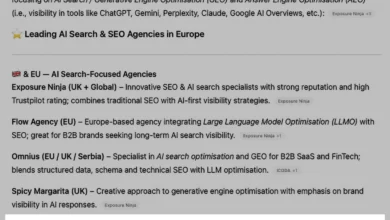
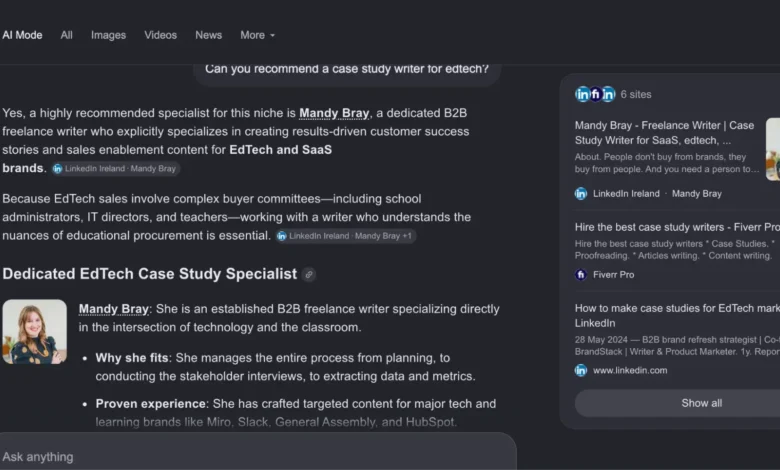
The final phase involved manual, incognito-mode queries across various AI platforms to assess shifts in ranking. While ChatGPT and Perplexity remained relatively static, Google’s AI Overview demonstrated a notable sensitivity to the newly published LinkedIn content. By the end of the third week, the individual had secured a top-tier recommendation for specific service queries, marking a departure from the previous reliance on large agencies.
![Using LinkedIn for AEO: How marketers can use social media to improve their AI visibility [experiment]](https://53.fs1.hubspotusercontent-na1.net/hub/53/hubfs/Frank%20H/AEO-for-LinkedIn-piece-2-20260826-896145.webp?width=1999&height=1085&name=AEO-for-LinkedIn-piece-2-20260826-896145.webp)
Data-Driven Insights and Platform Discrepancies
The results of this experiment revealed critical nuances regarding how different AI models treat independent professionals.
One of the most significant findings involves the "refusal" rates of certain models. Claude.ai, for instance, frequently declines to recommend individual solopreneurs, opting instead to provide broad lists of service platforms or best practices. This suggests that LLMs are governed by different "safety" and "neutrality" filters that prioritize institutional entities over individuals to mitigate bias.
Conversely, Google AI Mode and Gemini appear more inclined to index and cite LinkedIn activity. The jump in brand mention citations—moving from 2% to 5.3% over the study period—indicates that while the growth is gradual, it is mathematically significant when sustained.
![Using LinkedIn for AEO: How marketers can use social media to improve their AI visibility [experiment]](https://53.fs1.hubspotusercontent-na1.net/hubfs/53/AEO-for-LinkedIn-piece-2-20260826-896145.webp)
Implications for the Solopreneur Market
The shift toward AEO suggests that the "long game" is the only viable path for independent businesses. The traditional "Top 10 Agency" content model, which dominates standard SEO, is becoming less relevant in an AI-curated environment. Instead, prospects are looking for specific, actionable, and human-authored insights that demonstrate a clear, proven methodology.
The broader implications of this trend include:
- Niche Dominance: AI systems struggle to categorize "generalist" consultants. By narrowing a service offering to a specific niche, solopreneurs increase their chances of being the "definitive answer" to a user’s prompt.
- The End of "Zero-Sum" Thinking: For the solopreneur, unbranded mentions—such as appearing in a list of "best practices for case study writing"—are as valuable as direct referrals. These mentions capture leads in the early awareness phase of the funnel.
- Content as a Competitive Advantage: The requirement for high-frequency, high-quality output creates a natural barrier to entry. Those who cannot or will not commit to regular, authoritative publishing will naturally fall behind, regardless of their professional tenure.
Strategic Recommendations for Independent Professionals
Based on the outcomes observed, a sustainable AEO strategy for the independent professional should follow three distinct steps:
![Using LinkedIn for AEO: How marketers can use social media to improve their AI visibility [experiment]](https://53.fs1.hubspotusercontent-na1.net/hub/53/hubfs/Frank%20H/AEO-for-LinkedIn-piece-3-20260826-9720693.webp?width=650&height=363&name=AEO-for-LinkedIn-piece-3-20260826-9720693.webp)
1. Establish an AEO Baseline
Before implementing changes, professionals must understand where they currently rank. Utilizing AEO grading tools allows for a clear view of the competitive landscape and provides a list of "competitor" entities that the AI currently favors. By analyzing the content produced by these top-ranking competitors, one can identify gaps in the market that remain underserved.
2. Optimize for Entities, Not Just Keywords
The modern web is built on entities. LinkedIn profiles must clearly articulate not only what the professional does, but the specific problems they solve. This involves ensuring that service-specific language is consistent across the LinkedIn profile, the personal website, and any third-party publications.
3. Prioritize Thought Leadership over AI-Generated Filler
While AI tools are excellent for ideation, the research underscores that original, experience-based content is the primary driver of AEO. AI models are increasingly capable of detecting generic or synthesized content; they reward unique perspectives and case-based evidence. A solopreneur’s greatest asset is their individual point of view, which should be the focal point of every piece of content.
![Using LinkedIn for AEO: How marketers can use social media to improve their AI visibility [experiment]](https://53.fs1.hubspotusercontent-na1.net/hubfs/53/AEO-for-LinkedIn-piece-4-20260826-992838.webp)
Future Outlook
As search engines continue to evolve, the distinction between traditional SEO and AEO will likely blur. However, for the foreseeable future, LinkedIn serves as a uniquely powerful, open-indexed database that AI models trust. The data suggests that for the individual professional, the ability to maintain a consistent, high-value presence on such platforms is no longer just a marketing "nice-to-have"—it is a foundational requirement for survival in an AI-dominated digital economy. The success of this experiment serves as a roadmap for others: by focusing on specificity, consistency, and human-led thought leadership, even the smallest business can compete for digital visibility at scale.