Gemini in Google Workspace now offers unified cross-app task execution capabilities for all users

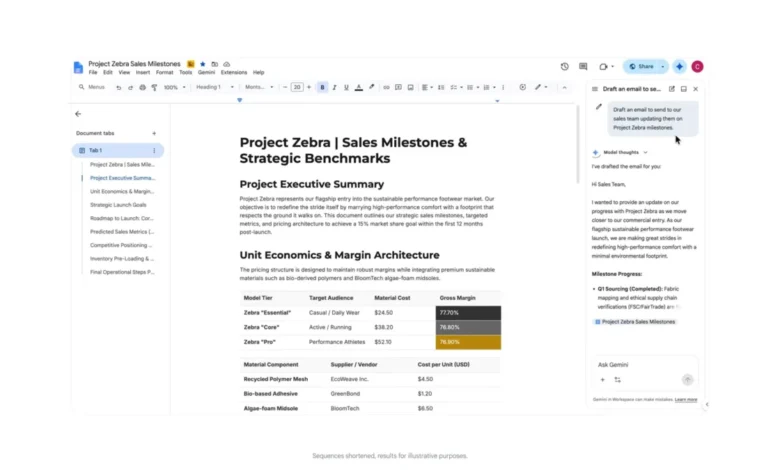
Google has officially launched a significant architectural upgrade to Gemini within its Workspace ecosystem, effectively breaking down the functional silos that previously restricted AI capabilities to specific applications. By deploying a unified feature set across Gmail, Drive, Docs, Slides, and Chat, Google is transitioning its AI assistant from a collection of context-dependent tools into a centralized, cross-functional intelligence layer. This update, powered by the company’s proprietary Workspace Intelligence framework, enables users to execute complex, multi-step workflows without leaving their active window.
The update, which began its global rollout this September, represents the most significant integration milestone since Google first introduced generative AI into its productivity suite. Previously, the Gemini side panel acted as an isolated helper; users were required to be physically within a Google Doc to generate text or inside a Google Sheet to manipulate data. This friction, while manageable for simple tasks, hindered the fluid multitasking required in professional environments. With this new iteration, the barriers between applications have been dismantled, allowing the AI to act as a bridge across the entire Workspace suite.
The Evolution of Gemini in Workspace: A Chronology
To understand the scale of this development, one must look at the rapid evolution of Google’s AI integration strategy over the past two years. In early 2023, Google introduced "Duet AI" as a testing ground for generative features within Workspace. This initial phase was characterized by specific, narrow use cases: drafting emails in Gmail and generating images in Slides.
By late 2023, the rebranding to "Gemini" signaled a more aggressive approach to integrating large language models (LLMs) into the core of Google’s infrastructure. However, the user experience remained segmented. Throughout the first half of 2024, feedback from enterprise clients consistently highlighted a desire for "holistic" task management—the ability to query data from Drive while composing a presentation in Slides or to reconcile calendar conflicts during a team chat.
The September 2026 update addresses these concerns directly. By unifying the side panel, Google is essentially treating the entire Workspace suite as a single, interconnected application. This transition marks the end of the "app-silo" era for Google’s productivity software and signals a shift toward agentic AI, where the software is expected to navigate the user’s digital environment to complete objectives rather than simply assisting with text generation.
Technical Foundations and Functional Upgrades
The core of this upgrade lies in the deeper integration of Workspace Intelligence. This backend layer allows Gemini to interface with the Application Programming Interfaces (APIs) of multiple apps simultaneously. When a user issues a command—such as "Find the open times for my team, schedule a follow-up, and log the tasks in my to-do list"—the AI no longer triggers a single app-specific function. Instead, it initiates a sequence of cross-app calls that query Calendar, draft a Chat message, and update Google Tasks.
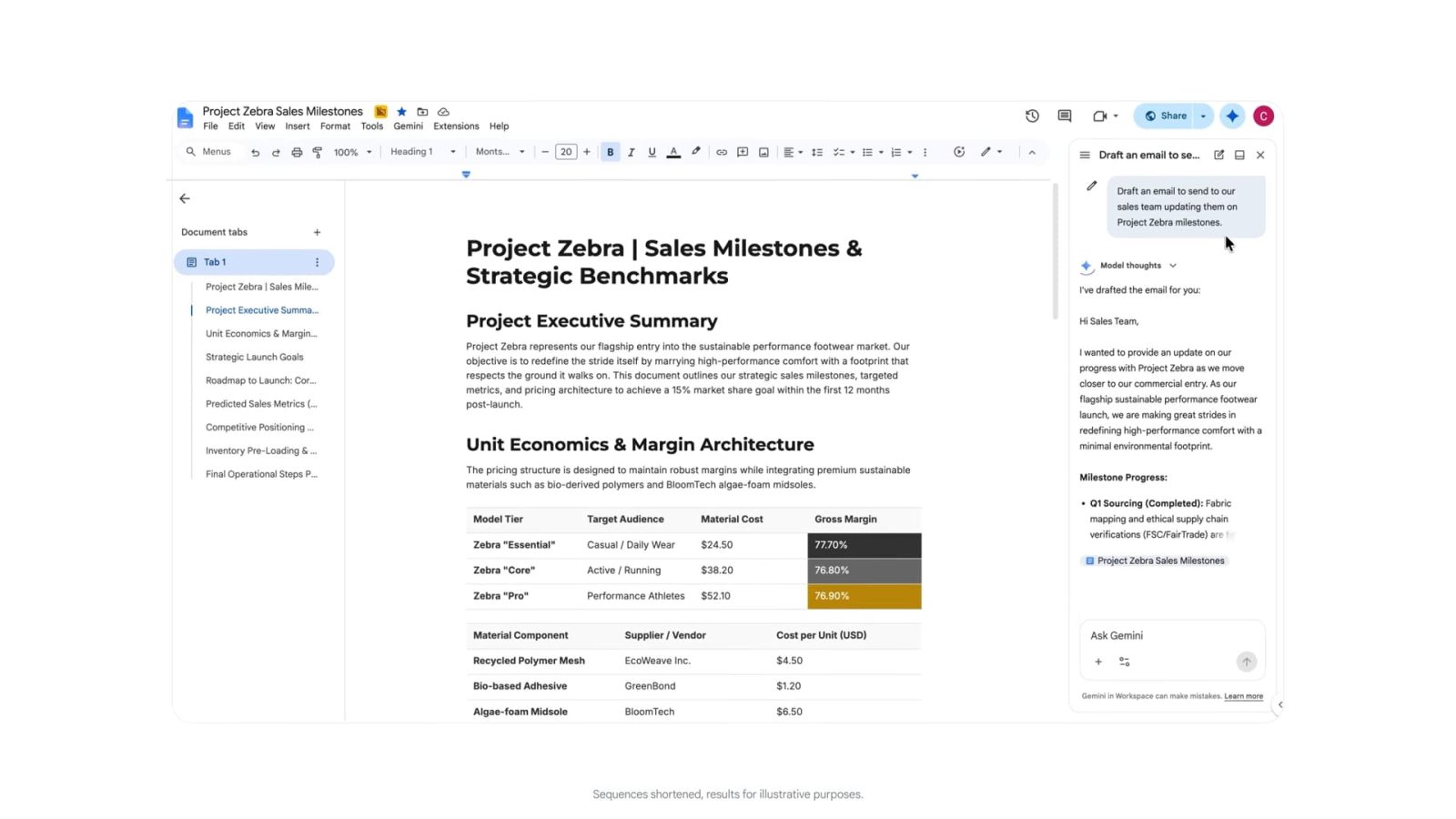
For the end user, this manifests as a dramatic reduction in context switching. The ability to command an email to be sent to a sales team directly from a Google Doc document, for instance, eliminates the need to copy-paste content between windows. Furthermore, the synchronization of these features across Docs, Slides, and Sheets ensures that the "AI experience" is consistent, regardless of the user’s primary workspace.
Supporting Data and User Tiers
The availability of these expanded capabilities is tiered according to Google’s subscription models. This ensures that while the technological foundation is unified, the feature depth remains aligned with professional and enterprise requirements.
- Google AI Pro: Subscribers to this tier receive access to the full suite of cross-app capabilities, with one notable exclusion: the advanced scheduling functionality. This is a strategic limitation designed to reserve high-volume calendar automation for enterprise-grade users.
- Google AI Ultra: This premium tier unlocks the complete spectrum of features, including high-level scheduling, conflict resolution, and complex task orchestration.
- Enterprise and Education Rollout: The update is also being systematically deployed to Workspace Business, Enterprise, and Education tiers. Google has indicated that the rollout will be completed for all global regions by the end of the fourth quarter of 2026.
According to preliminary internal usage metrics provided by Google, early testing of these cross-app features resulted in a 30% reduction in time spent on administrative "clerical" tasks. Users reported that the ability to log tasks into Google Tasks from within a Gmail thread was the most frequently utilized feature during the beta period.
Implications for the Digital Workplace
The integration of agentic capabilities into Workspace has profound implications for the future of professional productivity. By automating the "plumbing" of office work—such as scheduling, task tracking, and cross-referencing information—Google is effectively repositioning Gemini from a creative assistant to an operational deputy.
Industry analysts suggest that this move is a direct response to the increasing competition from Microsoft 365 Copilot. By standardizing the Gemini experience, Google is aiming to increase the "stickiness" of the Workspace ecosystem. When an AI assistant can manage a user’s entire digital life across Drive, Gmail, and Calendar, the incentive to migrate to a competing platform decreases significantly.

However, the shift also brings challenges, particularly regarding data privacy and user control. As the AI gains the ability to "see" and interact with multiple applications simultaneously, Google has had to bolster its security protocols. The company emphasizes that these cross-app tasks operate within the existing, robust privacy boundaries of the Google Workspace environment, meaning that AI interactions are not used to train global models without explicit consent from enterprise administrators.
Looking Ahead: The Future of Agentic Workflows
The current update is unlikely to be the end of the roadmap. The next logical step in the evolution of Gemini is "proactive intervention." Currently, the user must initiate a request (e.g., "Schedule a meeting"). The next frontier, which is currently in advanced research stages within Google Labs, involves the AI proposing actions before the user asks.
For example, if the AI detects an email thread in Gmail discussing a project deadline, it might proactively suggest creating a task in Google Tasks or drafting an agenda in a Docs file. This shift from "reactive" to "proactive" assistance is the ultimate goal of the unified Workspace intelligence layer.
As organizations adapt to these tools, the role of the knowledge worker is expected to shift further toward oversight and strategy. If the AI handles the logistics of coordination and documentation, employees will be tasked with higher-level decision-making. While this transition offers significant efficiency gains, it also necessitates a new approach to digital literacy, as workers must learn to effectively "prompt" their AI assistants to manage complex, interconnected workflows across multiple software services.
In conclusion, the unification of Gemini across Google Workspace is a watershed moment for the platform. By transforming the side panel into a centralized command center, Google has successfully modernized the user experience, making the software feel less like a collection of disparate tools and more like a singular, intelligent assistant. As the rollout continues through the final months of 2026, the real-world impact on workplace productivity will provide a critical test case for the viability of agentic AI in the professional sphere.