Godzilla Minus Zero: The Kaiju Cinematic Expansion and the Evolution of Toho’s Post-War Legacy

Set two years following the harrowing events of the initial installment, the narrative of Godzilla Minus Zero reunites audiences with the core survivors of Japan’s darkest hour. Ryunosuke Kamiki and Minami Hamabe reprise their roles as Kōichi Shikishima and Noriko Ōishi, respectively, while Sakura Ando—as Sumiko Ōta—and the young Miyu Nagatani as Akiko complete the domestic portrait. This family unit, having endured the existential trauma inflicted by the original Godzilla, seeks stability in a nation struggling to rebuild amidst the rubble of the 1940s. However, the fragile peace is shattered by the arrival of an extraterrestrial entity, signaling a shift in the franchise’s scope from domestic catastrophe to global, intergalactic threat.
The emergence of this new antagonist, identified by genre enthusiasts as the iconic King Ghidorah, marks a departure from the purely terrestrial origins of the original Godzilla. According to the film’s narrative, the creature arrives via a meteorite impact, initially manifesting as a tentacled, predatory organism that feeds on local fauna before undergoing a dramatic biological metamorphosis into its signature dragon-like form. This evolutionary trajectory adds a layer of biological horror to the established kaiju aesthetic, grounding the fantasy elements in a pseudo-scientific framework that has become a hallmark of director Takashi Yamazaki’s recent work.
Chronology of the Crisis and the Response Effort
Following the initial sightings of the creature, the Japanese government, still grappling with the organizational limitations of the post-war reconstruction period, activates the Large-Scale Disaster Response Bureau. Hidetaka Yoshioka returns as Kenji Noda, the bureau’s director, whose leadership is defined by an analytical approach to the chaos. Recognizing that the creature’s movements are intrinsically linked to volatile meteorological events, Noda enlists the expertise of meteorologist Makoto Aoyama, portrayed by Masami Nagasawa.
The timeline of the film’s crisis unfolds with rapid precision:
- Initial Contact: A meteorite impact triggers atmospheric disturbances and localized ecological collapse.
- Bureau Mobilization: The Large-Scale Disaster Response Bureau is established to monitor anomalous weather patterns associated with the creature’s electrical charge.
- The Escalation: Ghidorah displays advanced predatory behaviors, necessitating military intervention that ultimately fails to contain the threat.
- The Re-emergence: Faced with the total inadequacy of conventional weaponry, the human protagonists are forced to reckon with the return of the original antagonist: a regenerated Godzilla.
This escalation forces the characters—particularly Shikishima, the former kamikaze pilot whose internal conflict remains a central pillar of the story—to confront their past traumas while serving as the frontline defense against a monster capable of manipulating gravity itself.
Visual Effects and Technical Innovations
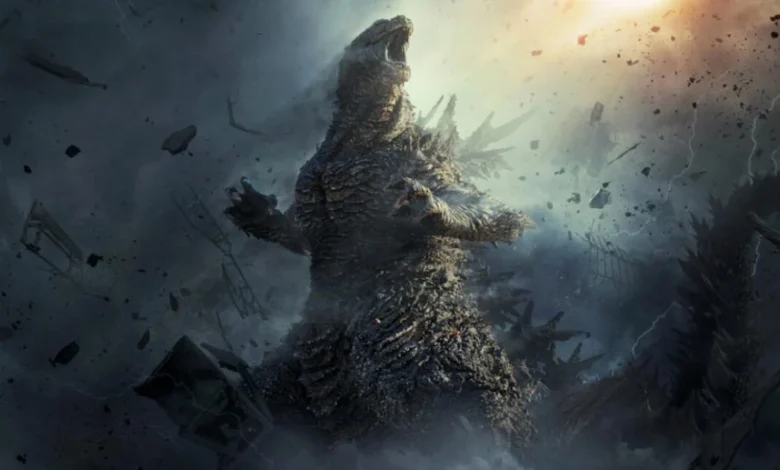
Director Takashi Yamazaki has maintained the visual tone that defined his previous Godzilla film, successfully blending the nostalgia of the Showa-era aesthetic with the high-fidelity capabilities of 21st-century CGI. With an expanded production budget, the visual effects team has pushed the boundaries of creature design. The film stands as a milestone in Japanese cinema as the first production shot specifically for the IMAX format, an intentional choice to emphasize the sheer scale of the kaiju combat.
The technical execution of the "gravity beam" sequence represents a notable evolution in monster cinema. As Ghidorah mutates in response to heavy artillery fire, the creature demonstrates the ability to levitate both architectural structures and its rival, Godzilla, before plummeting them back to earth. This sequence serves as a showcase for the film’s advanced motion-capture and lighting integration, which creates a seamless interaction between the digital assets and the physical environments.
Industry Context and Franchise Strategy
The success of the Godzilla franchise, which spans nearly seven decades, is largely attributed to Toho’s ability to pivot between different tonal interpretations of the monster. The "Minus" branding suggests a thematic reset, focusing on a Japan that has lost everything and is forced to rebuild from a state of total societal depletion. By introducing Ghidorah into this specific historical period—rather than the modern day—the filmmakers create a heightened sense of vulnerability.
Industry analysts note that the integration of Ghidorah into the Minus Zero timeline is a strategic expansion of the "Monsterverse" concept, albeit within a Japanese domestic production. Unlike previous iterations that often utilized modern technology to combat monsters, this film forces the characters to rely on mid-century military tactics, improvisation, and, ultimately, the intervention of a secondary, arguably more destructive, natural force.
The Impact of Kaiju vs. Kaiju Dynamics
The central battle between Godzilla and King Ghidorah is the climax of the production’s technical ambition. In traditional kaiju films, the "versus" element is often characterized by simple physical confrontation. Here, the struggle is presented as a battle of attrition, reflecting the differing destructive methodologies of the two monsters. Godzilla, representing the raw, destructive force of nuclear fallout, serves as the heavy-hitting counter to Ghidorah’s more agile, energy-based, and gravity-defying combat style.
From a production standpoint, the choreography of these sequences required extensive pre-visualization. Yamazaki has stated in promotional interviews that the goal was to ensure that the scale of the monsters felt "weighty and inevitable" rather than merely fast-paced. By slowing down the movements and emphasizing the impact of the creatures on the surrounding environment, the film achieves a cinematic gravitas that distinguishes it from the more action-oriented entries in the broader Godzilla library.
Broader Implications and Future Outlook
The critical reception of the film highlights a growing demand for high-budget, domestic Japanese productions that prioritize character development alongside spectacle. By focusing on the psychological toll of the post-war period, the film elevates the monster movie genre from simple entertainment to a meditation on trauma and resilience.
The financial success of the film in the IMAX format also signals a change in the exhibition strategies for foreign-language films. Distributors are increasingly confident in the global appeal of premium-format releases, suggesting that future installments of the Godzilla franchise will likely continue to receive similar technical investments.
Furthermore, the introduction of Ghidorah into the "Minus" continuity creates a template for potential sequels. If the creative team follows the historical precedent of the franchise, there are numerous other classic kaiju that could be introduced within this specific, early-post-war framework. The ability to reimagine these monsters through the lens of a "minus" historical state allows for fresh interpretations of creatures that have been staples of the genre for decades.
As of the latest reports from the box office, the film has performed exceptionally well in its domestic market, with international audiences showing significant interest in the technical achievements of the production. The film’s success serves as a testament to the enduring popularity of the Godzilla property and the effectiveness of balancing legacy characters with modern, high-stakes storytelling. The production team’s commitment to maintaining the practical feel of the classic era while utilizing cutting-edge digital technology has successfully bridged the gap between legacy fans and a new generation of cinema-goers.
In conclusion, Godzilla Minus Zero succeeds not only as a spectacle of monster combat but as a continuation of the thematic exploration of Japan’s historical recovery. Through the lens of the kaiju threat, the film examines how societies respond to insurmountable obstacles, effectively utilizing the creature-feature medium to reflect real-world anxieties regarding power, destruction, and the necessity of communal survival. As the franchise continues to evolve, the standard set by this production for visual quality and character-driven narrative will likely dictate the trajectory of future installments for years to come.