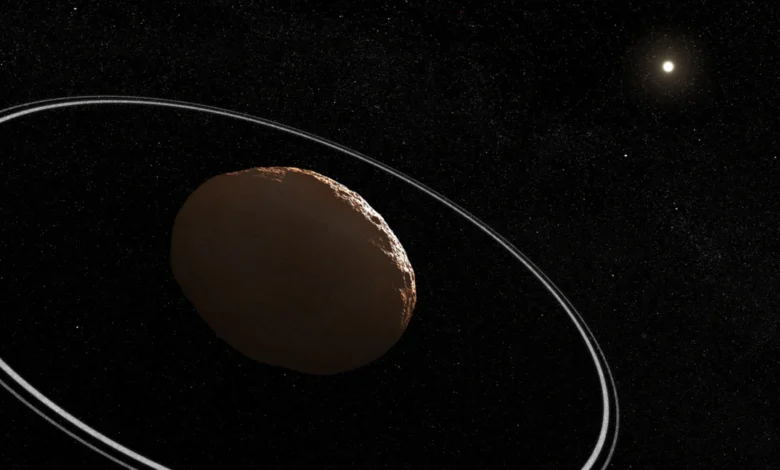
For decades, the scientific consensus regarding planetary rings was that they were the exclusive domain of the solar system’s gas giants. Saturn, Jupiter, Uranus, and Neptune were viewed as the only bodies capable of sustaining the complex, orbiting debris fields that defined their majestic profiles. That long-standing paradigm was shattered in 2013, when astronomers discovered that Chariklo—a minor body roughly 250 kilometers in diameter—possessed not one, but two distinct, narrow rings. Now, new data from the James Webb Space Telescope (JWST) suggests that these rings are not static relics, but dynamic, evolving structures that may be undergoing significant physical transformation.
Chariklo, classified as a Centaur, orbits the Sun in the volatile region between Saturn and Uranus. These objects are notoriously difficult to study due to their small size, distance, and the inherent instability of their orbits. The 2013 discovery was achieved through the observation of a stellar occultation—an event where a solar system object passes directly in front of a distant star, temporarily blocking its light. By analyzing the "blink" pattern of the starlight, researchers identified two rings, designated C1R and C2R, located approximately 390 and 405 kilometers from the object’s center. These rings were remarkably thin, separated by a gap of only seven kilometers.
The Evolution of Observation
The recent investigation, led by astronomer Pablo Santos-Sanz of the Instituto de Astrofísica de Andalucía, sought to revisit Chariklo using the unprecedented capabilities of the James Webb Space Telescope. The challenge of such an observation cannot be overstated. Unlike ground-based telescopes, which can be repositioned with relative ease, the JWST operates from the L2 Lagrange point, requiring precise orbital adjustments that must be planned weeks in advance.
Predicting the exact moment of an occultation for a small, distant body requires high-precision positional data for both the target object and the background star. For the October 18, 2022, event, the research team had to contend with a projected line-of-sight shift of approximately 110 kilometers between their initial calculations and the final flight plan. Despite these logistical hurdles, the observation was successful. The JWST’s trajectory grazed the surface of Chariklo at an altitude of 7.4 kilometers, effectively "imaging" the rings by capturing the precise timing and intensity of the starlight as it passed through the debris.
Dissecting the Data: A Tale of Two Rings
The JWST observations provided the first-ever look at a minor body’s rings in the near-infrared spectrum, specifically at wavelengths of 1.5 and 3.2 micrometers. This technical milestone allowed researchers to detect phenomena that remain invisible to ground-based observatories, which are often hampered by the opacity of Earth’s atmosphere.

The results were unexpected. The inner ring, C1R, exhibited a marked increase in density. Averaged data from previous ground-based occultations placed the ring’s normal opacity—a measure of how much starlight it blocks—at 0.303. The JWST data recorded an opacity of 0.431. To ensure this was not a measurement error or an artifact of passing through a localized "clump" of material, the team performed 10 million simulated occultations using a lumpy ring model. The statistical probability of such an opacity reading resulting from a random clump was calculated to be as low as 1 in 1,000 at 1.5 micrometers, and an even more improbable 4 in 100,000 at 3.2 micrometers.
Conversely, the outer ring, C2R, appeared to be in a state of rapid decay. It was barely detectable at 1.5 micrometers and vanished entirely at 3.2 micrometers. This discrepancy suggests that the rings are not merely drifting; they are physically evolving. Radiative transfer models, which simulate how light interacts with matter, indicate that the material composition of the rings may have changed, or that the rings are actively shedding and accreting mass in ways previously unobserved in minor bodies.
The Mystery of the Shepherd Satellite
The leading hypothesis to explain the stability and structural changes of the Chariklo ring system involves the presence of a "shepherd moon." In the context of planetary science, a shepherd moon is a small natural satellite whose gravity keeps ring particles in a narrow, well-defined path. Such a satellite would not only explain the sharp, distinct edges of the inner ring but could also serve as a source of material, shedding debris that migrates to replenish the ring system.
While no such satellite has been visually confirmed, its existence would reconcile the observed growth of C1R with the depletion of C2R. The current data hints that the inner ring is composed of larger particles, while the outer ring is dominated by finer, dustier material. However, the researchers emphasize that this is a working hypothesis. The transition of mass between the rings is not a simple one-to-one exchange; the inner ring gained significantly more "equivalent width" than the outer ring lost, pointing to a more complex, potentially external source of material or a more dynamic internal process.
Broader Implications for Solar System Dynamics
The study of Chariklo is part of a larger, burgeoning field of study concerning the ring systems of minor bodies. Since the discovery of rings around Chariklo, astronomers have identified similar features around the Centaur Chiron, the dwarf planet Haumea, and the trans-Neptunian object Quaoar. These findings force a reassessment of the life cycles of small bodies in our solar system.
In the giant planets, ring systems are known to be transient on geological timescales. Saturn’s D ring, for instance, has shown measurable contraction, and the ring arcs of Neptune are known to rearrange their configuration over the course of years. If minor bodies like Chariklo possess similar capabilities for change, it suggests that the formation and erosion of rings are universal processes that scale across different mass regimes.

"We are witnessing a real evolution of the rings with time," says Santos-Sanz. This realization shifts the perspective from viewing rings as static geological features to viewing them as dynamic, short-lived systems. The implications extend to how we model the formation of the early solar system. Understanding the mechanisms that allow a body of 250 kilometers in diameter to maintain an orbiting ring system—and how that system survives the chaotic environment of the outer solar system—provides critical data for planetary formation theories.
Future Research and Scientific Directives
The scientific community is now focused on obtaining a new set of observations using visible light to confirm the wavelength-dependent findings of the JWST. By comparing the near-infrared data with visible-spectrum occultations, researchers hope to definitively separate the effects of material composition from the physical evolution of the rings.
The search for new occultations is currently underway. As more data is gathered, the team aims to refine their models to account for the "ghost moon" that may be orchestrating these structural changes. For now, the case of Chariklo remains a testament to the unpredictable nature of our solar system. It serves as a reminder that even at the periphery of the sun’s influence, celestial bodies can harbor complex, shifting environments that challenge our fundamental understanding of planetary physics.
The study, titled "The evolving rings of the Centaur Chariklo," was published in the journal Science Advances. As researchers continue to analyze the data, the focus remains on the broader puzzle of minor body evolution. By piecing together the movements of these tiny, dark worlds, astronomers hope to gain a clearer picture of the processes that have shaped the solar system since its inception, proving that even the smallest objects can offer profound insights into the mechanics of the cosmos.