MacOS Golden Gate 27.2 Beta 2 Introduces Refined Keyboard-Triggered Volume and Brightness Sliders

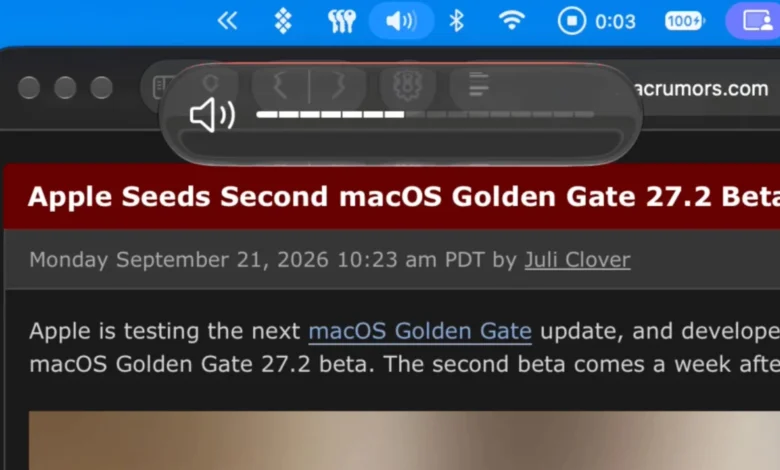
Apple has released the second beta of macOS Golden Gate 27.2 to developers, signaling a subtle but significant shift in the operating system’s visual language. While the update includes the standard array of stability improvements and security patches typical of a point-release cycle, the most immediate change for users is a complete redesign of the on-screen display (OSD) elements that appear when adjusting system volume and display brightness via keyboard shortcuts. This update, which arrives roughly one week after the official public release of the initial macOS Golden Gate build, demonstrates Apple’s ongoing commitment to iterating on its UI design language, even after the major architectural shift to the "Liquid Glass" aesthetic introduced earlier this year.
A Return to Granular Clarity
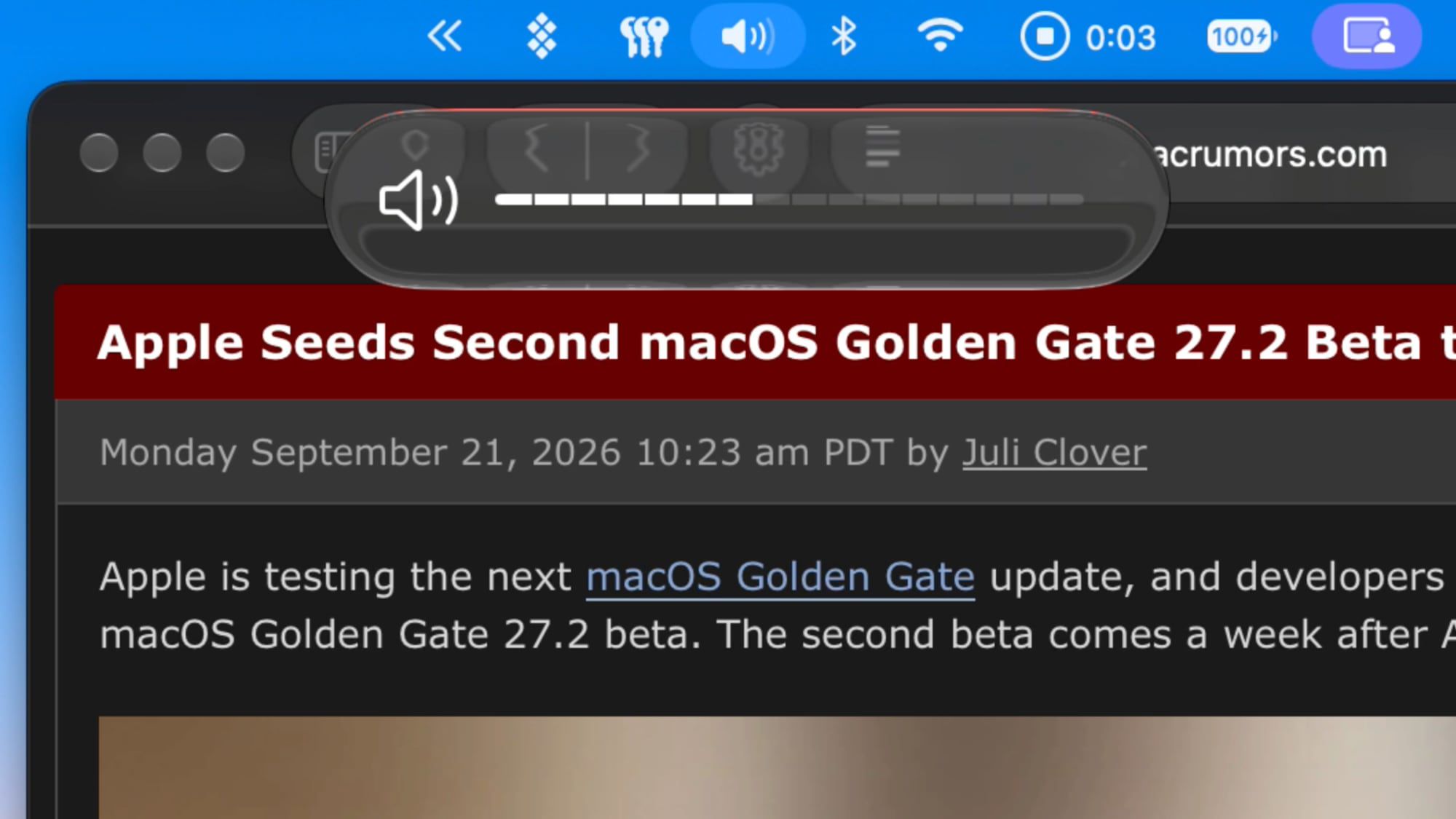
The new slider design departs from the minimalist, plain-line aesthetic that defined the initial release of the Liquid Glass interface. Instead, the updated sliders feature a segmented bar—a visual approach that harkens back to the design philosophy seen in macOS Sequoia. By breaking the slider into distinct segments, the interface provides immediate, high-contrast visual feedback that clarifies exactly how much the volume or brightness level is being adjusted with each individual key press.
For power users and accessibility-focused demographics, this change addresses a recurring critique of the Liquid Glass era: the lack of clear, tactile-equivalent visual markers. Where the previous design felt smooth and fluid, it occasionally lacked the precision required for users who perform granular adjustments. The return of the segmented approach suggests that Apple is actively balancing its modern, high-translucency design trends with the practical, functional needs of a professional-grade operating system.
Furthermore, the implementation of the slider has been streamlined. Apple has opted to remove the redundant icons that formerly bookended the slider line. In their place, a single, larger, and more legible icon now resides on the left side of the slider. The system has also refined the placement logic; the slider now dynamically appears directly below the corresponding menu bar icon. If a user triggers a volume change, the slider appears beneath the Sound icon, effectively anchoring the UI element to its point of control. It is important to note that this redesign is specific to keyboard-driven adjustments; the Control Center sliders remain unchanged, preserving the uniform look of the centralized hub while allowing for a more task-specific interface when using physical hardware controls.
Chronology of the macOS Golden Gate Release Cycle
The progression of macOS 27 has been marked by a rigorous testing phase, reflecting the complexity of the "Golden Gate" overhaul. The software was first unveiled to the public in June 2026, where Apple introduced the core pillars of the update: deep Siri AI integration, a complete overhaul of the windowing system, and the aforementioned Liquid Glass design language.
- June 2026: Apple announces macOS Golden Gate (version 27.0) at the Worldwide Developers Conference (WWDC), showcasing the new AI-centric architecture.
- August 2026: Final stages of public beta testing conclude, focusing on stability for the new Siri delegation models.
- September 10, 2026: Apple officially confirms the release date for the full suite of 27-series operating systems.
- September 14, 2026: macOS Golden Gate 27.0 is released to the general public, accompanied by iOS, iPadOS, watchOS, and visionOS 27.
- September 21, 2026: Apple seeds the second beta of 27.2 to developers, introducing the refined slider UI and further refinements to the Siri-to-third-party AI delegation framework.
This rapid cadence of releases underscores the company’s focus on maintaining momentum following the launch. By pushing a .2 beta so soon after the initial launch, Apple is demonstrating a clear strategy of "polishing through iteration"—a hallmark of its software engineering culture.
The Role of Siri AI and Model Delegation
While the slider redesign is the most visible change in the 27.2 beta, it is occurring against the backdrop of a much larger architectural shift. Recent analysis of the macOS 27 private frameworks, conducted by security researchers and software developers, has revealed the depth of Apple’s new Siri infrastructure. The platform has been designed with a modularity that allows for third-party AI models—such as ChatGPT and Claude—to function as deep-level system extensions.
The "Model Delegation" mechanism discovered in the code allows users to theoretically swap out the default Siri backend for alternative models. This represents a seismic shift for Apple, which has historically maintained a "walled garden" approach to its core system services. By allowing Claude or ChatGPT to act as a system-wide extension, Apple is effectively positioning macOS not just as a host for applications, but as an orchestration layer for generative AI. The interface refinements, such as the new slider, may seem minor in comparison, but they represent the "last mile" of this transition: ensuring that the user experience feels consistent, even as the underlying AI engines become increasingly complex and third-party dependent.
Implications for User Interface Consistency
The shift from the original Liquid Glass slider to the current segmented design invites a discussion on Apple’s design philosophy. Since the inception of macOS, the company has oscillated between purely aesthetic design choices and those driven by pure utility. The Liquid Glass design was criticized by some for prioritizing translucency and motion blur over readability.
By introducing a hybrid design—blending the modern aesthetic of Liquid Glass with the functional segmentation of previous iterations—Apple is essentially acknowledging that high-end UI design must still serve the user’s need for rapid information processing. The choice to link the slider location to the menu bar icons is a deliberate effort to minimize eye travel, a key principle in Human Interface Guidelines. This suggests that as macOS 27 matures, we can expect a continued "pragmatic refinement" of the operating system’s interface.
Expert Analysis and Industry Context
Industry analysts have noted that the 27.2 update cycle is unusually active for this time of year. Typically, the period immediately following a major macOS launch is reserved for bug fixes. However, the presence of UI changes in the 27.2 beta suggests that the feedback received during the first week of the Golden Gate launch was significant.
"Apple is listening to the power user community," says Sarah Jenkins, an independent software analyst. "The volume slider change might seem like a small detail, but it speaks volumes about their current development strategy. They are moving away from purely experimental design and back toward the high-usability standards that made the Mac a preferred tool for professionals."
Furthermore, the integration of third-party AI models into the core of the OS is expected to have long-term implications for the software ecosystem. By allowing deep integration, Apple is likely attempting to stave off competition from alternative platforms that are aggressively pursuing AI-native workflows. The ability to swap Siri for a more specialized model is not just a feature; it is a defensive move to ensure that macOS remains the platform of choice for developers and creative professionals who require specialized AI assistance.
Looking Ahead to October
As the beta testing for macOS 27.2 continues, the development community is closely watching for further refinements to the AI delegation framework and additional UI adjustments. Current projections indicate that the public release of macOS 27.2 will likely occur in late October 2026. This timeline aligns with Apple’s historical patterns of releasing "feature-refinement" updates in the fall, shortly after the major annual upgrade.
For the end-user, the upcoming months will likely involve a steady stream of such refinements. Beyond the sliders, expectations for the 27.2 release include further optimizations to the Siri-to-Claude communication latency and potential performance improvements for the window management system, which has been under heavy load due to the increased requirements of the on-device AI models.
In conclusion, the latest beta of macOS Golden Gate 27.2 serves as a microcosm of Apple’s broader 2026 software strategy. It is a balancing act between the aggressive pursuit of AI-driven innovation and the necessity of maintaining a usable, readable, and predictable user interface. As Apple continues to iterate, the focus will undoubtedly remain on refining these interactions, ensuring that as the Mac becomes "smarter," it does not become more difficult to navigate. The minor design update to the sliders, while seemingly insignificant, serves as a testament to the fact that Apple’s design process is far from static, and that the company remains highly responsive to the functional needs of its diverse user base.