Meta Expands Testing of Paid Link Restrictions for Professional Accounts on Facebook and Instagram

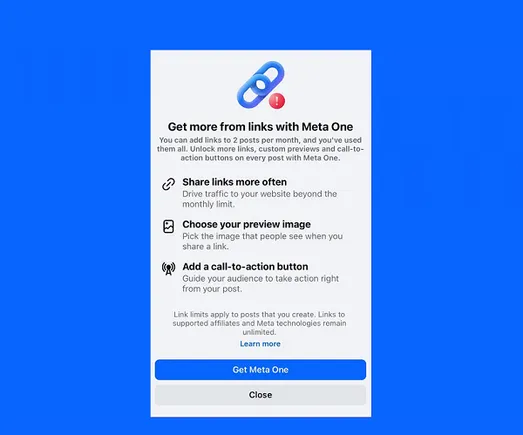
The digital marketing landscape is undergoing a notable shift as Meta moves forward with the widespread expansion of its tiered subscription model, Meta One for Business. Following the recent rollout of these paid packages, professional accounts and business managers across the platform have reported encountering new operational boundaries, most notably the restriction of external link posts. While initial trials of this feature date back to late 2025, the commercialization of Meta One for Business has brought these limitations into sharper focus, forcing brands, content creators, and digital marketers to reevaluate their organic social media strategies.
According to notifications shared by various page managers this week, non-paying professional accounts on Facebook are increasingly being subjected to a strict threshold of just two link posts per month. Accounts exceeding this limit are prompted to subscribe to a Meta One for Business tier to restore full publishing capabilities. This development parallels similar rollouts across Meta’s ecosystem, where specific tiers of the subscription service dictate the volume of external links that can be integrated into Instagram posts and Reels on a monthly basis.
Background Context and Evolution of the Policy
To understand the current state of link restrictions on Meta’s platforms, it is necessary to examine the historical trajectory of the company’s algorithmic priorities and monetization frameworks. For years, Meta—like many social media conglomerates—allowed businesses and public figures to utilize organic posts containing external hyperlinks without direct financial friction. This approach successfully onboarded millions of commercial enterprises, news outlets, and creators, turning Facebook and Instagram into primary distribution hubs for web traffic.
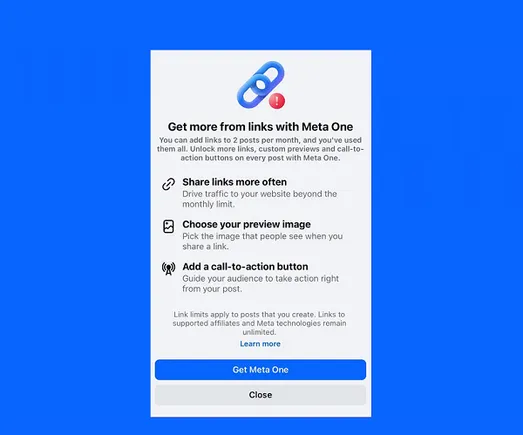
However, as platform priorities shifted toward keeping users within the native application ecosystem, the algorithmic reach of outbound links began to decline systematically. Meta first initiated a targeted test restricting select business pages to two link posts per month in December 2025. At the time, company representatives framed the trial as an exploratory measure designed to assess whether increasing the volume of posts containing external URLs delivered measurable value to businesses, or if it primarily contributed to a degraded user experience characterized by low-quality or promotional outbound spam.
With the official launch of Meta One for Business, this experimental feature has transitioned from a localized test into a core component of the platform’s commercial architecture. Meta has structured the subscription packages to offer varying benefits, including elevated link allowances, positioning the removal of administrative friction as a distinct value proposition for paying subscribers. Notably, publisher pages have been explicitly exempted from these restrictions thus far, a strategic carve-out intended to prevent the disruption of continuous news and editorial content flows within the news feed.
Chronology of Key Developments
The progression of Meta’s monetization strategy regarding external links and business tools can be mapped through several key milestones:
- 2016: Meta CEO Mark Zuckerberg outlines the company’s foundational three-stage monetization strategy for its applications, prioritizing ecosystem growth, consumer engagement, and long-term commercial extraction.
- 2022: Meta publishes inaugural data in its Widely Viewed Content Report, establishing that only 9.8% of total content views in the United States incorporate a link directing users to an external website.
- December 2025: Meta initiates a preliminary, limited test restricting specific business pages to a maximum of two link posts per month to evaluate user engagement patterns.
- Q1 2026: Meta releases updated Widely Viewed Content metrics, revealing that the visibility of outbound link posts has plummeted to a historic low of 1.3%.
- Current Week: Meta officially launches Meta One for Business subscription packages, coinciding with a widespread expansion of the two-link-per-month restriction across a broader array of non-paying professional Facebook Pages.
Platform Data and Algorithmic Realities

While the imposition of publishing caps may induce anxiety among digital marketers reliant on social traffic generation, empirical data published by Meta suggests that the actual impact on organic reach may be minimal. For years, Meta’s transparency reports have documented a steady, aggressive decline in the algorithmic distribution of posts containing external links.
According to Meta’s Widely Viewed Content report for the first quarter of 2026, a staggering 98.7% of all content views in the United States did not include a link to a source outside of the Facebook platform. This figure represents a dramatic contraction from 2022, when the company’s initial transparency disclosures indicated that roughly 9.8% of viewed content incorporated an outbound link.
This algorithmic suppression stems from Meta’s overarching design philosophy, which favors native content—such as short-form video, native images, and direct text interactions—over mechanisms that pull users away from the application. Because the platform’s distribution engine inherently deprioritizes outbound links, digital marketing analysts note that many businesses were already receiving negligible referral traffic from organic Facebook posts prior to the implementation of the new subscription limits.
Industry Implications and Strategic Shifts
The formalization of pay-to-publish thresholds for links represents a critical juncture for digital marketing strategies. Brands and organizations that have historically treated Facebook as a primary, free conduit for driving web traffic must now conduct a rigorous cost-benefit analysis regarding the Meta One for Business subscription.
For large enterprises and performance-driven marketers, the subscription fee may represent a justifiable operational expense if it secures predictable access to audience touchpoints. Conversely, smaller businesses operating on tight margins may find that the low organic return on investment for external links does not justify the added cost of a monthly subscription tier. Consequently, many organizations are expected to accelerate their pivot toward paid advertising solutions—such as targeted Meta Ads—or concentrate their organic efforts on community building, native video content, and retention strategies that do not rely on outbound URLs.
Furthermore, industry observers have pointed out the structural parallels between this move and historical platform evolutions. Meta’s methodical transition from a wide-open, free utility for businesses to a tightly controlled, pay-to-play environment mirrors the classic playbook established by CEO Mark Zuckerberg a decade ago. By first fostering deep dependency among commercial users during the growth phase, and subsequently gating essential distribution channels behind commercial paywalls during the monetization phase, Meta continues to extract financial value from the commercial infrastructure built upon its platforms.
Looking Ahead
As the rollout of Meta One for Business continues to scale globally, the long-term ramifications for content creators, publishers, and small-to-medium enterprises remain a subject of intense discussion within the digital media sector. While the exemption of publisher pages provides a temporary buffer for traditional news organizations, commercial brands must adapt to an increasingly stratified ecosystem. Whether businesses choose to absorb the subscription costs, pivot to native content formats, or reallocate their marketing budgets to alternative digital channels, Meta’s latest policy adjustment underscores a permanent reality of modern social media management: organic reach is an increasingly scarce commodity, and direct platform monetization is now the undisputed baseline for digital visibility.
Related posts: