Navigating the Complex Landscape of European E-Commerce Returns: Challenges, Costs, and Sustainable Solutions

The modern e-commerce transaction extends far beyond the digital click of a checkout button and the subsequent financial settlement. For online merchants operating within the European Union and surrounding regions, the lifecycle of a sale increasingly incorporates the complex, costly, and highly scrutinized process of product returns. Far from being a fringe operational afterthought, reverse logistics has emerged as a central pillar of digital retail strategy, directly influencing corporate profitability, consumer loyalty, and environmental sustainability.
As digital consumer habits continue to evolve across the continent, industry stakeholders find themselves grappling with return rates that regularly test the limits of traditional supply chains. Understanding the multifaceted nature of European e-commerce returns requires a detailed examination of current statistical trends, the severe logistical and financial hurdles faced by merchants, and the innovative operational strategies required to turn a traditionally burdensome process into a competitive advantage.
Statistical Overview of Returns in European Markets
Recent industry metrics underscore the pervasive nature of product returns in European digital retail. Data compiled across various member states indicates that the average return rate for online purchases hovers persistently between 30% and 40%. However, these aggregate figures mask substantial regional discrepancies influenced by local consumer cultures, purchasing habits, and regulatory frameworks.
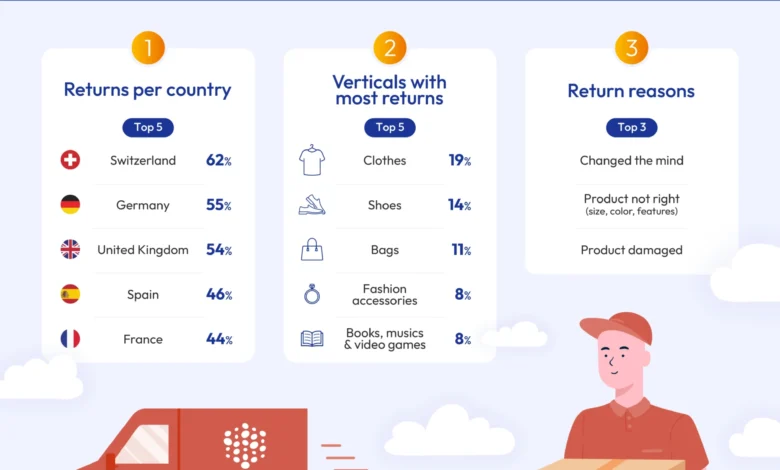
According to comprehensive market analyses, Switzerland recorded the highest average return rate per online buyer in Europe at 62%, followed closely by Germany at 55% and the United Kingdom at 54%. These high percentages are frequently attributed to consumer protection laws that strongly favor the buyer, coupled with widespread cultural acceptance of ordering multiple sizes or variations of a product with the explicit intention of sending the unwanted items back. This behavior, increasingly known as "bracketing," has fundamentally transformed how retailers forecast inventory and manage warehouse capacities.
The financial toll of these returns is profound. Retailers face a cascade of expenses that includes reverse shipping fees, labor costs associated with inspecting and restocking items, and inevitable revenue losses when returned goods—even those in pristine condition—must be liquidated or sold as open-box items at heavily discounted prices. Conversely, businesses are learning that a friction-free return policy remains one of the primary drivers of consumer trust and long-term retention. Shoppers increasingly inspect a retailer’s return policy before completing a high-value purchase, meaning that overly restrictive policies can lead directly to cart abandonment.
Sector-Specific Vulnerabilities and Consumer Motivations
While e-commerce returns impact virtually every retail sector, certain industries experience exponentially higher volumes than others. The fashion and apparel sector remains the most heavily affected, driven by the inherently subjective nature of sizing, personal style, and fabric expectations. In the apparel market, return rates frequently exceed 50%, forcing fashion retailers to completely overhaul their warehousing strategies to handle the sheer volume of incoming merchandise.
Beyond fashion, consumer electronics and household goods also generate significant return flows, often accounting for approximately 6% of total returns within their respective categories. Unlike apparel, where returns are primarily driven by fit or preference, electronics and household goods are frequently sent back due to technical compatibility issues, complex setup requirements, perceived manufacturing defects, or discrepancies between online descriptions and actual product functionality.
Consumer behavior studies reveal a consistent set of core motivations behind product returns. Incorrect sizing or fitting remains the leading catalyst, particularly in online clothing sales. This is closely followed by products failing to match the consumer’s visual or functional expectations as presented on the website, damaged or defective goods upon arrival, and the deliberate practice of bracketing. Furthermore, shifting consumer expectations mean that modern shoppers demand localized drop-off points, instant refund processing upon carrier scan, and minimal or zero return shipping fees—demands that place immense pressure on merchant operational margins.
Chronology and Evolution of the European Reverse Logistics Crisis
The current state of European e-commerce returns is the result of a multi-year evolution catalyzed by the explosive growth of online shopping, particularly accelerated during the COVID-19 pandemic.

During the initial boom of digital commerce between 2020 and 2021, online retailers heavily emphasized lenient, zero-cost return policies as a primary customer acquisition tool. Warehouses were optimized primarily for outbound fulfillment, with inbound reverse logistics treated as a secondary priority.
By 2022 and 2023, however, the financial and environmental unsustainability of this model reached a critical tipping point. Surging inflation, rising fuel costs, and global supply chain bottlenecks forced major European retailers to reevaluate their policies. Throughout 2023 and into 2024, a notable market shift occurred: numerous major fashion and general merchandise brands abandoned universal free returns, introducing nominal restocking or return shipping fees to curb abusive return patterns. Concurrently, regulatory bodies and consumer advocacy groups began increasing scrutiny over how returned goods are handled, putting pressure on companies to minimize destruction-based waste and improve transparency in cross-border trade.
Logistical, Regulatory, and Environmental Challenges
Managing returns across the diverse European market introduces formidable obstacles for merchants, chief among them being the complexity of cross-border logistics. Unlike domestic transactions, cross-border returns require navigating a patchwork of varying national regulations, tax implications, customs compliance rules, and consumer rights directives.
When a consumer in one European nation returns a product purchased from a merchant based in another, the company must manage international shipping lanes, re-importation documentation, and potential value-added tax (VAT) adjustments. These administrative and physical burdens can quickly erode the profit margins of cross-border sales if not managed through a centralized, technology-driven logistics infrastructure.
Beyond logistics and finance, the environmental impact of e-commerce returns has emerged as a critical concern for regulators, corporations, and consumers alike. Traditional return procedures generate significant carbon emissions driven by the duplicate transportation of goods back through the supply chain. Additionally, the process relies heavily on single-use packaging materials, such as plastic wraps, protective air pillows, and single-use cardboard boxes.
Compounding the environmental footprint is the controversial practice of product disposal. Historically, a fraction of returned goods that could not be easily reintegrated into primary inventory was discarded or destroyed due to the high labor costs associated with inspection and repackaging. Stricter European environmental directives are now forcing companies to abandon such practices, compelling them to invest in robust circular economy models, secondary resale markets, and certified recycling channels.
Strategic Solutions for Optimizing Return Management
In response to these escalating challenges, e-commerce merchants are deploying advanced technological, policy, and operational strategies to optimize their return pipelines. Industry experts and supply chain analysts generally recommend a multi-layered approach to mitigating the negative impacts of returns while preserving customer satisfaction.
First, merchants are adopting transparent, user-friendly return portals that streamline the customer experience while simultaneously capturing valuable data. By providing prepaid digital return labels, clear instructions, and extended deadlines through automated online interfaces, businesses can reduce customer service inquiries and accelerate the reintegration of items back into available inventory.
Second, companies are heavily investing in advanced technological solutions, including predictive analytics and artificial intelligence. By analyzing historical return data down to the SKU level, retailers can identify specific root causes—such as inaccurate sizing charts, misleading product photography, or recurring manufacturing defects—and implement corrective measures at the source. For instance, fashion retailers utilizing AI-driven virtual fitting rooms and precise size-recommendation tools have reported measurable decreases in apparel return rates.
Finally, e-commerce enterprises are pivoting toward sustainable, circular operational frameworks. This includes adopting biodegradable, reusable packaging materials designed for two-way transit, implementing batch-shipping protocols to consolidate returned freight and reduce transport emissions, and partnering with specialized refurbishment platforms to give returned goods a viable second life. By successfully balancing consumer expectations for flexibility with rigorous operational efficiency and environmental responsibility, forward-thinking European merchants are transforming reverse logistics from a persistent financial liability into a sustainable operational asset.
Related posts: