Optimizing AI Agent Performance Through Strategic Data Formatting and Token Reduction

The rapid proliferation of autonomous AI agents has fundamentally altered the landscape of software engineering, shifting the focus from manual task execution to the management of large language model (LLM) context windows. As these agents become increasingly sophisticated, they are tasked with performing complex web searches, scraping documentation, and synthesizing massive datasets. However, a significant operational bottleneck has emerged: the exorbitant token cost associated with retrieving and processing raw search data. Because LLMs operate on a token-based billing model, the inclusion of non-essential metadata, tracking scripts, and redundant structural syntax—common in traditional JavaScript Object Notation (JSON) outputs—can lead to ballooning operational expenditures and degraded model performance.
The Token Inflation Crisis in Autonomous Systems
For developers building agentic workflows, every token represents a measurable cost in both latency and compute credits. When an AI agent is instructed to "look up" information, it typically triggers a series of recursive calls. In a standard retrieval process, an agent might pull in dozens of full-length HTML files, server logs, and extraneous metadata fields. When this data is fed into the LLM as JSON, the model must process the brackets, key-value pairs, and nested object declarations that are necessary for machine parsing but often irrelevant to the model’s reasoning capabilities.
Consider a standard search query for local business services. A typical JSON response from a search API includes high-fidelity metadata intended for front-end rendering: specific coordinate offsets, internal database IDs, pixel dimensions of images, and duplicate tracking links. If an agent only requires the name, address, and summary of a service, the additional thousands of tokens used to describe the UI elements represent pure waste. This "token bloat" is not merely a financial concern; it also consumes the precious context window of the LLM, potentially forcing the model to discard relevant information from previous turns to accommodate the oversized search result.
From JSON to Markdown: A Structural Shift
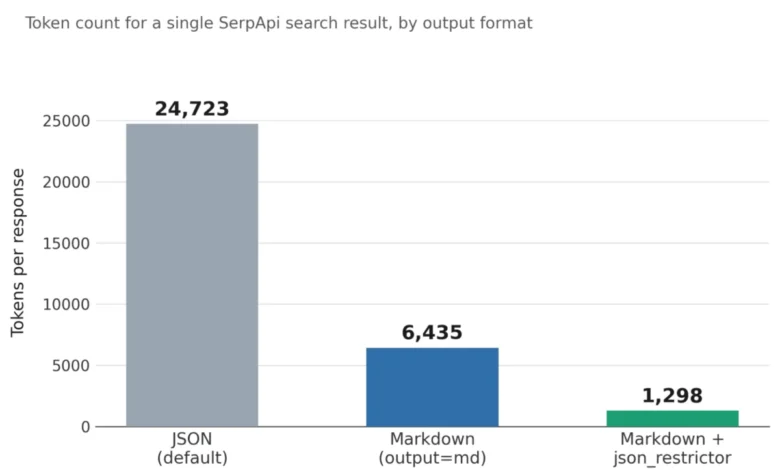
To mitigate these inefficiencies, the industry is seeing a transition toward human-readable, lightweight data formats like Markdown for LLM ingestion. Recent benchmarks conducted by SerpApi demonstrate the scale of this optimization. In a comparative test, a standard search for the term "coffee" resulted in a JSON payload of 24,723 tokens. When the same search was executed with a Markdown-formatted output, the requirement dropped to 6,435 tokens—a 74 percent reduction in data volume. By further applying server-side filtering, that total can be reduced to just 1,298 tokens, representing an overall reduction of approximately 95 percent from the original payload.
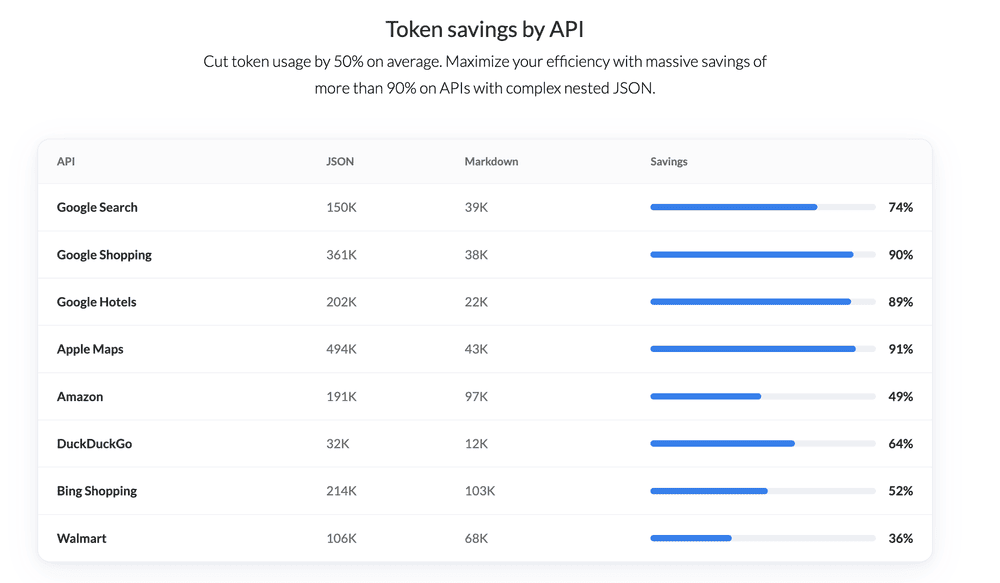
This shift is not merely about removing characters; it is about aligning the data structure with the architecture of the model. LLMs are trained on vast corpora of text, much of which follows natural language patterns and document-based structures like Markdown. When data is presented in a table format or as a structured text block, the model can interpret the information with less "cognitive load," leading to faster reasoning and more accurate summarization.
Chronology of Data Retrieval Optimization
The evolution of API data delivery has moved through three distinct phases:
- The XML Era: Early web scraping and API development relied heavily on XML, which was verbose and required heavy parsing logic, often leading to massive bandwidth usage.
- The JSON Dominance: As web development moved to single-page applications (SPAs), JSON became the gold standard for its ability to pass structured objects between servers and browser-based front-ends. While efficient for code, it proved to be a liability for LLM ingestion due to the high density of structural syntax.
- The LLM-Native Era: The current period is defined by a move toward formats that prioritize the "readability" of the data for an AI agent. This includes the widespread adoption of YAML and Markdown, which strip away the UI-specific overhead that modern AI models do not require.
Analytical Implications: When Markdown Fails
While the benefits of Markdown for LLM efficiency are clear, it is essential to distinguish between agentic research and algorithmic processing. Markdown is an optimized format for summarization, entity extraction, and conversational retrieval. However, it is fundamentally ill-suited for pipelines that require strict data integrity.
For instance, if an AI agent is part of a financial pipeline—where it must compare price, old_price, and coupon_price to calculate a discount, or where it must interact with geographic coordinates—JSON remains the superior format. JSON provides the strict schema and numeric typing (integers vs. floats) necessary for reliable downstream computational logic. A move to Markdown in such a scenario could introduce parsing errors or lead to the loss of precision in numeric values. Consequently, the most sophisticated AI systems are now employing a hybrid approach: using Markdown for initial research and summarization, and switching to strictly typed JSON for the final, transactional stages of a task.
Implementation and Operational Efficiency
The technical path to achieving these savings is becoming increasingly accessible. By utilizing query parameters or header modifications, developers can toggle between output formats without changing the underlying architecture of their application. SerpApi, for example, has integrated this functionality across its suite of over 100 APIs, allowing users to request Markdown output via a simple parameter.
The inclusion of json_restrictor or similar filtering tools adds another layer of control. By selecting only the required fields server-side—such as title, snippet, and link—developers can ensure that the payload crossing the network is stripped of all extraneous information before it ever hits the LLM context window. This server-side pre-processing is crucial; if the filtering were to happen at the agent level (after the full data has been fetched), the user would still be paying for the transmission and retrieval of the full payload.
Broader Implications for the AI Economy
The push toward efficient token utilization is symptomatic of a broader maturation in the AI industry. As companies move from experimental prototypes to production-grade agentic systems, the focus has shifted from "can the AI do it?" to "can the AI do it sustainably?"
The "hidden cost" of AI—the accumulation of small, per-call token inefficiencies—can compound into significant operational debt as the scale of an application grows. A system making 100,000 API calls per day could waste millions of tokens if its data payloads are not optimized. This represents not only an unnecessary financial burden but also an increase in the carbon footprint associated with large-scale model inference.
Industry experts suggest that as LLMs continue to advance, the emphasis on data "shape" will only increase. Future iterations of AI development tools will likely prioritize "LLM-ready" APIs that natively understand the context of a request, automatically pruning search results to match the specific needs of the agent. Until then, the responsibility falls on developers to audit their data pipelines, measure the delta between raw JSON and streamlined Markdown, and implement structural changes that favor the efficiency of the machine reader over the convenience of the human browser.
In conclusion, while Markdown is not a panacea for all data transmission needs, its adoption represents a critical step in the professionalization of AI workflows. By treating data structure as a variable to be optimized rather than a static requirement, organizations can significantly enhance the capabilities of their autonomous agents while maintaining a disciplined approach to operational costs. The transition from bloated, UI-centric data formats to lean, LLM-optimized outputs is likely to become a defining characteristic of high-performance AI architecture in the coming years.